Gwangju Travel Guide: Democracy, Art & Kimchi in One of Korea’s Most Overlooked Cities
Last Updated on September 11, 2026
You might think of Seoul for palaces, Busan for beaches, and Jeju for nature, but what comes to mind when you think of Gwangju? For a lot of international visitors, the answer is probably not much, and that’s exactly why I think Gwangju deserves more attention. If you live in Korea like I do, you’ve probably heard of their heroic democratization movement, but aside from that, what is actually there?
I’ve now visited Gwangju a few times, and every trip has revealed another layer of the city. This is one of the most important cities in Korea for understanding the country’s modern democracy, but it’s also an incredibly creative place packed with art museums, artist studios, historic architecture, and neighborhoods perfect for a weekend of wandering.
Gwangju is home to the internationally renowned Gwangju Biennale, was designated a UNESCO Creative City of Media Arts in 2014, and has an art scene that stretches far beyond its major museums. It’s also a city where you can spend the morning learning about one of the most important moments in modern Korean history, the afternoon wandering through old Hanok and missionary neighborhoods, and the evening eating the kind of food Jeolla-do is famous for. Pretty much makes it a city at least worth a weekend if you ask me.
I’ve been to a lot of the museums and cultural spaces around Gwangju now, but I haven’t seen everything. Rather than wait until I’ve somehow “completed” the city (does anyone ever really do that?), consider this my growing Gwangju travel guide. I’ll continue adding to it as I return.

Get ready to discover Gwangju, one of Korea’s most interesting cities for art, history, and culture.
- Basic Info
- Why Visit Gwangju?
- Downtown Gwangju: Understand The City Through May 18
- More Downtown Stops: Bium Folk Museum & Local Eats
- Wander Through Yangnim-dong: History, Art & Tea
- Gwangju’s Museum & Biennale District
- Beyond Downtown: Mudeungsan National Park
- Go To The Gwangju Kimchi Festival
- How I’d Spend Two Days In Gwangju
- Is Gwangju Worth Visiting?
- FAQ
(This post contains affiliate links, which means I receive a certain percentage of a sale if you purchase after clicking at no cost to you. Thank you for your support.)
Basic Info
From Seoul: The fastest and easiest option is generally the KTX from Yongsan Station to Gwangju Songjeong Station. The trip takes around two hours.
How long to stay: I’d recommend at least two days. There’s enough here for a weekend quite easily, and art lovers could spend considerably longer.
Getting around: Gwangju has a subway, buses, and taxis. Unlike Seoul, however, the subway doesn’t take you everywhere you’ll want to go. I found that combining public transportation with taxis made getting between areas much easier. The drivers are… aggressive though, much like the drivers in Busan, so be prepared for that.
Best for: Korean history, contemporary art, architecture, food, museums, and travelers looking beyond Korea’s most visited cities.
Good to know: Make sure you’re searching for Gwangju Metropolitan City (광주광역시), not Gwangju in Gyeonggi-do. Yes, Korea has two places called Gwangju. From Seoul if you’re hopping on an intercity bus, you could easily end up in the wrong Gwangju.
One more thing worth knowing: In July 2026, Gwangju and Jeollanam-do administratively merged into a new entity called 전남광주통합특별시 (Gwangju Special City). You’ll likely see this new name start showing up on Korean maps, signage, and official addresses over the next few years. I’m keeping every address in this guide as “Gwangju, Jeollanam-do” rather than switching to the new name, simply because that’s still how foreign visitors search for and think about the city. If you’re navigating with a Korean map app and the new name pops up, that’s why.
Gwangju By Neighborhood: Gwangju’s sights cluster into a few distinct areas, and knowing this before you go makes it much easier to plan your days without crisscrossing the city and helps when deciding where to stay in Gwangju. Here’s how I’d break it down:
| District | What’s there | Best for |
|---|---|---|
| Dong-gu (downtown) | 5·18 Democratization Movement Archives, Jeonil Building 245, Asia Culture Center, Bium Folk Museum, Eunam Museum, Chungjang-ro | History, downtown food and nightlife |
| Nam-gu (Yangnim-dong) | Penguin Village, House of Lee Jang Woo, Onjadam Tea House, Dwinggul Cave, the neighborhood’s smaller art spaces, G.MAP, Heekyungru, Sajik Park, Gwangju Civic Center | Art, architecture, tea, an evening view |
| Buk-gu | Gwangju Biennale Exhibition Hall, Gwangju Museum of Art | Contemporary art, especially in Biennale years |

Why Visit Gwangju?
Gwangju doesn’t feel like a city built around tourism, and I mean that as a compliment. There are major attractions, of course, but some of my favorite experiences have been finding tiny museums, walking through Yangnim-dong, popping into an artist’s studio, and realizing that the building I was standing beside had another story connected to Korea’s modern history.


The majority of things I found in Gwangju could fall into three categories: democracy, art, and community. You cannot really understand Gwangju without learning about the May 18 Democratization Movement. At the same time, you can’t walk very far without encountering art. Gwangju hosts one of Asia’s major contemporary art biennales and was the first Korean city designated a UNESCO Creative City of Media Arts. If you are looking for the best time to visit Gwangju? I’d have to say it’s during biennale season.

Downtown Gwangju: Understand the City Through May 18
If you only learn one thing before visiting Gwangju, learn about May 18. The May 18 Democratization Movement took place from May 18 through May 27, 1980, when students and ordinary citizens resisted military rule following the expansion of martial law. The military response was extraordinarily violent, and for years afterward the government attempted to suppress and distort what had happened. Read the book Human Acts by Han Kang for a look into the history before you arrive.
Today, the story of May 18 is woven into Gwangju itself. I had heard about the Gwangju Democratization Movement for years before visiting, but learning about it while standing on the streets where it happened was completely different. This isn’t distant history either. The events occurred within living memory, and understanding them helps explain not only Gwangju but modern South Korea and the importance Koreans place on defending democracy, protesting peacefully, and making their voices heard.
Recommended Tour: Gain a much deeper understanding of this period of history in Gwangju and how it has effected the people and the country as a whole on the Gwangju 5.18 Democratic Uprising Tour. The guide is local and shares different perspectives and stories she’s heard from neighbors who lived through the events. Book the tour on Viator.


5·18 Democratization Movement Archives (5·18 민주화운동기록관)
This should be high on your list of things to do in Gwangju, I can’t overstate that. The Archives preserves photographs, government records, citizen publications, personal belongings, testimony, and other materials documenting what happened before, during, and after May 1980. Records associated with the movement were inscribed on UNESCO’s Memory of the World Register in 2011. I went through the museum self-guided and spent around an hour there, though you could easily spend longer.
- Address: 221 Geumnam-ro, Dong-gu, Gwangju (광주 동구 금남로 221)
- Hours: Tuesday – Sunday: 9:00am – 6:00pm
- Admission: Free
- Subway: Geumnam-ro 4-ga Station, Exit 4
- Read more: I have an entire guide to the 5·18 Democratization Movement Archives that goes much deeper into the history and what you’ll see inside.

Jeonil Building 245 (전일빌딩245)
Jeonil Building 245 is just up the street from the archives and preserves physical evidence connected to the military suppression of the uprising. The building gets its current name from the 245 bullet marks found there, including evidence associated with helicopter gunfire.
What struck me about Jeonil Building is that it isn’t presented only as a somber memorial. The building has been transformed into a cultural and community space as well. People sit, read, meet, and spend time there while the history remains physically present around them. I think that coexistence of ordinary life and memory says quite a bit about Gwangju and the residents there.
- Address: 245 Geumnam-ro, Dong-gu, Gwangju (전남광주 동구 금남로 245)
- Hours: Every day: 9:00am ~ 10:00pm
Walk The May 18 Historic Area
One of the reasons I recommend doing these sites together is that you’re standing in the actual landscape where the events occurred. From the Archives, continue along Geumnam-ro toward Jeonil Building 245, 5·18 Democracy Square, the former South Jeolla Provincial Office, and the Asia Culture Center.
The former Provincial Office was the final stronghold of the citizen resistance before martial law forces retook central Gwangju on May 27, 1980. It was restored and reopened to the public in 2026. I haven’t been inside the restored building yet, so it’s on my list for my next visit.

Asia Culture Center (국립아시아문화전당, ACC)
I’ve walked past the ACC, but I still haven’t set aside the time to actually go in, which feels a little ridiculous to admit given how much space this place takes up in downtown Gwangju. It’s built directly on and around the site of the former South Jeolla Provincial Office, the same building at the heart of the May 18 story, and the design is meant to work as both a memorial and a functioning cultural center.
For context on just how big this place is: the ACC opened in November 2015 after roughly a decade of planning, and its combined floor space reportedly exceeds that of the National Museum of Korea. It’s organized into five main sections: ACC Culture Exchange, ACC Creation, ACC Archive & Research, ACC Theater, and ACC Children, covering everything from exhibitions and performances to a dedicated children’s culture space and an artist residency program. A lot of the site is also outdoors, with a green-roofed plaza built over part of the complex, so even a walk around the exterior gives you a sense of the scale.
I’ll update this section properly once I’ve actually gone through the exhibition halls myself. For now, consider it a “don’t skip the building itself” note, even if your schedule is as tight as mine was.
- Address: 38 Munhwajeondang-ro, Dong-gu, Gwangju (광주 동구 문화전당로 38)
- Hours: Tuesday – Sunday: 10:00am ~ 6:00pm
- Admission: Varies by exhibition, many permanent spaces are free
- Subway: Culture Complex Station (문화전당역)
More Downtown Stops: Bium Folk Museum & Local Eats
As I hopped between art pavilions during the Gwangju Biennale, I kept my eyes peeled for other spots that just looked interesting… as I do, and thus we have more places you could easily slot into an itinerary in downtown Gwangju too!


Bium Folk Museum (비움박물관)
If you like beautifully labeled display cases with detailed descriptions beside every object, adjust your expectations before entering. Bium feels much more like you’ve been allowed into someone’s extraordinary collection. The Bium Folk Museum was created thanks to a woman who spent 50 years saving things. When she was in her 20s she fell in love with an old box her mother-in-law was trying to throw away and thus she began collecting and opened a museum in 2016 with more than 30,000 folk artifacts. It’s a very full but interesting display across 5 floors.
I, for one, enjoy seeing like things all presented in a meaningful way. Objects connected with cooking, farming, clothing, household life, storage, crafts, and everyday routines seem to fill every available space. Rather than looking at a handful of precious royal artifacts, you’re looking at the things ordinary people actually touched and used.
- Address: 143-1 Jebong-ro, Dong-gu, Gwangju-si, Jeollanam-do (전남광주 동구 제봉로 143-1 대의동 2-1)
- Hours: Tuesday – Saturday: 10:00am ~ 6:00pm (Last entry at 5:20pm)
- Admission: Adults: W5,000; Children: Free


Myeongdeok Restaurant (명덕식당)
One thing I still need to do on my next trip is eat my way through considerably more of Gwangju. But one place I’ve been is Myeongdeok Restaurant, an old-school Korean restaurant in Dong-gu serving seolleongtang. This isn’t a trendy restaurant or somewhere you go for an Instagrammable interior. Don’t be surprised if you stick your head in and they ask you how you found it. Also don’t be surprised if you go in alone, like I did, and have them seat other old guys with you to use up the table space. It’s super local, super simple, and simply good.
- Address: 17 Jungang-ro 196beon-gil, Dong-gu, Gwangju (광주 동구 중앙로196번길 17)
- Hours: Weekdays: 11:30am ~ 3:00pm (Last order: 2:30pm)


Chungjang-ro (충장로)
The Chungjang area is Gwangju’s fashion district, something like Myeongdong in Seoul. The streets are lined with clothing stores, restaurants, and cafes. When we weren’t sure where to eat for dinner, we headed to the area and found Chungjangro’s Hong Kong Alley (충장로 홍콩골목). Take a wander in the area if you aren’t sure what you want to do or see and something will probably jump out to you.
- Address: 43 Chungjang-ro 3-ga, Dong-gu, Gwangju, Jeollanam-do (전남광주 동구 충장로3가 43)
Wander Through Yangnim-dong: History, Art & Tea
Yangnim History & Culture Village (양림역사문화마을) has become one of my favorite areas to explore because there isn’t just one thing to see. Traditional Korean architecture, early Western-style buildings, missionary history, tiny art museums, studios, cafes, and then suddenly you turn a corner and you just see penguins. Penguin murals. Penguins made from various recyclables. Penguin Village.

Western missionaries began settling in this area more than a century ago and established schools and medical facilities. As a result, you’ll see an unusual mix of Hanok and early Western architecture as you walk. You’ll also find signage around various corners letting you know about the missionaries and the historical figures from the area.


Penguin Village (펭귄마을)
Penguin Village developed into an unusual open-air art space after residents began cleaning and decorating an area damaged by a fire in 2013. Old clocks, radios, household items, tools, signs, toys, and all sorts of discarded objects were repurposed into installations throughout the alleys. I don’t think it has to be said, but just in case, there are no actual penguins here.
It feels part folk-art installation, part neighborhood memory box and is definitely one of those quirky places in Korea that I love to walk through. There are murals and photo spots mixed throughout, but look beyond those and at the objects themselves. You’ll see pieces of everyday Korean life from previous decades everywhere. This is still a residential neighborhood too, so much like other mural villages in Korea, be respectful as you wander.
- Address: 7 Seoseopyeong-gil, Nam-gu, Gwangju (광주 남구 천변좌로446번길 7)

Gwangju Namgu Comfort Women Statue
Near the entrance to Penguin Village is a memorial to the victims of the Imperial Japanese military sexual slavery system. If you’ve never seen a Statue of Peace before, stop and take a look a bit longer. The figure represented here is Lee Ok-seon, who was taken to a military brothel in China as a teenager and later became an outspoken survivor and activist demanding recognition and an official apology.
Unlike the more familiar seated statues you may have seen elsewhere in Korea, this work represents Lee at different ages, connecting the girl who was taken with the elderly woman who spent years speaking publicly about what happened. Learn more about the halmoni, as they prefer to be called, and perhaps visit the War and Women’s Human Rights Museum in Seoul to support these strong women.
- Address: 92-8 Baekseo-ro, Nam-gu, Gwangju (전남광주 남구 백서로 92-8)


House of Lee Jang Woo (이장우 가옥)
For a completely different look at Gwangju’s history, walk over to the House of Lee Jang Woo. Designated the first Gwangju Folk Material on March 20, 1989, Lee Jang-woo’s House is an upper-class, tile-roofed house with a gate, storeroom, servants’ quarters, detached building, and main building. The building is estimated to have been constructed in 1899 and is a beautiful and well-preserved example of Korean architecture. I visited during the Gwangju Biennale when the space also hosted a an art exhibition which thoughtfully added to the experience.
- Address: 21 Yangchon-gil, Nam-gu, Jeonnam-Gwangju Special Metropolitan City (전남광주통합특별시 남구 양촌길 21)
- Hours: Every day: 9:00am ~ 6:00pm
- Admission: Free


Onjadam Tea House (온자담 티하우스)
This adorable tea house in an old Hanok serves handmade ssanghwacha, or traditional herbal teas, along with handmade yanggaeng, a sweet bean jelly. The tea list had a lot to offer. There were teas that the Joseon Dynasty kings drank for immunity. Teas made from five kinds of fruit, nuts, flowers, and other plants. The traditional snacks come with the tea automatically. It’s a beautiful little set and definitely a great place to stop as you do a historical tour of the area.
- Address: 15 Seoseopyeong-gil, Nam-gu, Gwangju, Jeollanam-do (전남광주 남구 서서평길 15)
- Hours: Tuesday – Friday: 11:00am ~ 4:00pm; Saturday – Sunday: 11:00am ~ 6:00pm


Dwinggul Cave (뒹굴동굴)
As you’re coming or going from the Yangnim-dong area, you may notice this doorway, inside shelves with helmets, and it’s hard to tell if it’s a worksite or something people are supposed to enter. Well, hours were listed, and it was open, so I entered. No one else was there, no staff to explain what this place was. I put on a helmet and made my way to the back, a dead end.
Dwinggul Cave is an underground air raid shelter built during the Japanese colonial period. It is said to have been used as an arsenal and a gunpowder magazine. The shelter was constructed beneath Sajik Park in the 1940s to evacuate Japanese residents living in the downtown area of Gwangju, South Jeolla Province, from U.S. air raids. Because it was close to a Japanese residential area and the ground of Yangnimsan Mountain was solid, allowing for a stable evacuation, Japan initially planned to have four entrances and a central plaza during construction. However, due to the hard granite ground, construction progress was slow, and the war ended before it was completed.
Today, this is an odd remnant from the past, an ideal place to cool off in the summer when you’re walking around Gwangju though because it’s much cooler inside than it is outside.
- Address: 410 Cheonbyeonjwa-ro, Nam-gu, Gwangju, Jeollanam-do (전남광주 남구 천변좌로 410)
- Hours: Tuesday – Sunday: 10:00am ~ 6:00pm
- Admission: Free
Sajik Park & Observation Tower (사직공원 전망타워)
Dwinggul Cave actually sits underneath Sajik Park, and I’d walked near the tower on top of that same hill one evening without realizing what it was until I looked it up afterward.
The site itself has a long history: it was originally the location of a Joseon-era altar (사직단) used for state rituals, was later turned into a zoo, and by the 1990s had been redeveloped into a public park once the zoo relocated. The current observation tower gives visitors a panoramic view over downtown Gwangju and out toward Mudeungsan, and the park has more recently been redone with a media-art lighting installation for evening visits, which would explain why the tower looked the way it did the night I noticed it.
- Address: 49 Sajik-gil, Nam-gu, Gwangju, Jeollanam-do (광주 남구 사직길 49)
- Hours: 9:00am ~ 8:00–10:00pm depending on season
- Admission: Free


Heekyungru (희경루)
I wasn’t expecting to come across such an impressive traditional pavilion in this part of the city. I was actually staying just across the stream from here and it became a lovely afternoon spot to visit. Heekyungru originally dates to 1451, when it was constructed to celebrate Gwangju’s restoration from Mujin-gun to Gwangju-mok. The historic pavilion eventually disappeared, but it was reconstructed using historical evidence including the 16th-century painting Heekyungru Banghoedo and reopened in 2023.
The reconstructed pavilion has five bays across the front and four along the side with a two-story hipped-and-gabled roof. It’s right near Gwangju Park and G.MAP, making those three particularly easy to combine. Take of your shoes, head up to take in the view, and if you’re with a friend, take a seat and enjoy the afternoon. That’s what the locals were doing when I visited.
- Address: 344 Cheonbyeonjwa-ro, Nam-gu, Gwangju (광주 남구 천변좌로 344)
- Hours: 9:00am ~ 8:00pm
- Admission: Free


Gwangju Civic Center (광주시민회관)
One of those places you might see the name of and think, that doesn’t seem like a place for tourists, but it’s pretty cool. Originally built as a public gathering space, the Civic Center has been intertwined with everyday life in Gwangju for more than 60 years. Rather than demolish the aging structure and replace it with something entirely new, the building was renovated and given a new purpose as a cultural space and startup hub for local young people and I especially love finding spaces like this.
You can still see the age of the building in the exposed concrete, old structural elements, and worn exterior, but inside, brighter tiles, contemporary furnishings, and new uses have been layered onto the original bones of the space. If you’re interested in regeneration and adaptive reuse, this is the spot you’ll want to visit. Enjoy the cafe there.
- Address: 15 Jungang-ro 107beon-gil, Nam-gu, Gwangju (광주 남구 중앙로107번길 15)
- Hours: Wednesday – Monday: 10:00am ~ 8:00pm
Gwangju’s Museum & Biennale District
You don’t need to come during the Gwangju Biennale to experience art here, though I highly recommend that experience. Gwangju became Korea’s first UNESCO Creative City of Media Arts in 2014, and the infrastructure built around art and media is noticeable once you start looking for it.


Gwangju Biennale Exhibition Hall (광주비엔날레전시관)
Founded in the 1990s, the Gwangju Biennale helped establish the city internationally as a contemporary art destination. I’ve visited the Biennale Exhibition Hall and, more recently, explored the wider pavilion program spread through spaces around Gwangju. If you’re visiting during a Biennale year, don’t assume everything happens in this one building. Part of the fun is seeing how exhibitions extend into other museums, galleries, and cultural spaces around the city. The main exhibition hall is massive though so plan to spend a couple hours here at least.
- Address: 111 Biennale-ro, Buk-gu, Gwangju (광주 북구 비엔날레로 111)
- Hours: Tuesday – Sunday: 10:00am ~ 6:00pm*
- *If there is no biennale on, this site may be closed. Make sure to check their website for what is happening currently.
- Website: https://www.gwangjubiennale.org/gb/index.do


Gwangju Museum Of Art (광주시립미술관)
Right near the Biennale grounds is the Gwangju Museum of Art, which opened in 1992 and focuses in part on artists connected to Gwangju and the surrounding region. The museum holds hundreds of works and hosts both permanent and temporary exhibitions. Even when there’s no biennale going on, this is a museum to keep tabs on to see what they’re hosting.
- Address: 52 Haseo-ro, Buk-gu, Gwangju (광주 북구 하서로 52)
- Hours: Tuesday – Sunday: 10:00am ~ 6:00pm
- Admission: Free
Beyond Downtown: Mudeungsan National Park
I’ll be honest about this one instead of pretending otherwise: I haven’t been to Mudeungsan National Park. Every one of my trips to Gwangju so far has centered on the Biennale and the downtown neighborhoods, and by the time I’d worked through the history sites, Yangnim-dong, and the art spaces, I’d run out of days before I’d run out of city. I haven’t headed to Gwangju with the specific idea of hiking in mind, though I have flown into Gwangju Airport to get out to Naejangsan National Park when the maple trees are all gorgeously red.
What I can tell you is that Mudeungsan became South Korea’s 21st national park in 2012, after operating as a provincial park since 1972, and it dominates the skyline on Gwangju’s eastern edge. The summit, Cheonwangbong, sits at 1,187 meters, though the peak itself is off-limits as a military facility so hikers instead head for the granite rock formations of Seoseokdae and Ipseokdae, which function as the practical high point of most routes. Jeungsimsa, considered Gwangju’s oldest temple, sits along one of the more popular trails, along with the Uijae Museum of Korean Art, dedicated to landscape painter Heo Baek-ryeon. The full loop should take roughly five hours, with a shorter option if you only want to see the temple and museum.
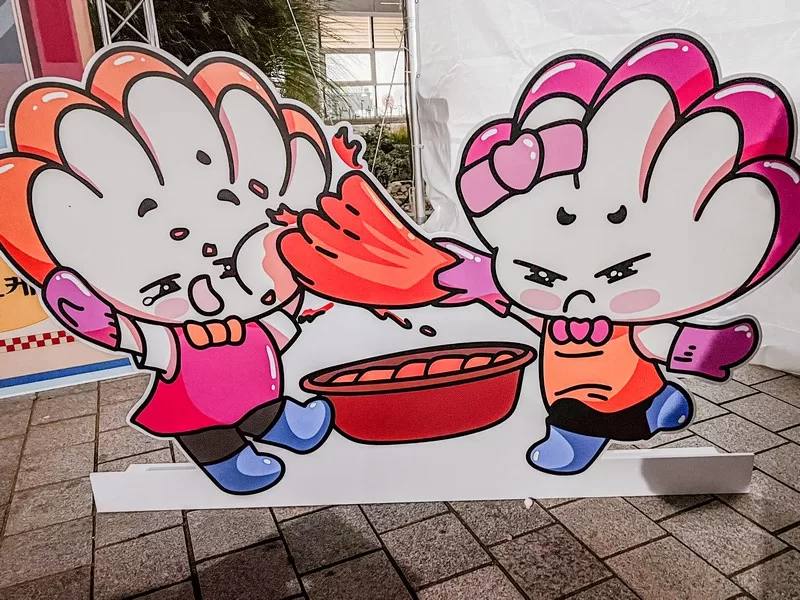
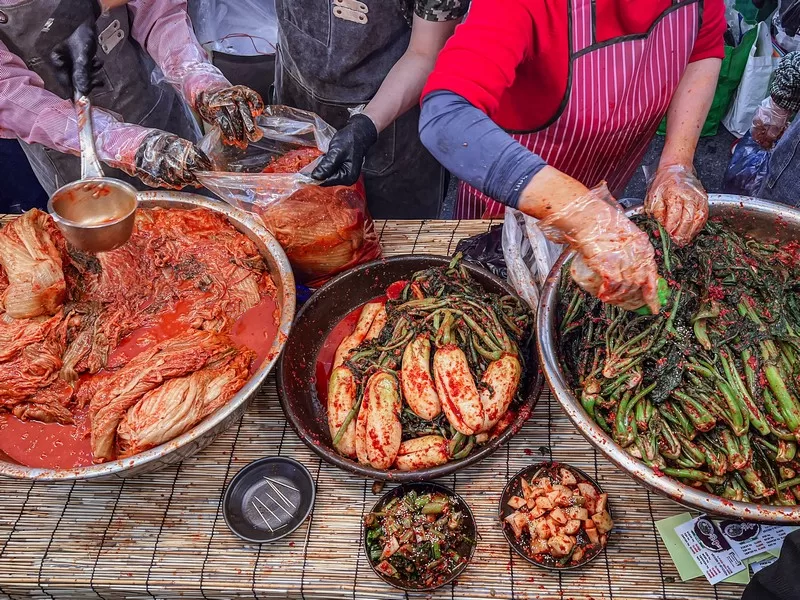
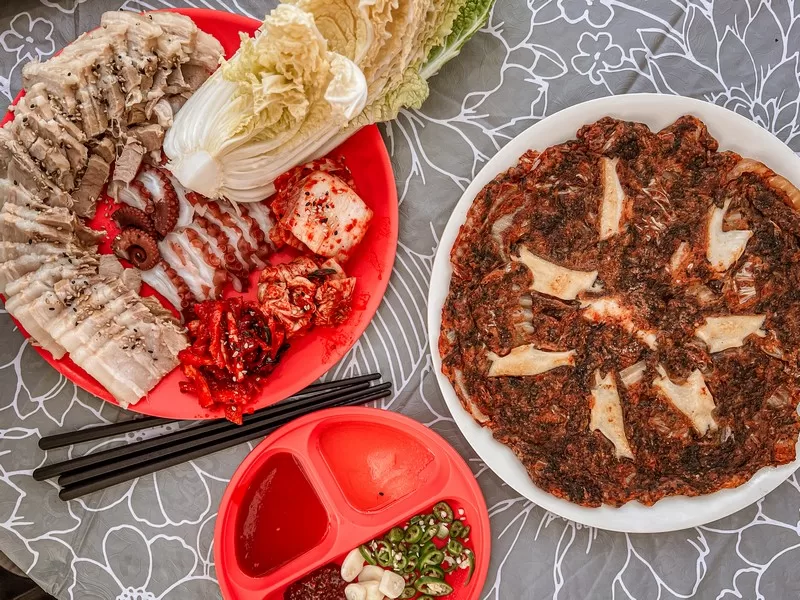
Go To The Gwangju Kimchi Festival
If your trip happens to fall in autumn, check the dates for the Gwangju Kimchi Festival. I love Korea’s local festivals because they’re usually full of families, food, performances, regional specialties, and people who are there to enjoy themselves rather than simply create a tourist experience.
Jeolla cuisine is known throughout Korea for bold flavors and generous tables, and regional kimchi reflects that. At the festival, you can taste different varieties, watch cooking demonstrations, eat dishes prepared by local restaurants and chefs, and even make kimchi yourself. I went hungry. I recommend you do the same.
How I’d Spend Two Days In Gwangju
If this is your first trip, I wouldn’t try to race around the entire city. I’ve been to Gwangju three or four times now and still find more that I want to see and do there.

Day One: Democracy & Downtown Gwangju
- Start at the 5·18 Democratization Movement Archives and give yourself time to actually understand what you’re seeing.
- From there, walk along Geumnam-ro to Jeonil Building 245, 5·18 Democracy Square, the former South Jeolla Provincial Office, and the Asia Culture Center.
- This puts the history into geographical context rather than treating each location as a separate museum.
- If you still have energy afterward, look around the smaller art spaces near the downtown area or stop into Eunam Museum of Art depending on its current exhibition.

Day Two: Yangnim-dong, Art & Tea
- Give the second day a completely different pace.
- Start in Yangnim History & Culture Village and see the House of Lee Jang Woo before wandering through Penguin Village. Stop at the Lee Ok-seon memorial rather than rushing past it.
- Then start picking from the neighborhood’s art spaces. Yangnim Museum of Art, LEEKANGHA Art Museum, Horanggasy Art Polygon, and Leeleenam Studio can all fit naturally into the neighborhood rather than feeling like separate excursions.
- Stop at Onjadam for traditional tea and yanggaeng somewhere in the middle.
- From there, you could continue toward G.MAP and Heekyungru or save the larger Biennale and Gwangju Museum of Art area for another day.
- And this is exactly why I don’t really think Gwangju works as a quick day trip from Seoul.
Is Gwangju Worth Visiting?
Absolutely, especially if you’ve already seen Seoul, Busan, and some of Korea’s better-known destinations and want to understand another side of the country. Gwangju isn’t necessarily a postcard-perfect destination, but it’s deep, layered, and has so many stories to tell if you’re ready to listen.
The May 18 Archives explains the city’s relationship with democracy. Yangnim-dong reveals layers of Korean and Western architecture and the city’s missionary history. Penguin Village preserves ordinary objects as neighborhood art. G.MAP points toward the city’s future while the Biennale connects Gwangju to an international contemporary art conversation.
FAQ
Is Gwangju worth visiting?
Yes, especially if you’ve already covered Seoul, Busan, or Jeju and want to see a side of Korea most tourists skip. Gwangju rewards visitors interested in modern Korean history, contemporary art, and food more than it does anyone chasing postcard scenery.
How many days do you need in Gwangju?
Two full days covers the essentials comfortably; art lovers or Biennale-season visitors could easily spend three or more, especially if you want to add Mudeungsan National Park or a stop at 1913 Songjeong Station Market.
Is Gwangju a good day trip from Seoul?
I wouldn’t do it as a day trip. The KTX alone runs around two hours each way, and between the May 18 history sites, Yangnim-dong, and the art spaces, you’ll want at least one overnight to do the city justice without feeling rushed.
What is Gwangju famous for?
The May 18 Democratization Movement, the Gwangju Biennale, its UNESCO Creative City of Media Arts designation, and Jeolla-do’s regional cuisine, including its kimchi.
Are there two Gwangjus in Korea?
Yes, Gwangju Metropolitan City in the southwest (covered in this guide) and a separate Gwangju in Gyeonggi-do, near Seoul. Double-check you’ve searched for the right one before booking transport.
Did Gwangju’s name or region change recently?
Yes. In July 2026, Gwangju administratively merged with Jeollanam-do into a new entity called 전남광주통합특별시 (Gwangju Special City). You’ll see this name on Korean government sites and some maps, but I’ve kept every address in this guide as “Gwangju, Jeollanam-do” since that’s still how most foreign visitors search for and navigate to the city.
What is the May 18 Democratization Movement?
A citizen and student uprising against martial law that took place in Gwangju from May 18–27, 1980. It’s considered a foundational moment in modern South Korean democracy, and the related archives were added to UNESCO’s Memory of the World Register in 2011.
What’s a good hiking option near Gwangju?
Mudeungsan National Park is the obvious answer, it borders the city and became South Korea’s 21st national park in 2012. I haven’t hiked it myself yet [see the Mudeungsan section above], so treat the practical details there as a starting point rather than a firsthand account.
Did you like this post? PIN IT!


