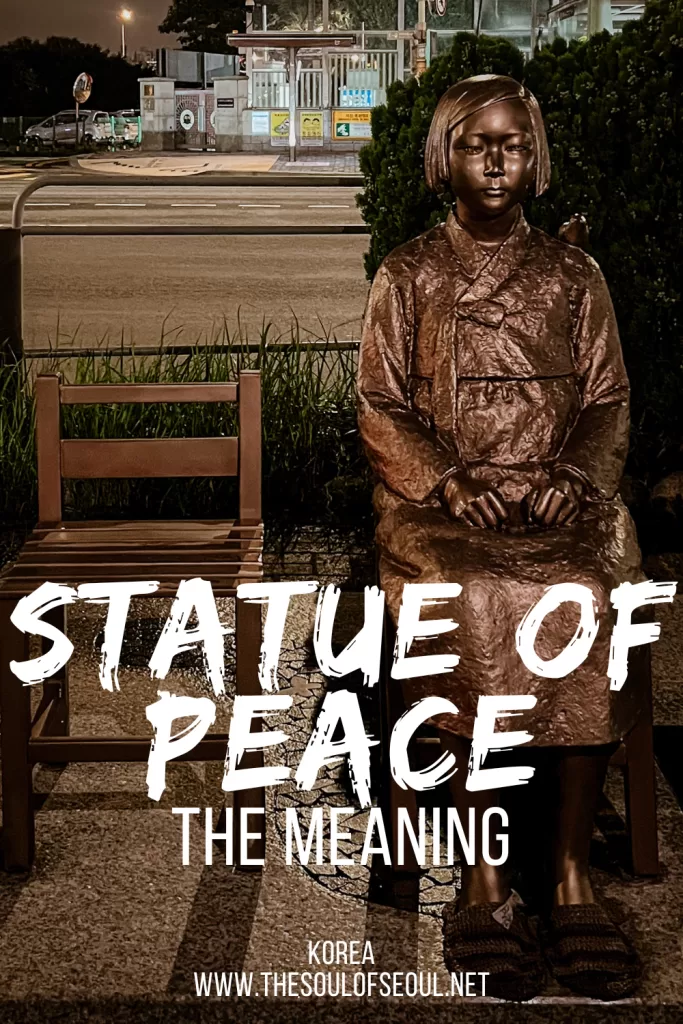
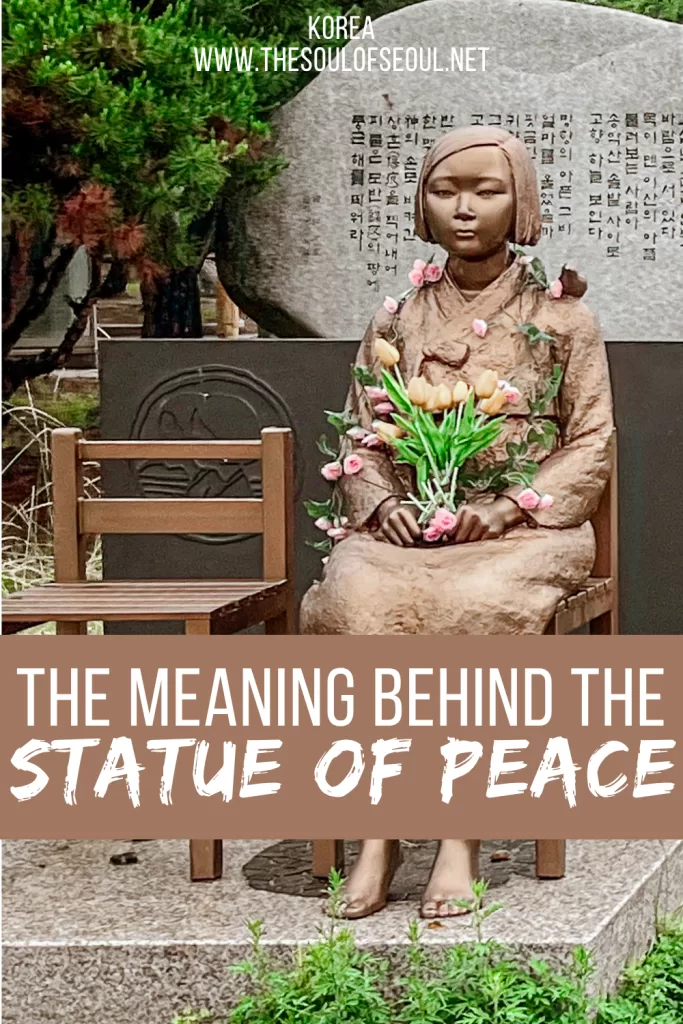
The Statue of Peace in Korea: Who Is The Girl You Keep Seeing?
Last Updated on August 21, 2026
You might walk past her without realizing it. Maybe you’re heading to Gyeongbokgung Palace or Insadong when you notice a small bronze girl sitting quietly on a chair, barefoot, fists clenched, staring straight ahead. Maybe you’re visiting a temple in Gunsan and see a barefoot girl standing alone. Or perhaps you’re on a DMZ tour at Imjingak when your guide points out a pair of girls.
I’ve lived in Korea for many years and have passed these statues in parks, visited museums dedicated to this history, attended the Wednesday Demonstrations, and even met some of the women these statues are devoted to. More recently, though, I’ve noticed how many visitors stop and look without actually knowing about the Korean comfort women. Who is that girl? Why is there an empty chair? Why is she barefoot? Those are exactly the questions to ask because every detail is deliberate.
The bronze girl most people recognize is the Statue of Peace (평화의 소녀상), known in Korean as Sonyeosang (소녀상), literally “statue of girl.” You may also find people searching for or referring to her as the “comfort women statue in Korea.” She is a memorial dedicated to the women and girls subjected to the Japanese military’s system of sexual slavery before and during World War II.
Here’s what you need to know about the girl statues you may see while traveling in Korea, what the Statue of Peace means, why the statues don’t all look the same, and the history they are asking us to remember:
- Who Is The Bronze Girl You See Around Korea?
- What Does Every Detail Of The Statue Of Peace Mean?
- Why Don’t All Of The Comfort Women Statues Look The Same?
- The History You Need To Know
- What Have The Halmonis Asked Japan For?
- The Wednesday Demonstrations
- Where You Might Encounter Her In Seoul
- How To Find A Statue Of Peace Near You
- Beyond Seoul: Statues Across Korea
- Go Deeper: The War And Women’s Human Rights Museum
- FAQ
(This post contains affiliate links, which means I receive a certain percentage of a sale if you purchase after clicking at no cost to you. Thank you for your support.)
Who Is The Bronze Girl You See Around Korea?
The Statue of Peace represents the victims and survivors of the Japanese military’s wartime sexual slavery system, commonly referred to by the euphemism “comfort women.”
The exact number of women subjected to this system isn’t known. Japanese historian Yoshiaki Yoshimi has estimated that between 50,000 and 200,000 women were involved. Other estimates differ, in part because surviving wartime documentation is incomplete. If you visit places like the War and Women’s Human Rights Museum in Seoul, you can learn about how the girls were listed under various terms on shipping documents, not as people, but as supplies.
The women came from across territories occupied or controlled by Imperial Japan, including Korea, China, Taiwan, the Philippines, Indonesia, and elsewhere. Korean women are generally considered to have made up the largest group of victims, though exact proportions are disputed.
Korea was under Japanese colonial rule from 1910 until the end of World War II in 1945. Korean women were coerced via abduction, deception, being promised jobs, trafficking, and recruitment. Once inside the military “comfort station” system, they were subjected to repeated sexual violence.
The statues that are now around the world don’t just represent once particular girl, they represent thousands.
Consider: The word “women” can also obscure just how young many of the victims were. Many were teenagers or young women, and documented survivor accounts include girls in their early teens.
What Does Every Detail of the Statue of Peace Mean?
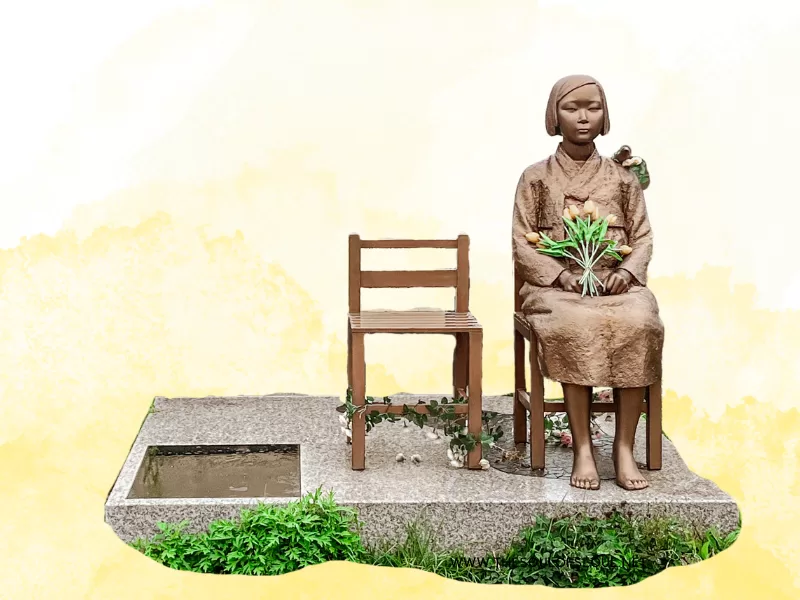
At first glance, it may just look like a young girl sitting quietly, but look closer and you’ll notice the many deliberate details that sculptors Kim Seo Kyung and Kim Eun Sung added that tell a specific story.
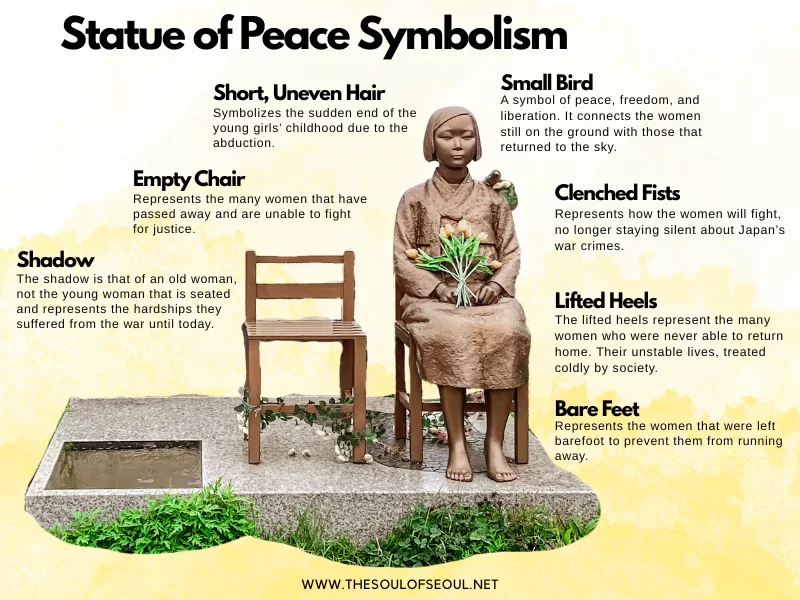
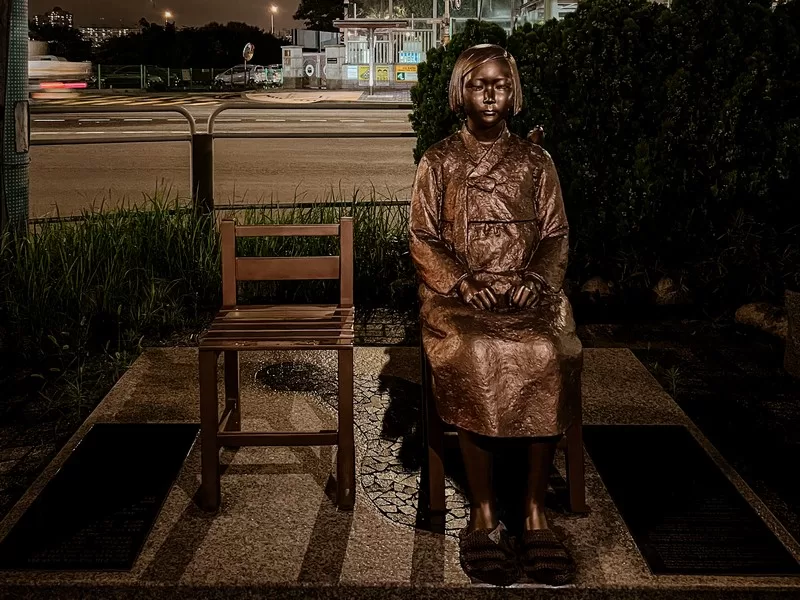
The Empty Chair: The empty chair beside the girl remembers the women who died without seeing the resolution they had fought for, but it also creates space for us to sit. Rather than just being an observer, take a seat, listen, remember, become part of keeping the story alive. I have been asked if it’s disrespectful to sit here and it is most certainly not if done with the right intentions.
Short, Uneven Hair: At the time, young girls would wear their hair in long braids. Showing them with roughly cut, uneven hair that was cut thoughtlessly and quick not only represents an end to their life as they knew it, but also represents the severing of their ties to their family and country.
Small Bird: A symbol of peace and freedom, the small bird also represents the connection between the survivors that are still living and the many that have passed away.
Clenched Fists: Look closely and you’ll notice along with the resolute expression on her face, her fists are clenched. The sculptors did not create a girl that was collapsed in sadness, instead they kept her upright in resistance.
Bare Feet: In the comfort station, girls were left shoeless so that they couldn’t run away.
Lifted Heels: Their soles are not touching the ground which represents the many women who were never able to return home even after the war had ended. Whether they chose not to return due to the shame they felt, or because they were completely abandoned far from home, they were left, unsettled, silenced.
A Shadow: One of the details that is easier to miss, the shadow cast beneath the chair and stretches across the platform is not of the girl that is seated on the chair, but is of an elderly woman. This is meant to symbolize the full lifespan from the child that was abducted until the grandmothers that have been fighting for justice year in and year out.
Why Don’t All Comfort Women Statues Look the Same?
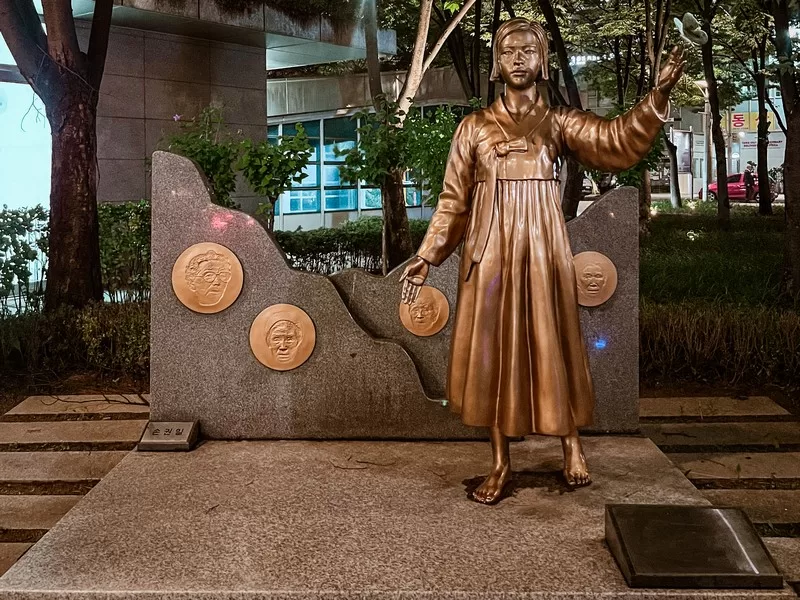
The seated girl is the most famous of the statues, she was the first. However, after the Seoul statue created by Kim Seo Kyung and Kim Eun Sung was established and created the image most people recognize today, more statues were made, some standing, some staring straight ahead, while others looked to the horizon. Sometimes the location was just as meaningful as the figure so statues were made to reflect that.
There isn’t one girl to look for anymore, but the details and style are the same/similar and you’ll understand when you see them.
The History You Need To Know
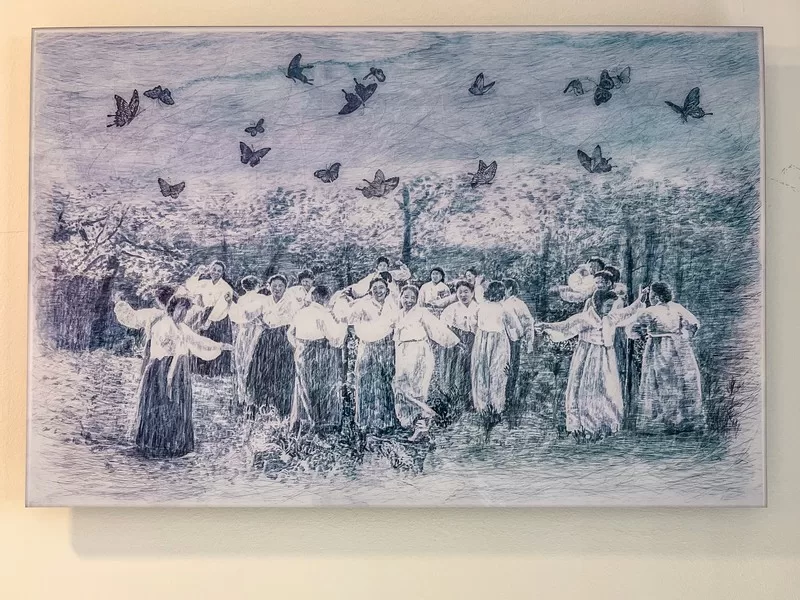
The Japanese military’s system of “comfort stations” operated across Asia before and during World War II. The term “comfort women” itself can make the history sound far less violent than it was. It was a euphemism used for women in the Japanese military’s comfort-station system, which is why survivors, historians, activists, and human-rights organizations have used the more accurate term Japanese military sexual slavery.
For decades after the war, many survivors remained silent. Sexual violence carried enormous social stigma. Survivors could face alienation from their families and communities rather than recognition as victims. Many experienced their trauma privately for most of their lives.
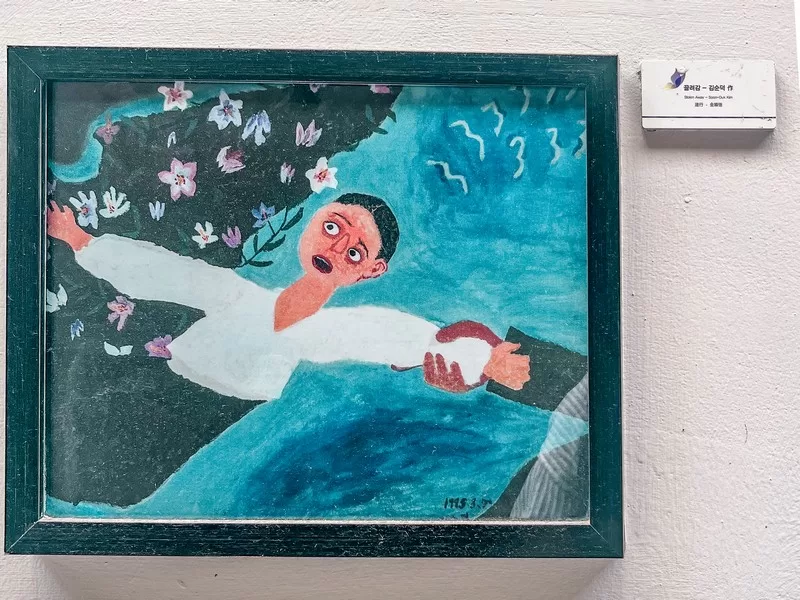
On August 14, 1991, Kim Hak Sun (김학순) became the first Korean survivor to publicly identify herself and testify about her experience. Her decision ultimately changed the trajectory of history. Other survivors began speaking publicly. Their testimonies highlighted a part of World War II history that had largely been kept hidden, ignored, and disputed for decades and turned it into an international human-rights issue.
The grandmothers were coming forward and not just looking to tell their story, but they were looking for action.
Comfort women is a term created by the aggressor, the Korean women that came forward opted to be called by the more endearing term halmoni (할머니), or grandmother, an important note as we want to respect their story.
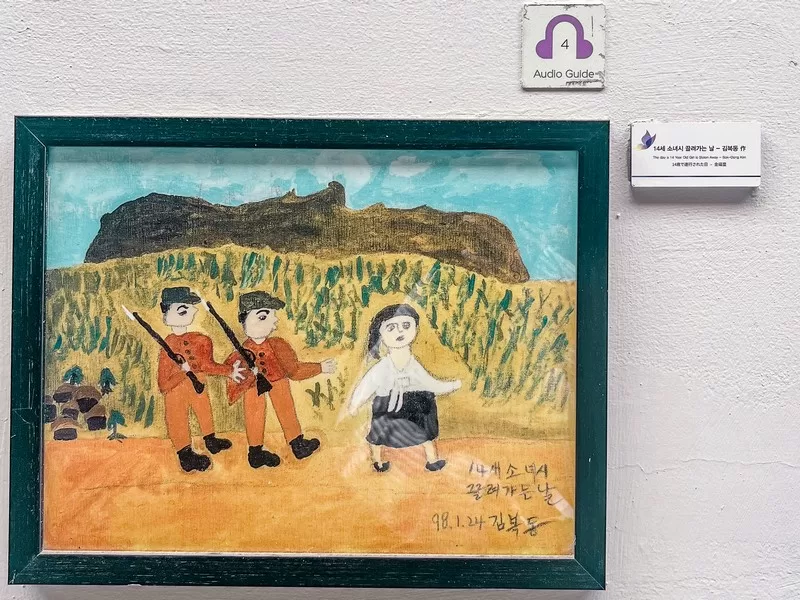
What Have the Halmonis Asked Japan For?
This is important because you will sometimes hear that Japan has “already apologized” for the comfort women issue. That statement leaves out much of the reason this dispute continues.
The survivors and the organizations supporting them have consistently demanded:
- Official recognition: They wanted the Japanese government to formally admit that their military had a system of sexual slavery and coerced women against their will.
- Legal reparations: Pay official state compensation directly to the victims as a legal acknowledgement of responsibility. I want to highlight that they did not want private or humanitarian funds, which have been offered, as that allows the Japanese government to skirt the issue and not legally take responsibility.
- Formal apology: A clear and irreversible official apology from the Japanese government and Prime Minister.
- Punishment and Records: Punishment for those responsible and to fully disclose all of the related military and government archives with information.
- Historical education: An accurate record of this history in Japanese school textbooks so that future generations learn about the atrocities and don’t repeat them.
- Remembrance: Memorialization of the victims and preservation of their testimony.
These demands are also why the wording and structure of Japan’s previous apologies and compensation programs matter.
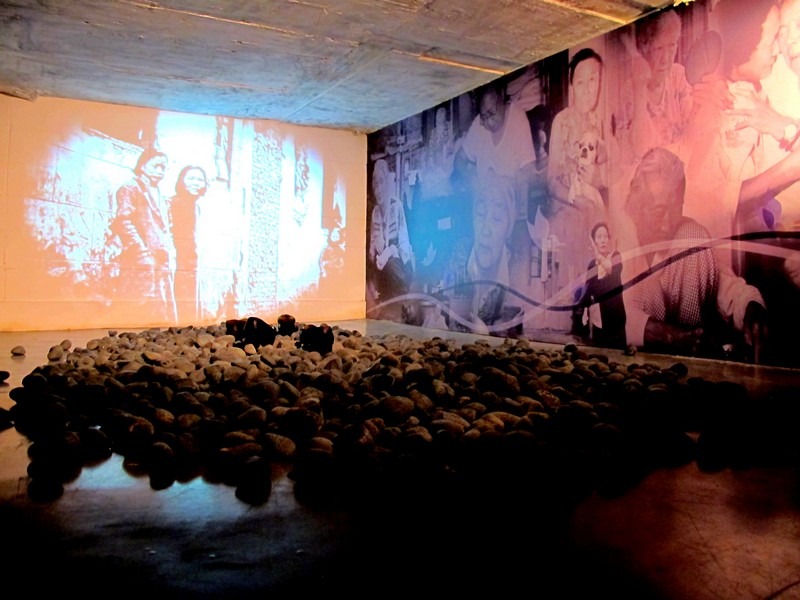
What Has Japan Acknowledged?
In 1993, Chief Cabinet Secretary Yohei Kono issued what became known as the Kono Statement.
Japan’s own government investigation acknowledged that the Japanese military was directly or indirectly involved in the establishment and management of comfort stations and the transfer of women. It also acknowledged that many women were recruited against their will through coaxing and coercion and that, at times, military or administrative personnel directly participated in recruitment. You can read the Kono Statement through Japan’s Ministry of Foreign Affairs.
Successive Japanese prime ministers expressed apology or remorse, including Tomiichi Murayama and Junichiro Koizumi. Yet survivors continued to object that Japan had not accepted the kind of direct legal responsibility they were demanding. The Asian Women’s Fund, established in 1995, illustrates that problem well.
The ¥2 million “atonement money” offered to individual survivors came from private donations by Japanese citizens rather than direct state compensation. The Japanese government funded medical and welfare assistance and the Fund’s operations, and prime ministers sent letters expressing apology and remorse. You can see how the Japanese Ministry of Foreign Affairs describes the Asian Women’s Fund here.
For survivors demanding that the Japanese state itself acknowledge legal responsibility and compensate victims accordingly, that distinction was not a technicality. It was the point.
The 2015 Agreement
In 2015, Japan and South Korea announced another agreement intended to resolve the comfort women issue “finally and irreversibly.” Japan contributed ¥1 billion to a foundation established to support surviving victims, while Prime Minister Shinzo Abe expressed “most sincere apologies and remorse.”
In the agreement Japan requested that the Statue of Peace outside its embassy be removed, with South Korea agreeing to consult relevant organizations about ways of addressing the issue. But there was a major issue with all of this, the victims themselves had not been included in creating the agreement. Given they had strongly advocated for remembrance and memorialization, this was a slap in the face.
A later South Korean government review concluded that the agreement had serious flaws in both process and content and had failed to sufficiently reflect the views of the survivors. In January 2018, the South Korean government stated plainly that the agreement “cannot resolve the comfort women issue.” You can read the South Korean Ministry of Foreign Affairs’ 2018 position on the agreement here.
Japan continues to maintain that the agreement resolved the issue “finally and irreversibly.” The halmonis and their supporters have continued to demand something different: a victim-centered resolution that recognizes their voices, dignity, and demands for accountability.
What About Japanese Textbooks?
This is another reason the issue cannot simply be dismissed as something that Japan apologized for decades ago and everyone should now move past. One of the survivors’ longstanding demands has been that this history be taught accurately to future generations of Japan.
A peer-reviewed study published in the International Journal of Asian Studies examining Japanese textbooks approved in 2021 and 2025 found that all but two of the approved history textbooks examined omitted the comfort women entirely. The two exceptions had very small market shares, and one included the issue only in a brief marginal note. An apology cannot preserve history if future generations aren’t taught what happened.
Read the 2026 Cambridge University Press study on Japanese history textbooks here.
The Wednesday Demonstrations
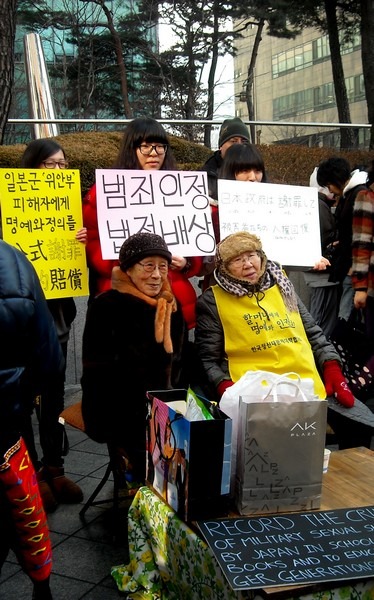
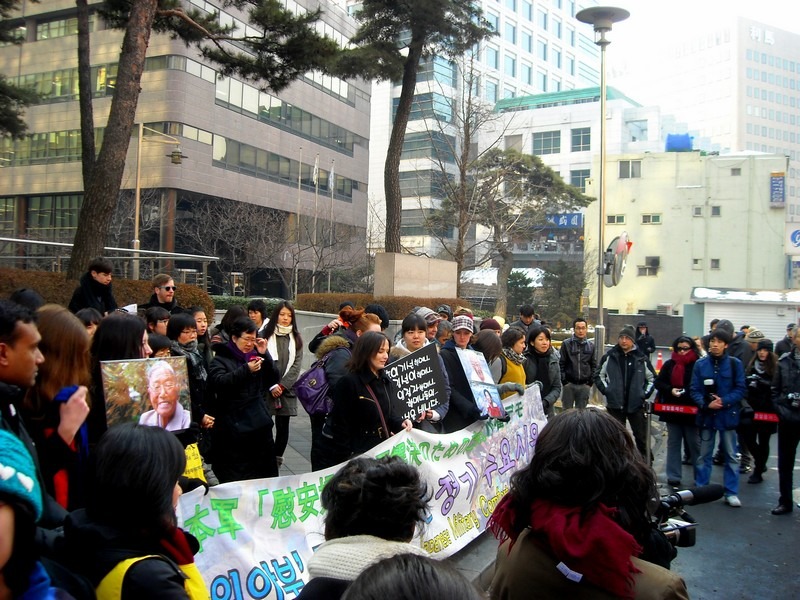
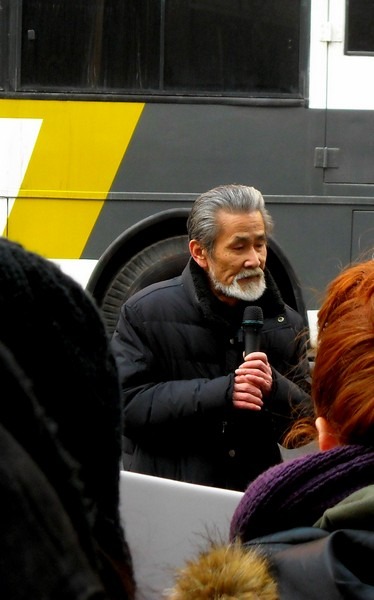
Every Wednesday at noon, near the site of the former Japanese Embassy in Seoul, people gather to demand a formal apology and full accountability from the Japanese government. These are the Wednesday Demonstrations (수요시위), and they have taken place continuously since January 8, 1992, making them one of the longest-running weekly protests in the world. The number of attendees fluctuates week to week with anywhere from 20 to hundreds of people showing their support for the courageous women that have spoken out.
The first Statue of Peace was unveiled at this site on December 14, 2011, during the 1,000th Wednesday Demonstration. The protests are organized by the Korean Council for Justice and Remembrance for the Issues of Military Sexual Slavery by Japan, and they continue to this day. If you are in Seoul on a Wednesday, you can witness or respectfully join this gathering. I’ve been on a number of occasions, seen some of the halmonis, had Japanese citizens join and apologize on behalf of their countrymen, and stood in solidarity and silence at times as well.
A note for foreigners: International visitors are regularly present at the Wednesday Demonstrations, but foreigners in Korea should be aware that Article 17 of South Korea’s Immigration Act restricts political activities by foreign nationals. According to reporting from The Korea Times, the Ministry of Justice said in 2025 that the provision had never been enforced up to that point. The Wednesday Demonstrations regularly welcome international supporters, but foreigners should understand Korean immigration law and make their own informed decision about participating rather than simply observing.
Where You Might Encounter Her in Seoul
You do not have to go looking for the Statue of Peace necessarily. She has a way of finding you. There are more than a dozen statues in Seoul alone, placed deliberately in the kinds of public spaces that visitors and locals move through every day. Statues have been placed outside, in spaces that people will walk by often, not museums where people have to choose to learn about history. A few of the most likely places you’ll come across her:
The Original Statue of Peace: Installed in 2011, she sits in central Seoul not far from Gyeongbokgung Palace, Gwanghwamun Square, and Insadong. That means it’s entirely possible to be having a normal day of sightseeing and suddenly find yourself standing in front of a much heavier piece of Korean history. For six years, protective barricades surrounded the statue amid repeated clashes and demonstrations around the site. In May 2026, police permanently removed those barricades.
How To Find a Statue of Peace Near You
If you’re not sure where to find them but want to see where the nearest one is, open Naver Map or KakaoMap and search:
“평화의 소녀상”, “소녀상”, or “Statue of Peace” all bring up the statues that are located around Korea.
Beyond Seoul: Statues Across Korea
After the original statue was installed in Seoul in 2011, replicas began appearing across South Korea. There are now around 150 statues in Korea alone.
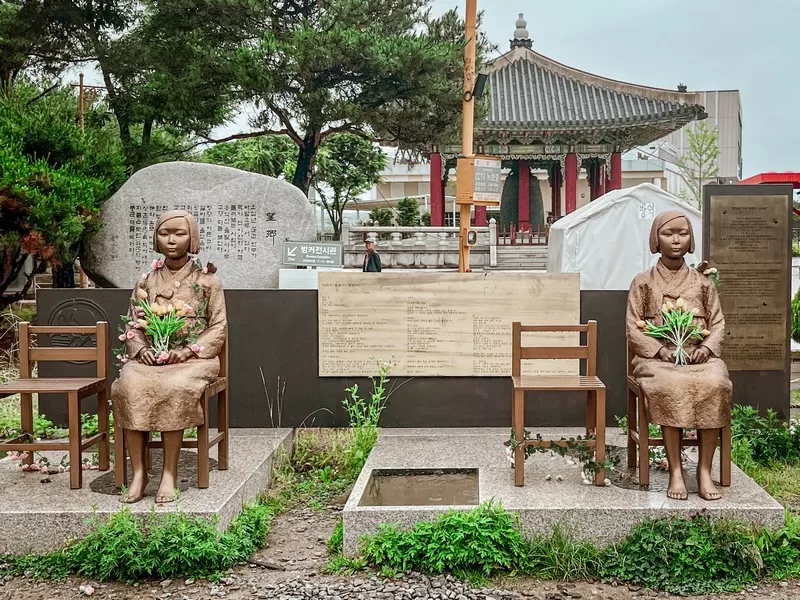
At Imjingak, for example, near the DMZ in Paju, there is a Statue of Peace created as part of a pair. A unique set, the project is known as “Girl, Let’s Go Home” (소녀야, 고향 가자). The pair was created with the idea that one girl would sit in South Korea at Imjingak while her counterpart could one day be placed in North Korea.
The Imjingak statue was installed on April 27, 2019. It marked the anniversary of the April 27, 2018 Panmunjom Declaration between South and North Korea. Korea was still one country when these girls were taken. If you have a good guide to the DMZ when you visit, I’m sure they’ll stop to tell you about this statue. Find out about what to see at Imjingak and various DMZ tours in How to Visit the DMZ From Seoul: Imjingak, JSA, and Cheorwon
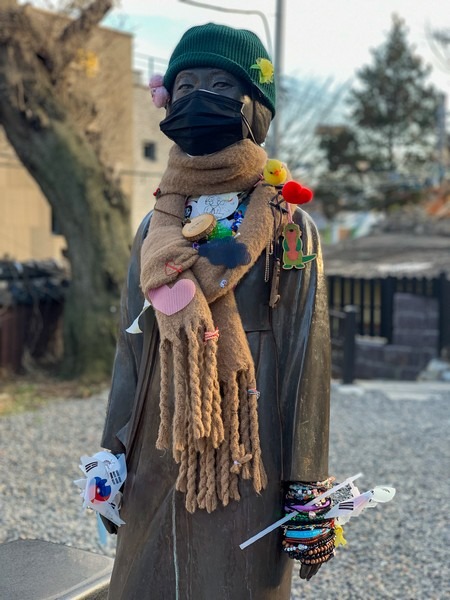
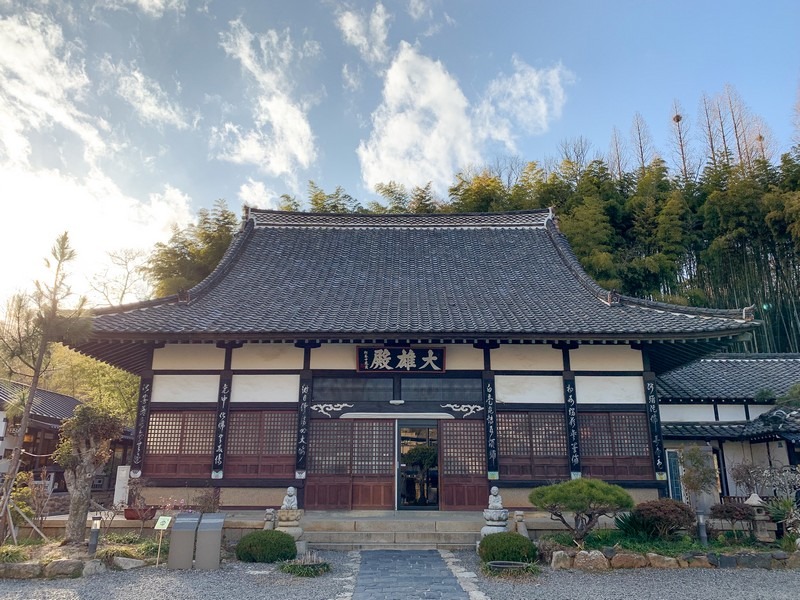
One of the statues that really made me notice how different these memorials can be is in Gunsan. Instead of sitting quietly on a chair, this girl stands. This Statue of Peace is inside Dongguksa Temple (동국사), a Japanese-style Buddhist temple with its own complicated connection to Korea’s colonial period.
Dongguksa traces its origins to a temple established by Japanese Buddhist monk Uchida in 1909, with the temple moving to its present location in 1913. It belonged to Japan’s Soto Zen tradition during the colonial period. Today, it is notable as a surviving Japanese-style Buddhist temple in Korea.
The Gunsan Statue of Peace was unveiled here on August 12, 2015, just before the 70th anniversary of Korean liberation. Artist Ko Kwang-kuk created a 158-centimeter-tall bronze girl stands looking into the distance. The artist reportedly reviewed hundreds of photographs of girls from the colonial period and based the figure on the appearance of a girl around 17 years old.
Behind the statue stands a monument containing a statement of repentance from Japan’s Soto Zen Buddhist order acknowledging its historical role in supporting Japanese imperialism and colonial policies. Even more remarkably, Japanese citizens who had been involved in reflecting on their country’s wartime past contributed to fundraising for the Gunsan statue. Read more and plan a trip to Gunsan, generally a city overlooked by many but with some really interesting sites to visit.
Go Deeper: The War and Women’s Human Rights Museum
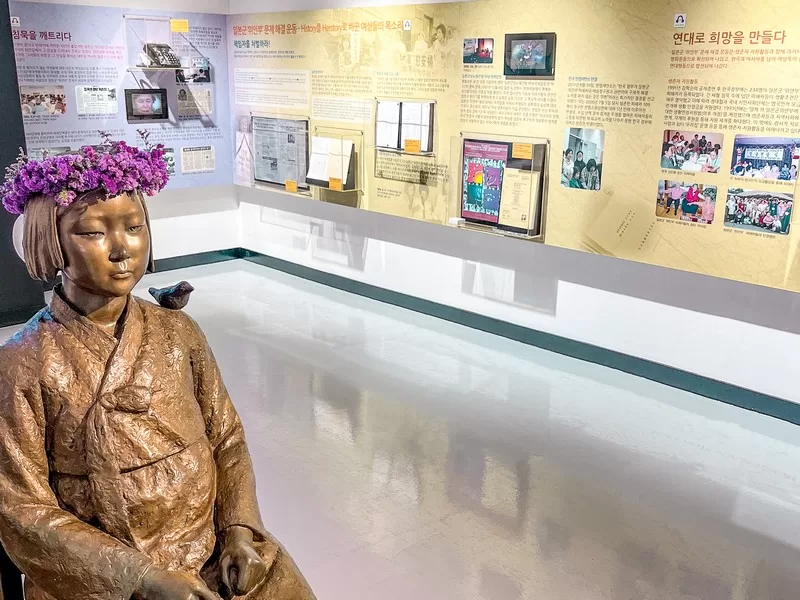
The Statues of Peace are a brief introduction into what the deeper history is and if you want to take the time to learn more about this part of history that has been overlooked for far too long, visit projectsonyeo.com. If you’re in Seoul, you should also visit the War and Women’s Human Rights Museum (전쟁과여성인권박물관) in Mapo-gu, Seoul.
The museum tells the halmoni’s stories through video footage, personal audio testimonies, photographs, diaries, and artifacts. Visitors receive a card at the entrance printed with the story of a specific halmoni, a small but powerful way of making the history feel personal. You will be connected and inspired to take action after you visit.
- Address: 20 World Cup buk-ro 11-gil, Mapo-gu, Seoul (서울특별시 마포구 월드컵북로11길 20)
- Hours: Tuesday to Saturday: 10:00am ~ 6:00pm
- Admission: Adults: W5,000
FAQ
What is the girl statue I keep seeing in Korea?
You’re probably seeing a Statue of Peace (평화의 소녀상), a memorial representing women and girls subjected to the Japanese military sexual slavery system before and during World War II. The most recognizable version shows a barefoot girl wearing Hanbok, a Korean traditional dress, sitting beside an empty chair.
What is the Korean girl statue called?
The memorial is generally called the Statue of Peace (평화의 소녀상). Koreans also commonly shorten the name to Sonyeosang (소녀상), which literally means “girl statue.”
Is the Statue Of Peace the same as a comfort women statue?
The Statue of Peace is a memorial to the victims of the Japanese military’s “comfort women” system, so you may see it described in English as a “comfort women statue.” However, Statue of Peace (평화의 소녀상) is the proper name of the famous seated Korean memorial. Not every comfort women memorial uses the same design.
Why is there an empty chair next to the Korean girl statue?
The empty chair remembers victims who died and also invites visitors to sit beside the girl. It turns the observer into a participant in remembrance.
Can you sit in the empty chair?
Yes. In fact, that’s part of its purpose. If you see someone sitting next to the Statue of Peace for a photograph, don’t immediately assume they’re being disrespectful. The empty chair was deliberately created as a space where people can sit beside her, reflect, and symbolically join the work of remembering.
Are all of the comfort women statues in Korea the same?
No. The famous Seoul Statue of Peace shows a seated girl, but other Korean memorials use different imagery. At Dongguksa Temple in Gunsan, for example, the girl stands barefoot looking into the distance. At Imjingak, a statue was created as one half of a pair, with the hope that its counterpart could someday be installed in North Korea.
What are the Wednesday Demonstrations?
The Wednesday Demonstrations (수요시위) are weekly gatherings that began in Seoul in January 1992. The original Statue of Peace was installed near the Japanese Embassy during the 1,000th Wednesday Demonstration on December 14, 2011. The demonstrations continue today.
Has Japan apologized to the comfort women?
Japanese officials have issued statements and apologies, including the 1993 Kono Statement and letters from several prime ministers. But that doesn’t tell the whole story.
Many survivors have maintained that Japan has not fulfilled their demands for a victim-centered resolution that includes unequivocal acknowledgment of legal responsibility, direct state reparations, preservation and disclosure of historical records, and accurate education about the system.
Do Japanese students learn about the comfort women?
Not necessarily. Coverage has changed substantially over time. A 2026 peer-reviewed study examining approved Japanese history textbooks published in 2021 and 2025 found that all but two of the textbooks it examined omitted the comfort women. The two exceptions had very small market shares. That is particularly significant because education about the history has been one of the survivors’ longstanding demands.
Where can I learn more about the comfort women in Seoul?
Visit the War and Women’s Human Rights Museum (전쟁과여성인권박물관) in Mapo-gu. I’d especially recommend visiting if you’ve encountered one of the statues first. Once you’ve learned the individual stories behind the memorial, you’ll never really see that bronze girl the same way again.
These statues aren’t decoration. But they’re also not all the same. One girl sits with clenched fists across from the former Japanese Embassy. Another stands barefoot inside a Japanese-style Buddhist temple in Gunsan. Another waits near the DMZ while her counterpart has yet to reach the other side. And others have traveled much farther, appearing in cities around the world.
That’s why I wanted to write this. I’ve watched people pass these girls without knowing who they are. And I understand why. If no one explains the empty chair, the bare feet, the strange shadow, or why a bronze girl is sitting in the middle of a busy Seoul neighborhood, there’s no reason a visitor would automatically know.
But once you do know, it’s very difficult to walk past without looking. Whether you first see her beside a busy Seoul street, in a temple courtyard, near the DMZ, or halfway around the world, I hope she stops you. And I hope you let her.
Did you like this post? PIN IT!