The Wednesday Demonstrations in Seoul: How to Attend the Comfort Women Protest
Last Updated on August 21, 2026
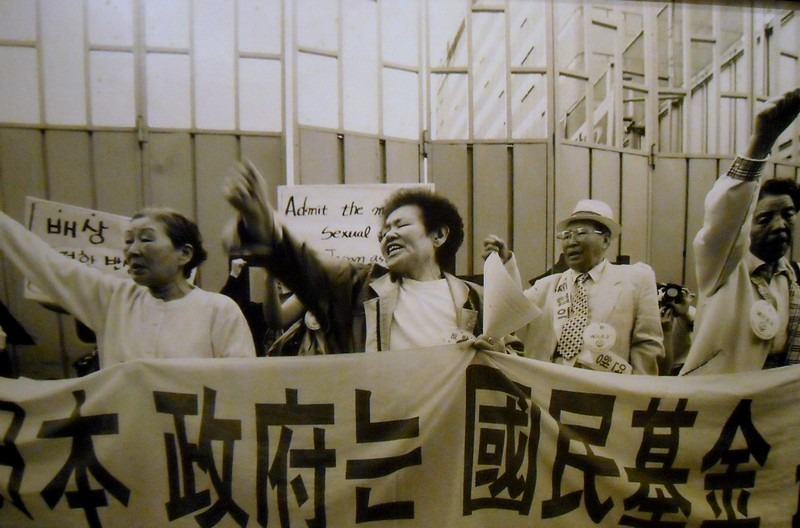
Every Wednesday at noon, near the site of the former Japanese Embassy in central Seoul, a crowd gathers. Some weeks it’s a couple dozen people. Some weeks it’s a hundred or more. All of them are there for the same reason: to demand that Japan formally acknowledge and take legal responsibility for its WWII military sexual slavery system, commonly known by the euphemism “comfort women.”
These are the Wednesday Demonstrations (수요시위), and they’ve been happening continuously since January 8, 1992, making them one of the longest-running weekly protests in the world. If you’ve read my piece on the Statue of Peace, you already know some of this history. This article is about actually going. Where to stand, what to expect, whether it’s safe, and whether you, a foreigner, can join.
Here’s what to know before you go:
- What Are the Wednesday Demonstrations?
- Where To Actually Go (And Why The “Embassy” Part Is Confusing)
- What It Was Like The Time I Did Join
- Is It Safe? Is It Legal For Foreigners To Attend?
- How Long Should You Stay? Can You Bring Kids?
- How To Get There
- FAQ
(This post contains affiliate links, which means I receive a certain percentage of a sale if you purchase after clicking at no cost to you. Thank you for your support.)
What Are the Wednesday Demonstrations?
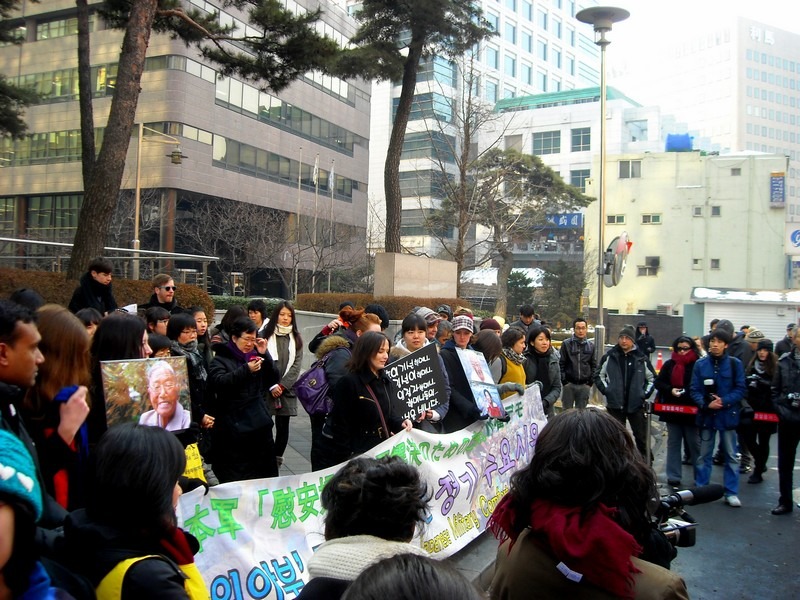
The Wednesday Demonstrations are weekly protests held every Wednesday at noon, demanding that the Japanese government formally acknowledge legal responsibility, issue a direct state apology, and provide legal reparations to the survivors of its wartime sexual slavery system. They’re organized by the Justice and Remembrance Solidarity, formerly known as the Korean Council (정의기억연대), and they’ve run continuously, through Lunar New Year, through the pandemic, through years of being pushed off their own spot by counter-protesters, since January 8, 1992.
The survivors who attend or are represented here are the halmoni, grandmothers, the term they chose for themselves rather than the one their captors gave them.
Where To Actually Go (And Why the “Embassy” Part is Confusing)
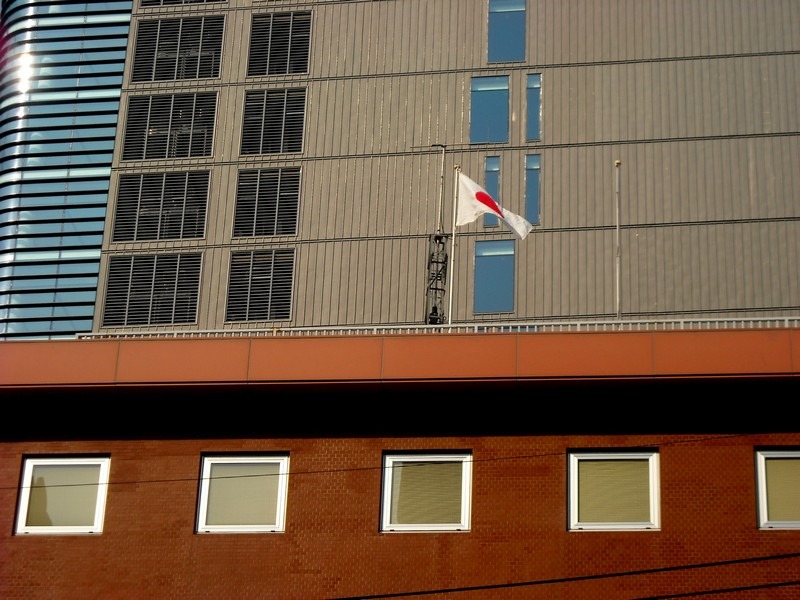
Here’s something that trips people up, including people who’ve lived here a while: the Japanese Embassy is not where the Statue of Peace is, and it’s not where this protest happens. The actual embassy building relocated to Twin Tree Tower on Yulgok-ro in 2015 for a rebuild. That’s where you’d go for a visa or passport matter. It is not where the Wednesday Demonstration is held.
The protest stayed exactly where it’s always been: at the site of the former embassy in Susong-dong, right beside the Statue of Peace. If you search “Japanese Embassy” on a map app expecting to find the protest, you’ll end up in the wrong place entirely. Search “평화의 소녀상” (Statue of Peace) or “구 일본대사관” (old Japanese Embassy) instead.
Additionally, starting in 2020, a counter-protest group, one that disputes the survivors’ history and has called for the statue’s removal, began filing for the permit to that exact spot before the Justice and Remembrance Solidarity could. Under Korean protest law, first filed, first held. That pushed the Wednesday Demonstration off its own site for years, cycling through nearby locations: in front of the Somerset Palace hotel, the sidewalk by K-Twin Tower, near the Yonhap News building. In February 2026, reporting confirmed the demonstration had returned to its original spot beside the statue after the counter-protest group stopped filing first.
My recommendation: if you want to attend, check 정의기억연대’s own site or social channels (womenandwar.net) the morning of, and don’t be surprised if the situation looks different from what any article, including this one, describes. There’s been some upheaval for a few years now.
What It Was Like The Time I Did Join
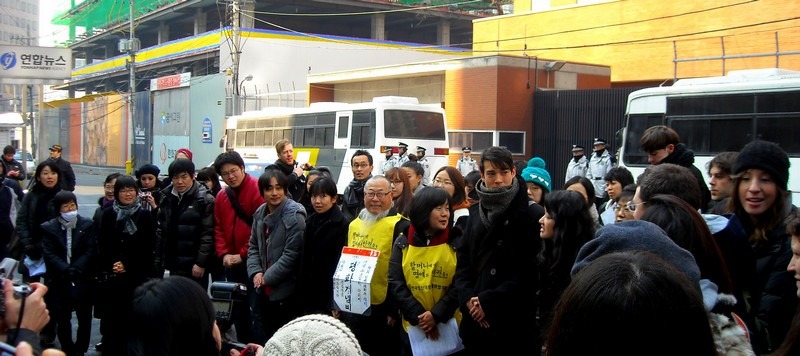
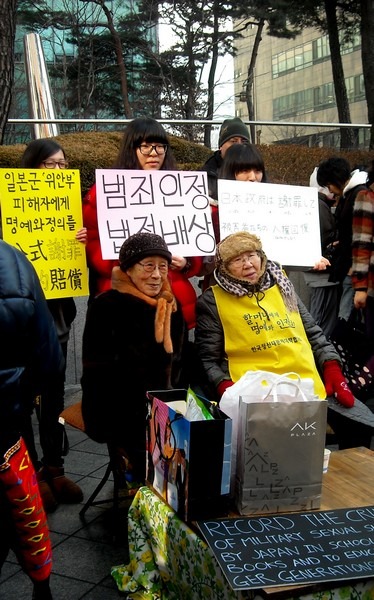
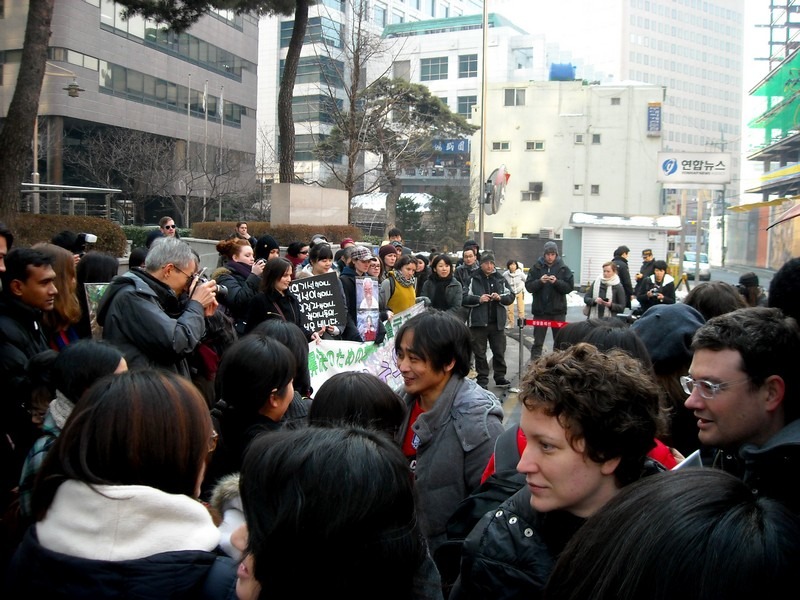
I visited on the Lunar New Year in 2011 the first time I went. As it was a holiday foreigners that usually have to go to work on Wednesdays had no work this week. I’ve heard crowds at these protests can range from 20 to in the hundreds and this week, with the extra foreigner power, there were at least 100 people there showing their support for these courageous women making their voices heard week in and week out.
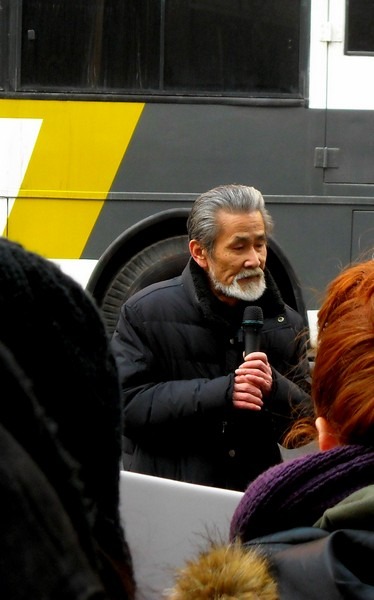
They accept any and all support because this isn’t just about the Korean comfort women, this is about all women who have been put into this position around the world, and all people learning and accepting that this has happened and learning from the mistakes we have all made. There were also Japanese students there who had come to Korea to learn and then also learned about this issue and came to support the women. There was a Japanese man who stood to speak up and say he knows this happened during the war and he thinks the government should also accept that it has.
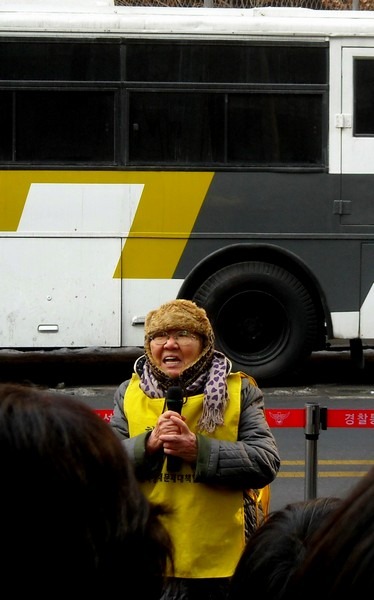
One of the grandmothers stood and spoke, and at one point, in an amusing twist, turned to the police enforcing the line and told them, “You are Koreans as well, you are listening to this. Go home and tell your friends and family about this issue.” They looked around for a moment before regaining their composure. Foreigners, Japanese students and families, Koreans, grandmothers, all together standing for an issue that more need to hear about.
Is It Safe? Is It Legal For Foreigners To Attend?
Yes to both, with a couple of honest caveats.
On safety: You’ll always find police at protests in Korea. That’s not specific to this one, and it’s not a sign that something dangerous is expected, it’s simply how protests are managed here. Police presence is there to keep things from escalating between the demonstration and any counter-protesters, not to shut the Wednesday Demonstration down. I’ve never felt unsafe attending. Given the counter-protest activity around the site in recent years, I’d just say: pay attention to your surroundings, and if the atmosphere feels tense or unclear, as it did on my most recent visit, it’s fine to observe from a distance rather than wade in.
On legality: International visitors regularly attend the Wednesday Demonstrations. Foreigners in Korea should still be aware that Article 17 of South Korea’s Immigration Act technically restricts political activities by foreign nationals, I go into this in more detail in my Statue of Peace article, including reporting that this provision has never actually been enforced against protest attendees. The Wednesday Demonstrations welcome international supporters, but it’s worth understanding the law and making your own informed call rather than just assuming.
How Long Should You Stay? Can You Bring Kids?
As long or as short as you like. Some people stay the full hour; some stop by for ten minutes on their way somewhere else. There’s no obligation and no one is checking.
I’ve also seen people there with kids, and I think it can be a good opportunity to introduce children to this part of history and, just as importantly, to what it looks like to advocate for something and make your voice heard. It’s educational in a way that’s hard to replicate in a classroom. Use your own judgment on your kids’ age and how much of the history you’ve already explained to them beforehand, the War and Women’s Human Rights Museum has its own notes on this if you’re weighing a museum visit with children too.
How To Get There
Take Line 3 to Anguk Station and leave via Exit 6. From there, walk up the road, you’ll cross a larger intersection and then come upon the next largish street on your left and that’s where you’ll see the Statue of Peace, that’s your landmark, not the current embassy building.
If you’re nervous about finding the right spot on your own, it may be worth checking “정의기억연대’s” site or social channels for the current week’s exact gathering point before you go, given the location instability described above. The speakers are aware that foreigners come, and they clearly cue when to join in the chants, so you don’t need to speak Korean to follow along.
FAQ
What are the Wednesday Demonstrations?
Weekly protests held every Wednesday at noon in Seoul, demanding a formal apology and legal reparations from Japan for its WWII military sexual slavery system. They’ve run continuously since January 8, 1992, organized by 정의기억연대 (Justice and Remembrance Solidarity).
Where exactly are the Wednesday Demonstrations held?
Beside the Statue of Peace, at the site of the former Japanese Embassy in Susong-dong, Jongno-gu, not the current embassy, which relocated to Twin Tree Tower on Yulgok-ro in 2015. Search “평화의 소녀상” on a map app rather than “Japanese Embassy” to find the right spot.
Can foreigners attend?
Yes, international visitors regularly do. Foreigners should be aware of Article 17 of Korea’s Immigration Act, which technically restricts political activity by non-citizens, though it hasn’t been enforced against protest attendees.
Is it safe?
Yes. Police are present, as they are at essentially all protests in Korea, that’s standard practice here, not a sign of danger, and they’re there to keep the demonstration and any counter-protesters separated peacefully. Given recent counter-protest activity at the site, it’s worth paying attention to the atmosphere when you arrive.
How long should I stay?
However long you like. There’s no minimum or expectation, some people stay the full hour, others stop by briefly.
Can I bring kids?
Yes, and it can be a genuinely valuable, age-appropriate way to introduce children to this history and to what advocacy looks like in practice.
Do I need to speak Korean?
No. Speakers know foreigners attend and clearly cue when to join in chants.
Is the demonstration still happening at its usual spot?
Officially, yes, as of February 2026 reporting, but the site has been contested by counter-protesters for years, and on a recent visit I found barriers up and an unclear situation on the ground. Check current information before you go rather than assuming it will match what any article describes.
What’s the difference between visiting the Statue of Peace and attending the Wednesday Demonstration?
The statue is a memorial you can visit any day, alone, at your own pace. The demonstration is the one hour a week the survivors’ supporters actually gather in person to make their demands heard, it’s the living, ongoing version of the same history.
I’ve been to this demonstration. I’ve also, more recently, shown up and not been sure where to stand. Both of those are true at once, and I think that’s worth saying plainly rather than smoothing over. This isn’t a tourist attraction with fixed hours. It’s an ongoing act of advocacy that’s been contested, literally, over who gets to stand on that patch of sidewalk. If you go and it’s not exactly as described here, that’s not this article failing you. That’s the story continuing.
Did you like this post? Pin IT!