Ring the Bosingak Bell: One of Seoul’s Most Overlooked Experiences
Last Updated on September 13, 2026
Most people, locals and tourists alike, walk right past Bosingak Belfry (보신각 터) in downtown Seoul and don’t even realize they can do more than just take a photo in front of a beautiful traditional pavilion. Sitting in the middle of busy Jongno, surrounded by office buildings, traffic, restaurants, and shops, the traditional pavilion can almost feel like a little historic island in the modern city. Most people don’t even really pay attention to this historic site until New Year’s Eve when tens of thousands of people descend on the area to watch as the bell is rung 33 times at the stroke of midnight.
But what most tourists and locals don’t realize is that they can actually ring the bell themselves most days of the year! Yes, tourists can ring the Bosingak Bell in Seoul. The free citizen bell-ringing ceremony normally takes place at noon Tuesday through Sunday, with advance reservations and designated walk-in opportunities for international visitors. This is not only one of the coolest free things to do in Seoul, but it’s also seriously underrated and one of the most unique things you can do in downtown Seoul. I’ve done the Bosingak bell-ringing experience three times now, and I’m still surprised more visitors to Seoul don’t know about it.
If you’re looking for unique things to do in Seoul, especially something historical that feels much more interactive than simply walking through another palace or museum, put this one on your list. Not only an interesting way to interact with a historic site in downtown Seoul, but it’s also family-friendly, and the sign-up makes it basically a private experience… I’ll explain below.
Learn how to ring the Bosingak Bell in downtown Seoul, one of the most unique experiences you can do and it’s free on top of that. Here’s what to know:
- Basic Info
- You Can Actually Ring The Bosingak Bell
- How To Sign Up To Ring The Bosingak Bell
- Why Is The Bosingak Bell Important?
- Why Did The Bosingak Bell Ring 33 Times In The Morning?
- Why Did The Bell Ring 28 Times At Night?
- How Old Is Bosingak?
- Is The Bell At Bosingak The Original Bell?
- What To Do Near Bosingak
- Is Ringing The Bosingak Bell Worth It?
- FAQ
(This post contains affiliate links, which means I receive a certain percentage of a sale if you purchase after clicking at no cost to you. Thank you for your support.)
Basic Info
Address: 54 Jong-ro, Jongno-gu, Seoul (서울특별시 종로구 종로 54)
How to get there: Jonggak Station (종각역), Seoul Subway Line 1, Exit 4. Do a u-turn out of the exit and you’ll see the Bosingak Belfry on your left just there.
Admission: Free
Bell-Ringing Experience: Free
Regular Ceremony: Tuesday through Sunday. Closed Mondays, Lunar New Year, and Chuseok. Additional closures may occur due to weather, demonstrations, special events, or safety concerns.
Arrival Time: Participants with reservations should arrive by 11:40am.
Bell Ringing: Begins at 12:00pm promptly.
Reservations: Advance reservations are available for up to two teams per day, with six or fewer participants per team. Reservations open at 10:00am on the first day of the previous month.
Foreign Visitors: Can’t figure out how to make a reservation? The site accepts foreign walk-ins on Tuesdays and Wednesdays in a first-come first-serve basis, so get there by 11:30am and you could get lucky!
Website: Bosingak Permanent Citizen Bell-Ringing Program
Important 2026 Closure
The regular Bosingak Permanent Citizen Bell-Ringing Ceremony is suspended from September through early December 2026 due to renovation work at Bosingak Pavilion. The exact reopening date may change depending on construction progress. Plans are to certainly be reopened prior to New Year’s Eve. The ceremony will also be suspended from December 26, 2026 through January 2, 2027 while preparations are underway for Seoul’s New Year’s Eve bell-ringing ceremony though. If you want to participate, make sure to check the official schedule before heading over.
You Can Actually Ring The Bosingak Bell
Bosingak isn’t just something you stand on the sidewalk and look at, though most pedestrians in the area see it that way. Seoul operates a citizen bell-ringing program that lets people go up into the pavilion and participate in the noon ceremony.
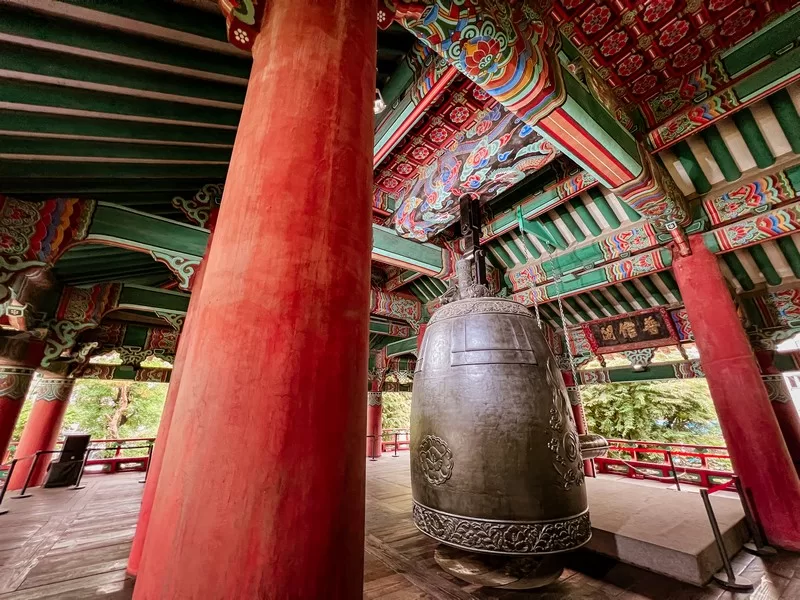
You arrive before noon and head up to the second floor of the pavilion via a set of stairs, there’s no elevator, so plan accordingly if that matters for your group. Don’t be late though. The ceremony runs on a precise schedule. Even just being upstairs changes your perspective on Bosingak. From street level, you see a traditional pavilion sitting at one of the busiest intersections in downtown Seoul. From inside, you’re suddenly standing next to this enormous bell looking out over modern Jongno.
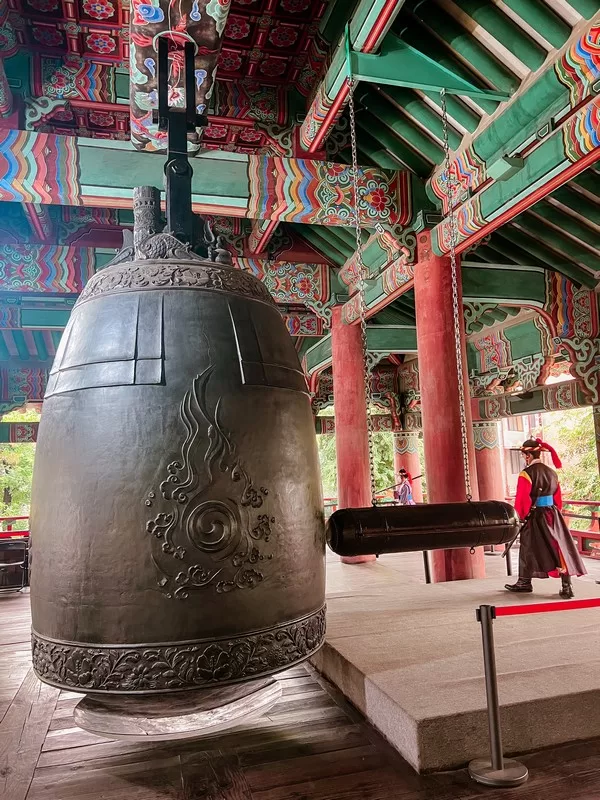
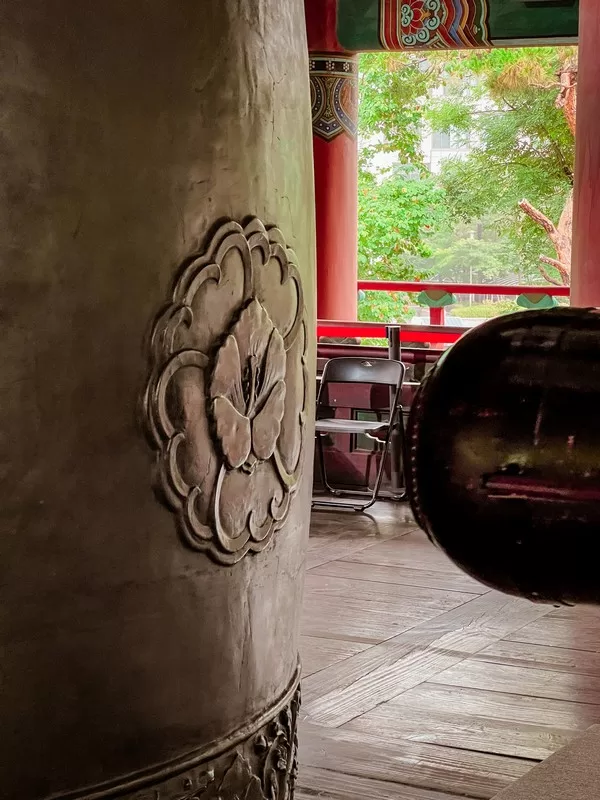
Precisely at noon, the bell ringing begins. A total of 12 strikes are made during the ceremony. Two groups of up to 6 people can sign up for this experience. So the first group, whether that’s just one or six, head to the bell and ring it 6 times. Then the second group takes their place and rings 6 times.
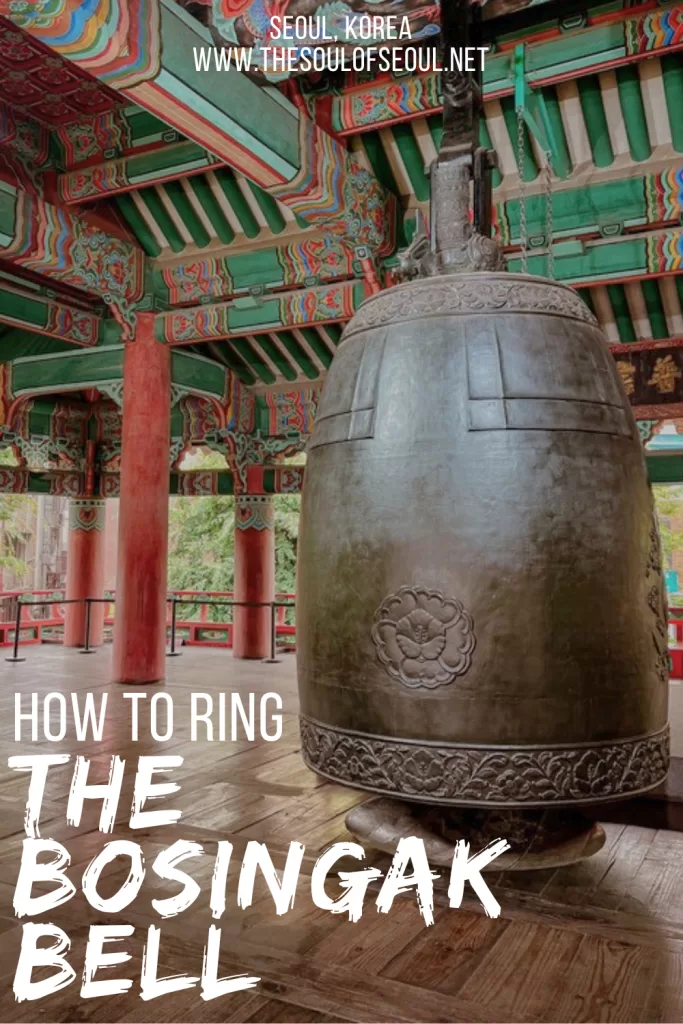
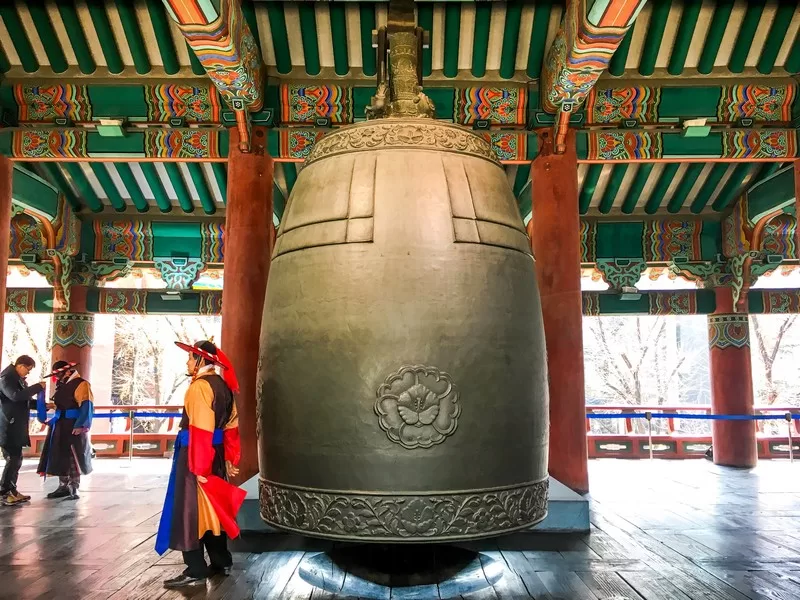
This isn’t a little ceremonial ding either. This is a massive bell. You work together to pull back the wooden striker and send it toward the bell. Staff stand at the back directing the process. When it hits, you don’t just hear the sound. You feel it. Knowing that bells have been ringing from this part of Seoul for centuries makes the experience even better.
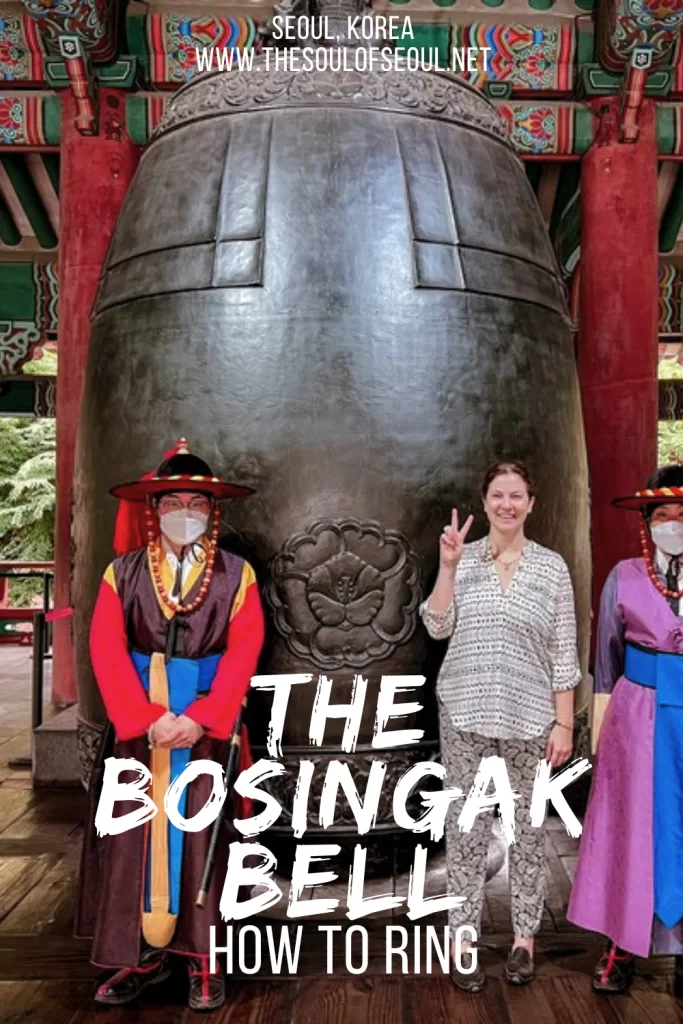
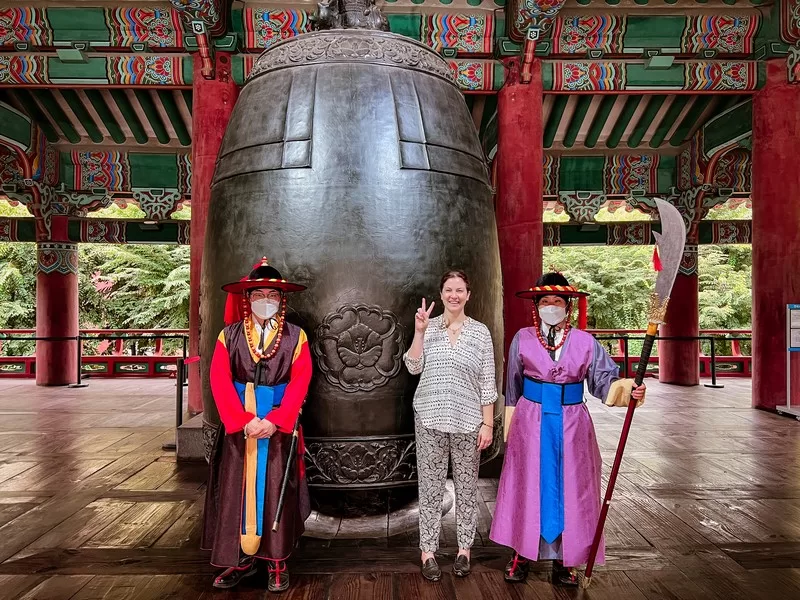
After the twelfth and final strike, the bell is still quietly vibrating, and you get to rest your hand against it while it hums and make a wish. It’s a small but moving moment as you can feel the vibration move through the bronze under your palm. Afterward, you get to take photos with the palace guards in traditional dress standing beside the bell, which is a nice, easy souvenir moment to end on.
How To Sign Up To Ring The Bosingak Bell
There are a couple of ways to participate, depending on the day you visit.
For the regular citizen bell-ringing program
Visitors can make a reservation in advance on a first-come, first-served basis. There are normally two teams accepted each day, with a maximum of six participants per team, of course you can sign up solo if you want to.
Here’s something worth knowing if you’re signing up solo: because there are only two slots per day on regular reservation days, booking as a solo participant means you’re the only visitor ringing the bell in your group, alongside the staff member helping guide the process. Nobody else gets added to your slot. That’s different from the foreign walk-in days, where I’ve seen strangers grouped together to fill out a team so more people can take part.
What to know:
- Reservations open at 10:00am on the first day of the month preceding your visit.
- For example, if you want to participate sometime in October, reservations would normally open September 1.
- You’ll receive an email when it’s successful. Additionally, the program operators contact successful applicants individually the day before their scheduled experience, so be prepared for this call which will be in Korean.
- I also received a call the morning of as it was raining and staff wanted to check that I would still come. I did, the rain doesn’t stop the bell from ringing.
- Participants should arrive at Bosingak by 11:40am, and the ceremony begins at noon.
For international visitors
According to the current program information, Tuesdays and Wednesdays are set aside for on-site participation by foreigners, so advance applications aren’t accepted for those days. Look for a sign posted in front of Bosingak with a QR code, that’s how walk-in sign-ups are handled on-site, so have your phone ready when you arrive.
I would still check the official Bosingak program website before simply showing up. Programs like this can change because of weather, holidays, demonstrations, maintenance, or special events in central Seoul.
Why Is The Bosingak Bell Important?
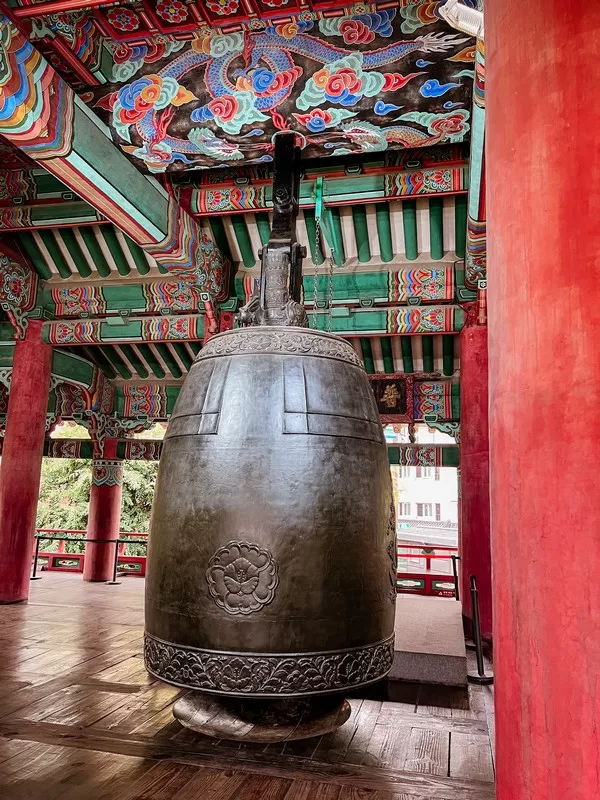
To understand why ringing the bell is such a cool experience, you have to imagine Seoul without clocks, phones, subway announcements, or even the ability to move around the city whenever you wanted. That’s a crazy thought in this fast-moving period of time in Seoul, I know. But, when the Joseon Dynasty established its capital in Hanyang, the city was surrounded by a fortress wall. Gates controlled movement into and out of the capital. You can hike along the Seoul Fortress Wall today and still see some of these gates.
Bosingak stood near the center of the city and its bell helped regulate daily life. When the official time was determined, the sound of Bosingak carried that information through the city. Residents knew from the bell when the gates were opening and when they were closing, important information to know at the time.
Did you know? Jongno (종로) means “Bell Street.” Jong (종) means bell and ro (로) means road or street. The entire district that visitors now associate with places like Insadong, Jongmyo Shrine, Gwangjang Market, and some of central Seoul’s busiest streets takes its name from this bell.
Why Did The Bosingak Bell Ring 33 Times In The Morning?
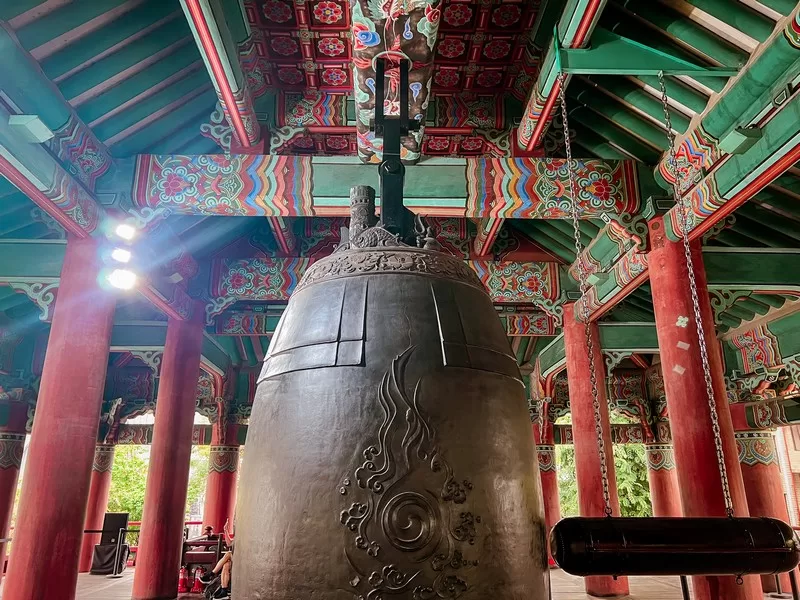
Every morning at approximately 4:00am, the Bosingak Bell was rung 33 times. This was called paru (파루). The 33 strikes signaled the end of the nightly curfew and the opening of the city gates. People could once again move into and out of the capital.
The number 33 wasn’t arbitrary. It has connections to the Thirty-Three Heavens in Buddhist cosmology. You might be wondering why a bell used by the Joseon capital had Buddhist symbolism when Joseon is known for its Confucian government. Buddhism didn’t simply disappear when the Buddhist Goryeo Dynasty ended. Its cultural influence remained, particularly in the early Joseon period. The 33 morning strikes expressed hopes for peace and the well-being of the country and its people.
Though the bell doesn’t continue to toll 33 times every day any longer, you can still see it rung 33 times on New Year’s Eve. The tradition of ringing in the new year here started in 1953 and has drawn in some 100,000 people at times. Striking the bell 33 times is a prayer for the well-being and safety of the nation and its people and today more and more as a new beginning.
Did you know? In 1895, during the reign of King Gojong, the bell-ringing schedule changed from approximately 4:00am and 10:00pm to noon and midnight.
Why Did The Bell Ring 28 Times At Night?
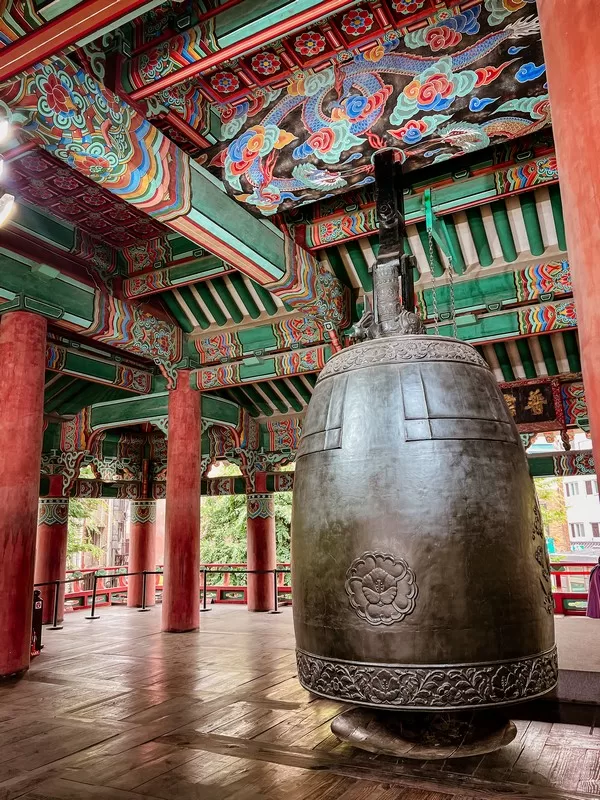
At approximately 10:00pm, the process happened again. This time though, Bosingak was struck 28 times in a ceremony known as injeong (인정). The 28 strikes signaled that Seoul’s gates were closing and the nightly curfew was beginning. The number is associated with the 28 traditional celestial constellations.
Once the gates were closed, movement through the walled capital was restricted. The bell could also be used to alert residents during emergencies, including fires.
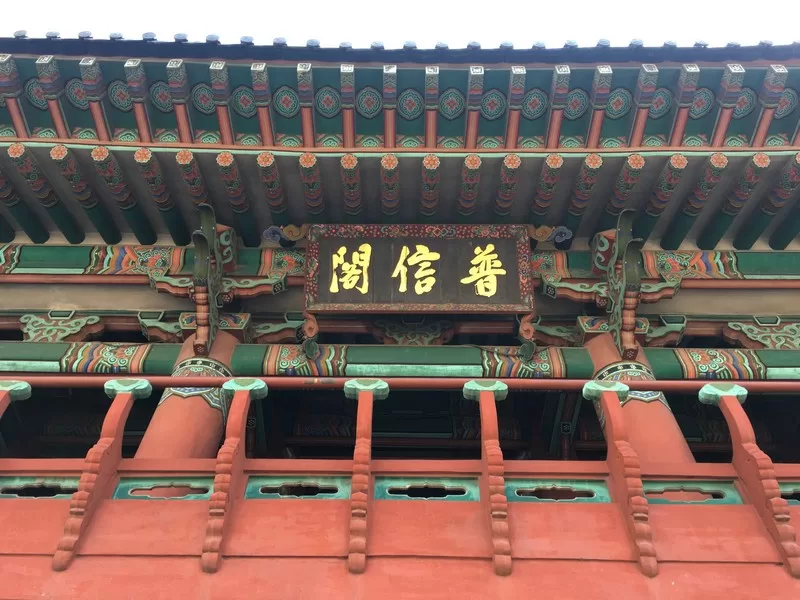
How Old Is Bosingak?
A bell pavilion was established in this area during the very early years of the Joseon Dynasty (1392 – 1897), not long after Hanyang became the capital. King Taejo, who reigned from 1392 to 1398, ordered the building of the belfry to serve as the official timekeeper and the central alarm system for the capital and it has been rung since 1396.
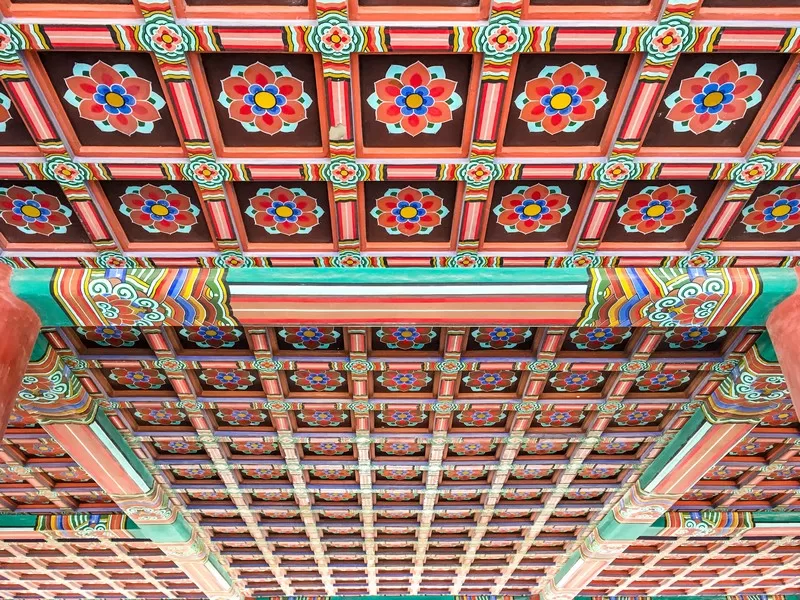
Like many historic wooden structures in Korea though, the pavilion you see today isn’t the original. Bosingak has been damaged and rebuilt repeatedly over the centuries because of fires and war. The pavilion has also been known by several names, including Jongnu, Jonggoru, Jonggak, and Ingyeongjeon. The pavilion was officially named Bosingak in 1895 during the reign of King Gojong. The current pavilion dates to 1979.
It can get confusing: The Bosingak bell-ringing tradition dates to 1396, the historic bell associated with Bosingak dates to 1468, the pavilion standing today dates to 1979, and the bell visitors ring today dates to 1985.
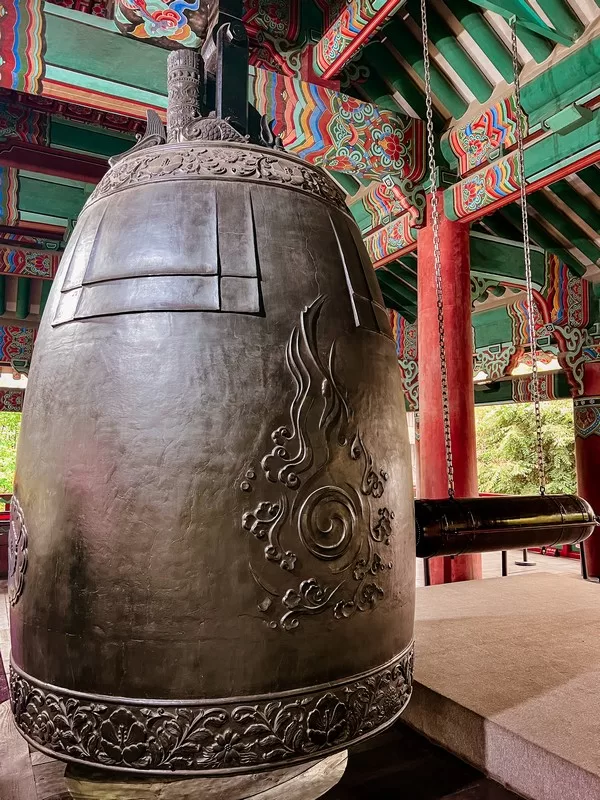
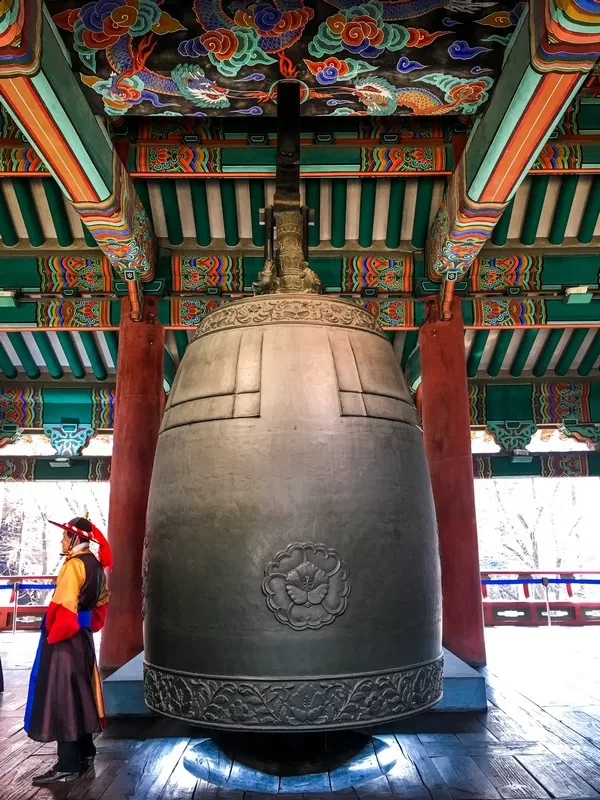
Is The Bell At Bosingak The Original Bell?
No, and this is another interesting piece of the story. Though the bell began tolling in the morning and night from 1396, the bell that’s actually most associated with the belfry was cast in 1468. Even more interesting, it wasn’t originally made for Bosingak. Backing up for a moment, the original belfry and the original bells were repeatedly damaged due to fire in the early years.
The bell that eventually came to define Bosingak was actually created for Wongaksa Temple, an important Buddhist temple that once stood around what is now Tapgol Park. After the temple was closed and dismantled, the bell was left deserted on the site. It was moved to Namdaemun, then moved to Myeongdong, and then finally moved to Unjongga Street (today’s Jongno Sageori).
After centuries of use, preservation became a concern and that old bell was removed from Bosingak in 1985 and replaced with the bell you see hanging there today. The replacement bell was first rung on August 15, 1985, commemorating the 40th anniversary of Korea’s liberation.
Did you know? You can still see the historic Bosingak Bell if you know where to look though. Today, the 1468 bell is preserved at the National Museum of Korea in Yongsan. The bronze bell stands approximately 3.18 meters tall, measures about 2.28 meters across at its mouth, and weighs almost 20 tons.
Bosingak Bell History at a Glance
| Year | What Happened |
|---|---|
| 1396 | Bell ringing begins in early Joseon to signal the opening and closing of Hanyang’s gates. |
| 1468 | The historic bronze bell is cast for Wongaksa Temple. |
| 1619 | The Wongaksa bell is moved to the bell tower on today’s Jongno. |
| 1895 | The bell tower receives the name Bosingak. |
| 1979 | The current Bosingak pavilion is reconstructed. |
| 1985 | The historic bell is retired and a new Bosingak Bell begins ringing. |
What To Do Near Bosingak Bell in Jongno
One of the reasons Bosingak is so easy to add to a Seoul itinerary is its location. You’re right in the middle of Jongno, so you definitely don’t need to make an entire day out of visiting the bell. Book the noon experience and build it into a day exploring this part of downtown Seoul.
Bosingak sits between several of downtown Seoul’s most popular areas, making it easy to combine with Jongno, Insadong, Jogyesa Temple, Cheonggyecheon Stream, or Gwanghwamun.
The Seoul Itinerary Pack – 15 Seoul Itineraries
$25.00
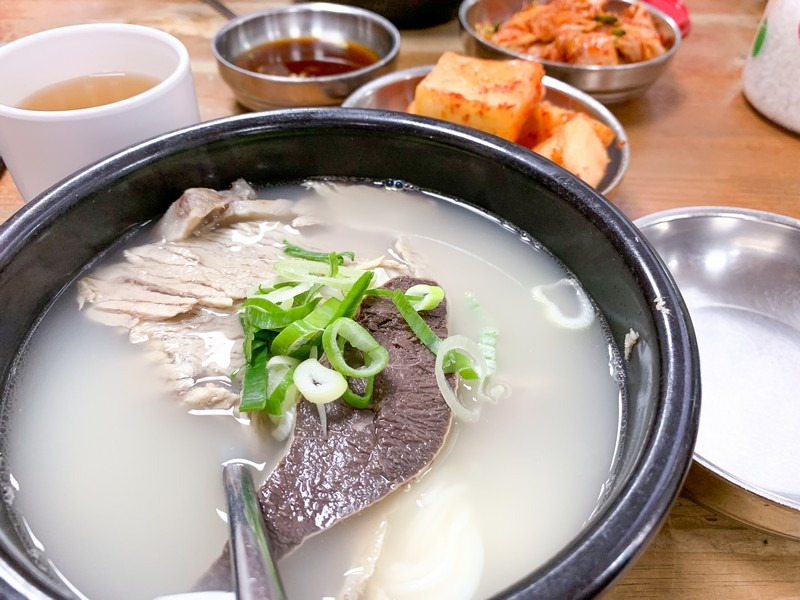
Hungry after ringing the bell? Cross the street headed north and you’ll find Imun Seolleongtang, the oldest restaurant in Seoul. Opened in 1904, it was the first restaurant licensed by Seoul City. The seolleongtang has a thinner broth than some other places but really hits the spot. We’ve eaten here numerous times.
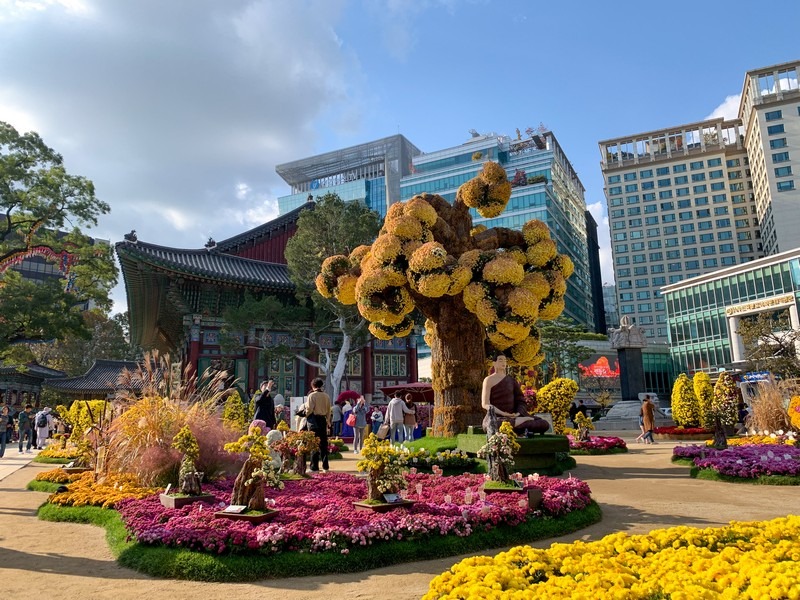
Keep heading up the street and you’ll find the famous Jogyesa Temple, one of the most important Buddhist temples in Seoul. Originally founded in 1395, the temple was originally named Gakhwangsa Temple but was founded as Jogyesa Temple in 1910, the very year Korea was brought under Japanese colonial rule.
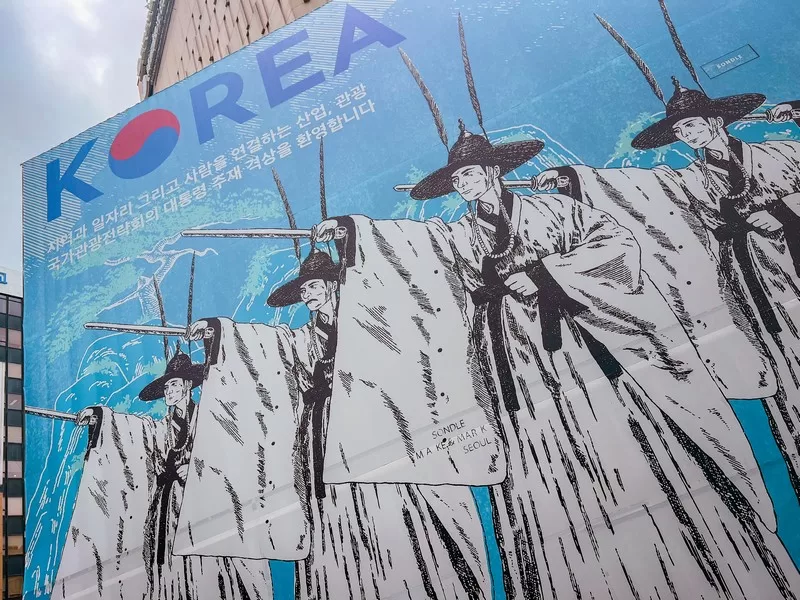
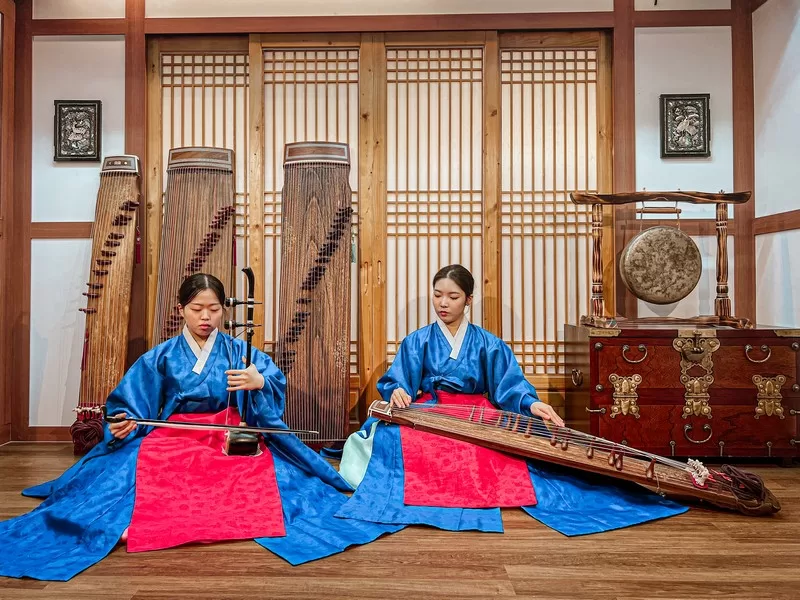
From there, cross the street toward Insadong for traditional crafts, tea houses, galleries, and souvenirs. There are some great experiences to be had here as well like carving your own dojang, or a Korean name stamp, or watching a performance.
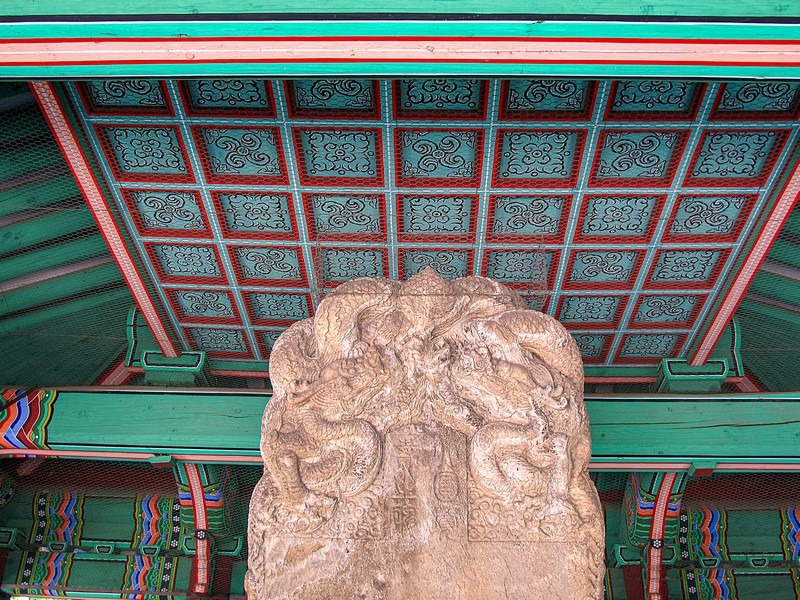
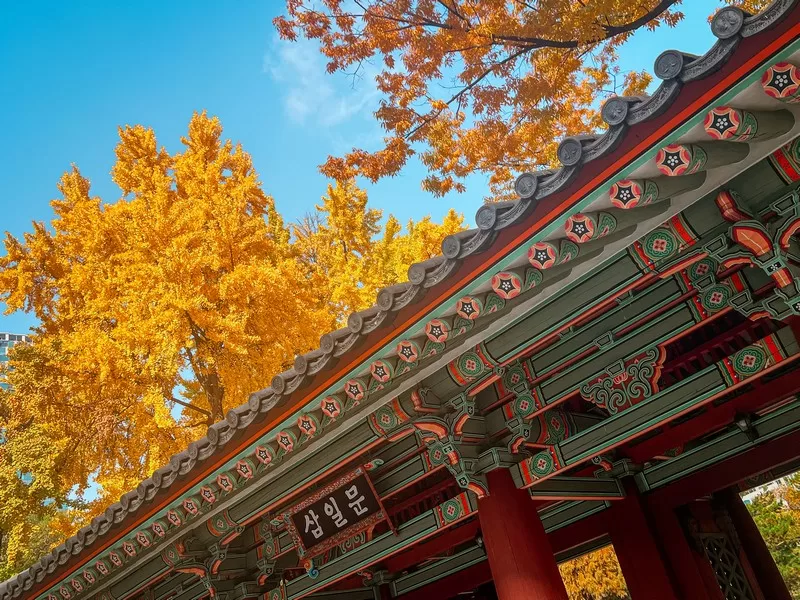
For a historical continuation of the Bosingak story, walk about 10 minutes east to Tapgol Park. The 1468 bell now associated with Bosingak was originally made for Wongaksa Temple, which once stood on the site. You can still see temple remnants in the park, but it is now also famous as in 1919 on March 1st, college student Chung Jae-yong read Korea’s Declaration of Independence and it set off proclamations of Korean independence around the country which resulted in a year of 1500 protests.
Is Ringing The Bosingak Bell Worth It?
Yes. I’ve done it three times, and I would absolutely recommend it to visitors who want to experience something in Seoul beyond simply seeing the major tourist attractions. You can visit a lot of palaces and older buildings in Korea, but you won’t be able to touch anything. Here, you actually get to take part in a bell-ringing tradition that dates back to 1396.
Bosingak itself isn’t hidden. It’s sitting right there on one of the busiest roads in downtown Seoul and yet people don’t realize they can actually experience this place. Thousands of people pass it every day. Most people don’t realize they can climb into the pavilion. They don’t realize they can stand beside the bell. And they definitely don’t realize they can help ring it at noon. That’s what I love about experiences like this in Seoul.
FAQ
Can tourists ring the Bosingak Bell?
Yes. International visitors can participate in the citizen bell-ringing program. Advance reservations and designated foreign visitor walk-in days are available depending on the current schedule.
How much does it cost to ring the Bosingak Bell?
The experience is free.
What time does the Bosingak Bell ring?
The regular citizen ceremony begins at noon. Participants with reservations should arrive by 11:40am.
Is the Bosingak Bell the original bell?
No. The bell currently hanging at Bosingak dates to 1985. The historic 1468 bell is preserved at the National Museum of Korea.
Do I need to speak Korean to ring the Bosingak Bell?
No, but be prepared for the experience to run mostly in Korean. The reservation confirmation call the day before comes in Korean, and the ceremony itself is generally conducted in Korean. That said, staff have been known to switch to English on the spot for visitors who don’t have anyone to translate, so don’t let the language barrier keep you from showing up.
What should I wear to ring the Bosingak Bell?
There’s no dress code, and you don’t need to remove your shoes to go up into the pavilion.
Is Bosingak wheelchair accessible?
The second floor of the pavilion, where the bell-ringing takes place, is only reachable by stairs. There’s no elevator.
Do I sign up alone or with a group?
“Team” simply means your own party. On regular reservation days there are only two slots total, so if you sign up solo, you’re the only visitor ringing the bell alongside the staff member guiding you, no strangers are added to your slot. On the Tuesday/Wednesday foreign walk-in days, solo visitors may be grouped with other walk-ins to fill out a team.
How do walk-ins sign up on-site?
Look for a sign posted in front of Bosingak with a QR code, that’s how on-site walk-in registration is handled, so have your phone ready.
Is the Bosingak Bell the same bell used for Seoul’s New Year’s Eve countdown?
Yes. It’s the same bell and the same belfry. On New Year’s Eve, it’s struck 33 times at midnight instead of the usual 12 strikes at noon, drawing tens of thousands of spectators to the surrounding streets.
Did you like this post? PIN IT!