How To Set the Jesa Table for Seollal and Chuseok
Last Updated on October 13, 2026
Seollal (설날) and Chuseok (추석) are among the most important holidays in Korea. The three-day holiday sends more than half the country traveling to their hometowns. Once families arrive, preparations begin, if they haven’t started already, for jesa (제사), the ancestral memorial ceremony held at dawn.
I’ve written a separate guide on how to conduct the jesa ceremony itself. This article covers the table setting specifically, the spatial rules, what goes where, and the placement logic that families debate every year.
Here’s what you’ll find in this post:
(This post contains affiliate links, which means I receive a certain percentage of a sale if you purchase after clicking at no cost to you. Thank you for your support.)
What’s the Difference Between Charye and Jesa?
Foreigners often confuse the terms charye (차례) and jesa (제사). Jesa is the broad term for any ancestral memorial ceremony. Several distinct types fall under it:
- Charye (차례): Held on major holidays, Seollal and Chuseok. A simplified form of ancestral rites, with a single offering of wine (단잔/danjang) and no formal prayer text read aloud. The abbreviated nature is intentional: charye was designed to allow families to honor ancestors on holidays without the full ceremonial complexity of gijesa.
- Gijesa (기제사): Held once a year on the anniversary of the death of the person being honored. More formal than charye — wine is offered three times in sequence (삼작/samjak: first, second, and final offering), and a formal prayer text (축문/chukmon) is read aloud. This is the full memorial ceremony.
- Sije (시제): Held every season.
- Myoje (묘제): Held at the grave.
What most foreigners encounter, and what this guide focuses on, is charye, the holiday ceremony held at Seollal and Chuseok.
Families gather to partake in a charye (차례) ceremony on Seolla and Chuseok which is what most foreigners might recognize from tv shows or their own multicultural homes. This ceremony may honor paternal family members up to four generations back, though in 1973 in an effort to reduce the amount of money being spent on rituals the government recommended that families honor just two generations back.
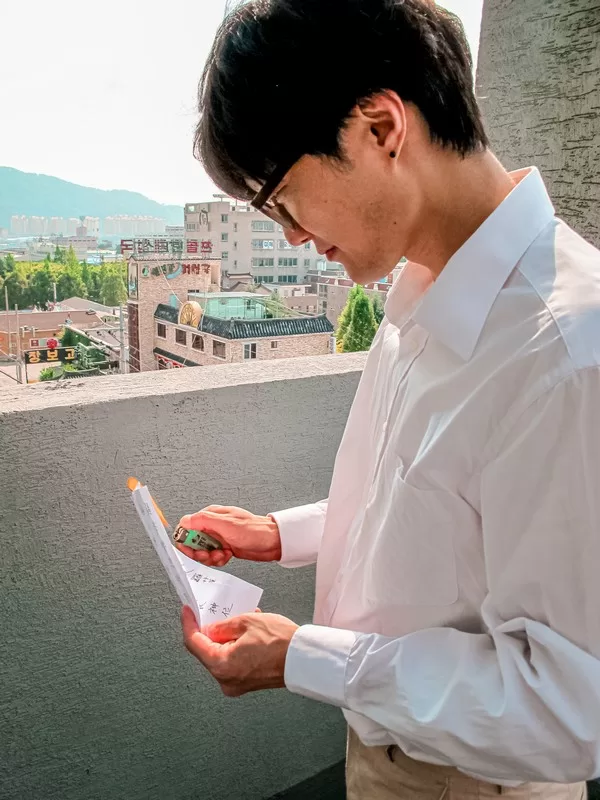
These ceremonies are passed down among the male heirs of the family so, my husband will honor his father and grandfather and so on in his household whereas his sister will honor her husband’s father and grandfather and so on. This can be a bit more confusing when there is no male heir in a household and then in the simplest terms, it would skip over to the closest male be it a cousin or uncle, etc.
That’s extremely simplified though, there would be a bit more information necessary to figure out which household would need to honor the family then. Jesa is a way to thank our ancestors for what we have received and to remember them at the same time.
Let’s Talk Table Setting!
The table setting varies from region to region and family to family, but there are some basic rules that are followed everywhere. Much like with the ritual itself, I want to remind readers that you don’t need to get too bogged down in the specifics and necessities to actually hold this memorial ceremony.
Remember that this ceremony is meant to honor our ancestors so if you can’t find some specific food, that’s okay. Set the table with what you have and your ancestors will appreciate it.
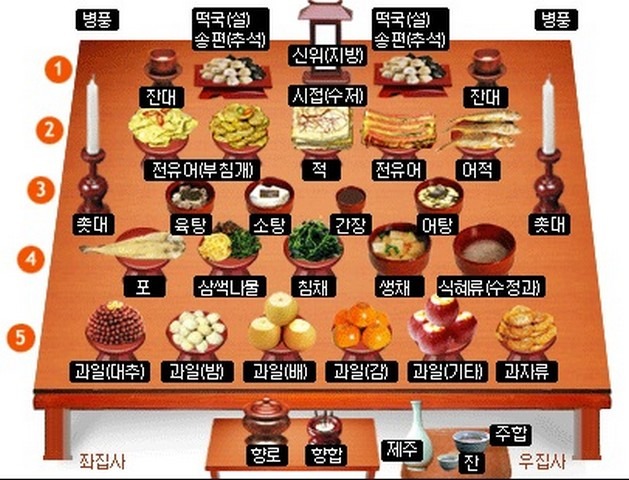
The Screen, Table, & Shinwi
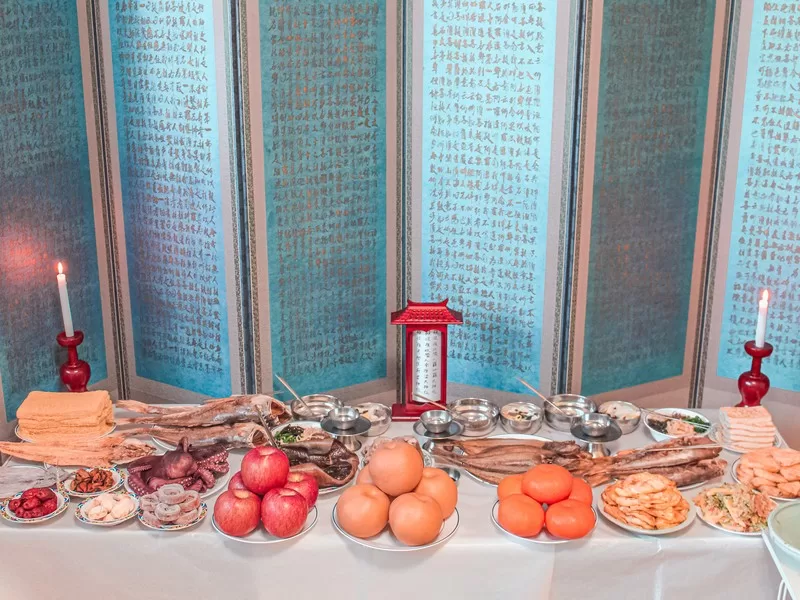
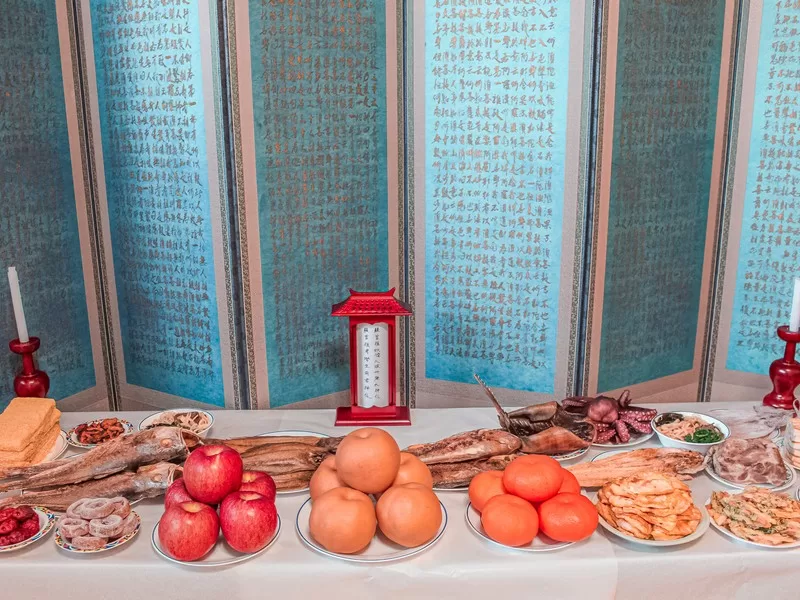
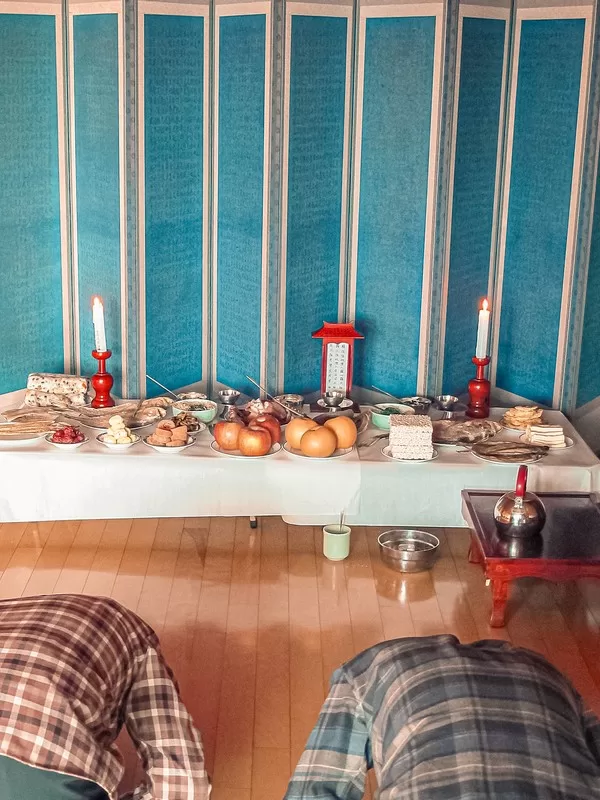
To begin, set up the screen to the north and then the table will be placed in front (to the south) of it. The north is the direction for the dead and the direction they are usually buried in Korea. If you’re in a multicultural marriage like me, you may have had your Korean partner tell you that you cannot place your bed with the head end to the north. This is why.
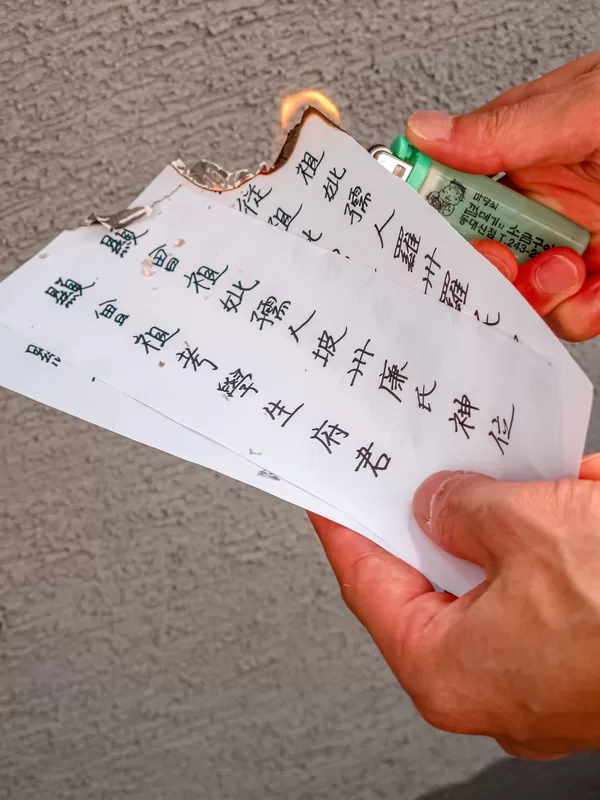
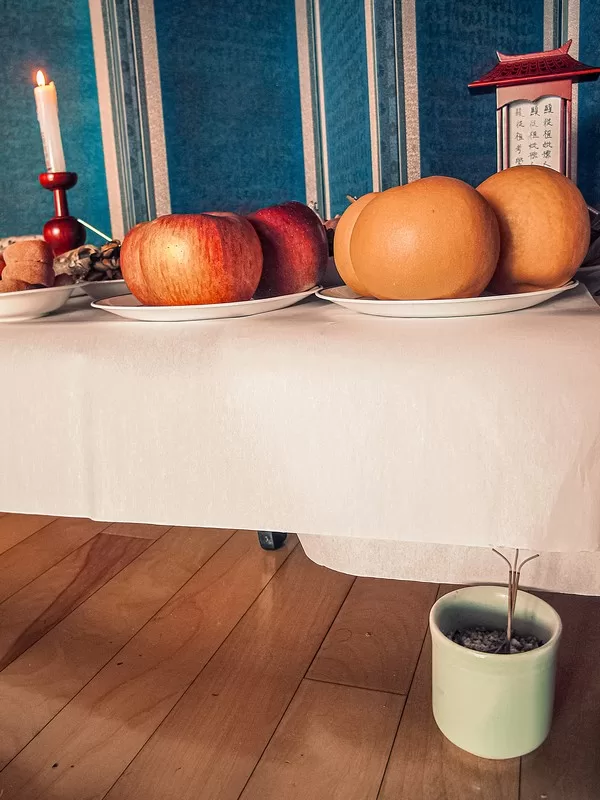
On the side of the table closest to the screen, the shinwi (신위), which is the “spiritual body” of the ancestors, namely a piece of paper with their names written in Chinese characters, sits in the center with candles flanking it. The shinwi can take different forms.
For us, we have a tablet that paper is slipped into with the names written in Hanji. Since we go through three rounds of ancestors, the paper is put in and another replaced three times during our ceremony. These days, many families are opting to have portraits of ancestors on the table instead of the small tablet with names.
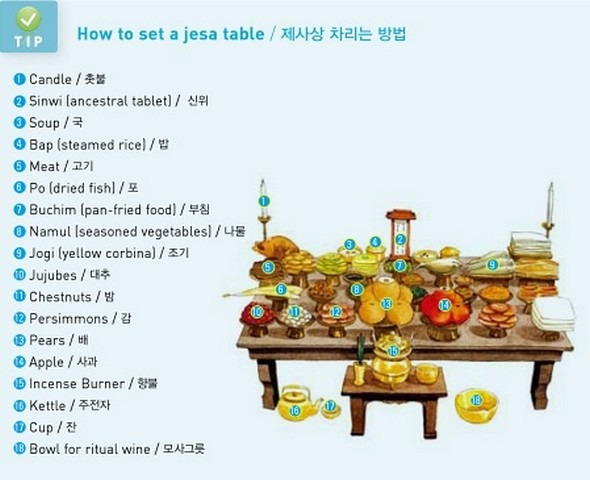
Row 1: Fruits & Desserts
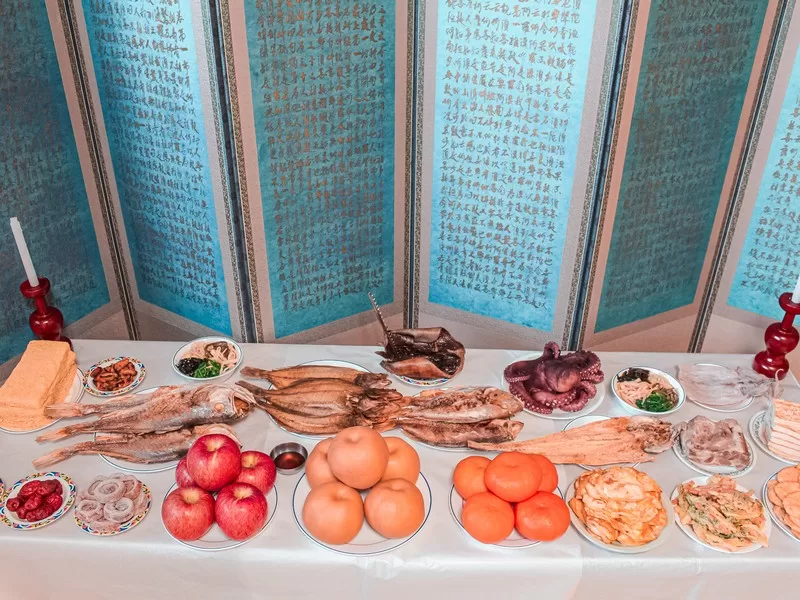
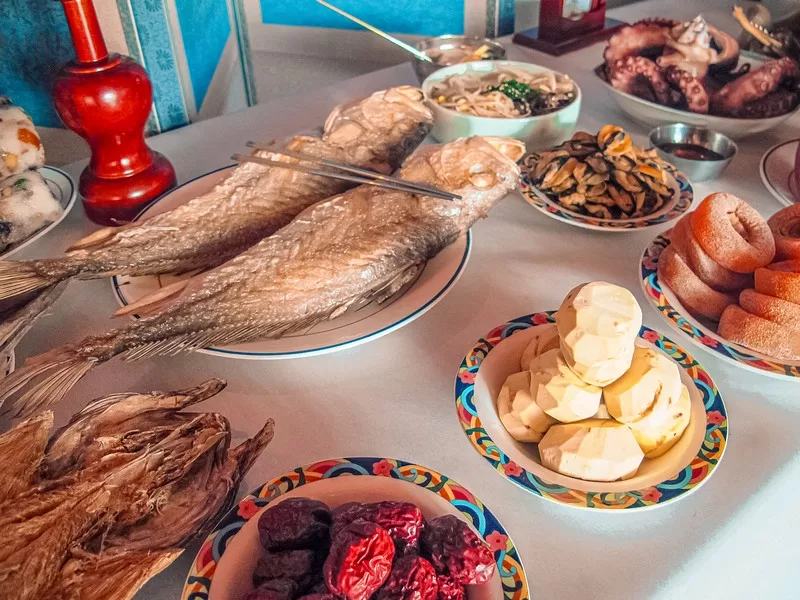
In the first row of food closest to the living who would be sitting opposite the ancestors, there would be fruits and desserts. Commonly, dates, apples, Korean pears, chestnuts, persimmons and jujubes may be placed in the front row but don’t just place them willy-nilly.
The placement rule: Red foods on the east end of the table, white foods on the west (홍동백서). Apples on the east with the jujubes; Korean pears on the west.
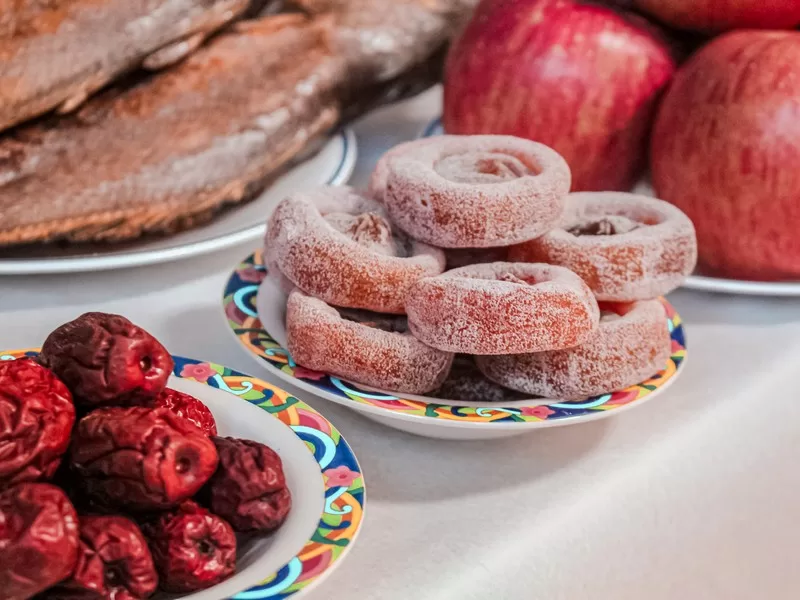
Yakgwa (약과) and other cookies or desserts can go in the front row as well, their color determines placement.
In our family a few years ago, a debate arose over the apple. The outside is red, but the inside is white. After discussion, placing the apples more centrally seemed appropriate. This story is the best illustration I have for what table-setting in a Korean family actually looks like: there are rules, and then there are the conversations.
A note on the scholarly order (Jo-Yul-Si-Yi / 조율시이): Some scholars hold that the front row should follow a specific seed-symbolism order: jujube (대추/jo) with one seed representing the king; chestnut (밤/yul) with three seeds representing the three prime ministers; persimmon (감/si) with six seeds representing the six officials; pear (배/i) with eight seeds representing the eight provincial governors. Not every family follows this, but it’s worth knowing it exists.
Row 2: Meat & Vegetables
The second row, behind the fruit, contains dried fish, cooked or fermented vegetable side dishes (namul), tofu, and seafood, cod, squid, and other fish are common depending on the region.
According to eudongyukseo (어동육서), fish goes on the east while meat goes in the west. However, these are not strictly fixed rules and there can be variations depending on the region or family.
If a whole fish with a head is placed on the table, the head faces east and the back faces south, so that the fish appears right-side-up to the ancestors looking from the north (두동미서).
Note: Fish like mackerel (꽁치), anchovy (멸치), hairtail (갈치), or tuna (삼치) wouldn’t be used because they end in the syllable chi (치).
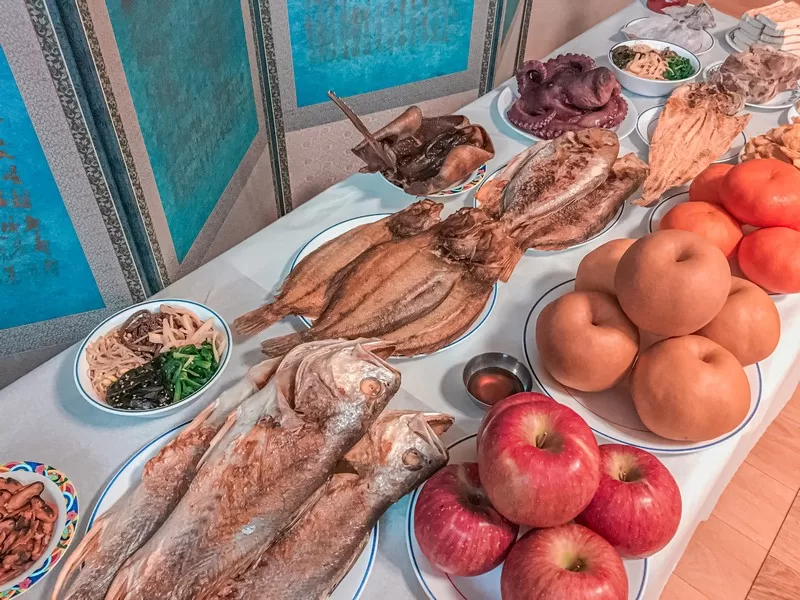
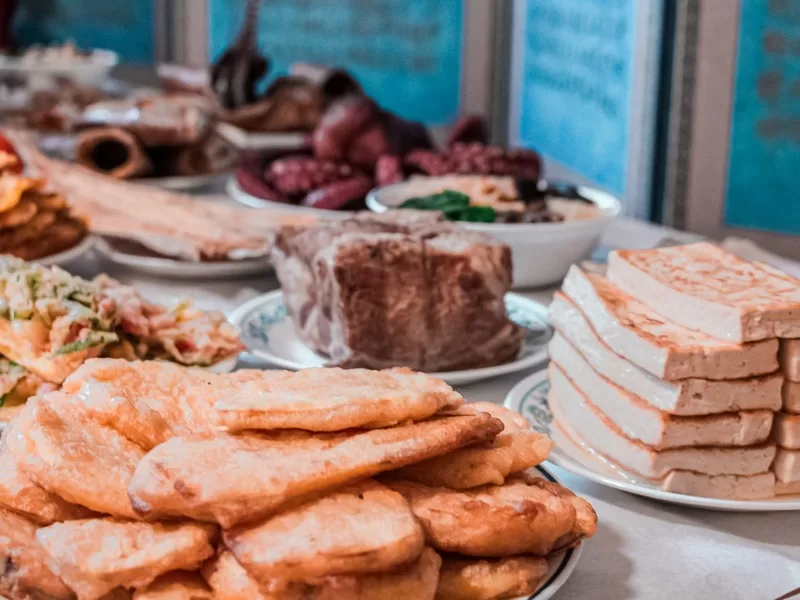
Again, red foods would be on the east so that would include most meat while white foods, which include fish would be on the west end of the table. How much meat or fish is on the table varies widely among the regions of Korea. In our house, for example, we have more fish on our table because my husband’s family is from a coastal area. My friends in the north usually have more meat dishes on their table instead.
Row 3: Soups & Rice
The final row on the table, closest to the ancestors contains a bowl of rice and a bowl of soup for each ancestor being honored. The bowls of rice should be piled high to look like a mound over the top of the bowl. The rice bowl should sit on the west side of the rice on the east side, so the rice should be on the left with the soup on the right when you look at it so it is correct if the ancestors were looking at it.
The table can have as few as two or three rows of food or as much as five or six as again, it is up to the family and it depends on the size of the table. We have a long table but if you have a shorter wider table then you’ll probably have more rows of food.
Note: Generally as a rule, foods for ancestral rites should avoid being too salty, spicy, or use flashy colors and they shouldn’t have red pepper powder or garlic.
Cheongju & Incense
Once the table has been set, and possibly a discussion with a few members in your house as to whether or not everything is correct as often happens in my husband’s house, a smaller table is set up in front of the altar of food. Cheongju (청주), similar to a sake, is placed on that table to be used during the rite.
Also necessary to begin is incense and an incense bowl packed with sand which is placed on the floor just in front of the altar table.
FAQ
What is jesa?
Jesa (제사) is the broad Korean term for ancestral memorial ceremonies. It encompasses several types including charye (holiday ceremonies at Seollal and Chuseok), gijesa (annual death anniversary ceremonies), sije (seasonal ceremonies), and myoje (grave ceremonies).
What is charye?
Charye (차례) is the simplified ancestral ceremony held on major Korean holidays, Seollal (Lunar New Year) and Chuseok (Korean Thanksgiving). It differs from gijesa in that wine is offered only once (단잔), no formal prayer text is read aloud, and the procedure is abbreviated. It honors multiple generations of paternal ancestors simultaneously.
What goes on the jesa table?
Fruits and desserts in the front row (red foods east, white foods west); dried fish, vegetables, tofu, and meat in the middle rows; rice and soup for each ancestor in the back row closest to the shinwi (ancestral tablet). Cheongju (rice wine) and incense are placed separately.
What direction does the fish face on a jesa table?
Fish head faces east, tail faces west (두동미서 / dudong-miseo), so that it appears right-side-up to the ancestors looking from the northern side of the table.
What foods are not allowed on the jesa table?
No red pepper powder or garlic. Avoid overly salty, spicy, or brightly colored foods. Fish with names ending in the syllable chi (치) are traditionally excluded: mackerel (꽁치), anchovy (멸치), hairtail (갈치), tuna (삼치).
Does the jesa table have to be exact?
No. Placement rules vary by region and family, and most Korean families debate the specifics every time. The most important thing is the ceremony and the intention behind it. If a specific food isn’t available, set the table with what you have.
If you’re interested in trying to the traditional Jesa food but don’t have time to wait until Seollal or Chuseok, there are actually restaurants that serve Jesa meals year round. This meal, called heotjesabap, originated in Andong, Korea and if you visit that city you can find restaurants serving up some great Jesa food and then go and visit the Andong sites.
Now the table has been set, you’re ready to honor the ancestors that came before you.
Happy Seollal, or Lunar New Year!
새해복 많이 받으세요.
(Sae-hae bok manhi ba-deu-sei-yo)
Did you like this post? Pin It!

8 Comments
Syang
What happens to the food afterwards?
Hallie
We eat it! ^^
isabelle
the people at the jesa will split it up and take it home
Will
Amazing. Such a ritual deserves such intricacy. Well done.
Hallie
Thanks Will. And just think, that’s just the set up for the ritual. The ceremony itself is even more complex with the order and what to remember to do in my opinion.
Will
I know, I just help make some food the night before and sleep through the ceremony as quietly as I can so as not to disrupt the ancestral rites.
Kang Ju-won (강주원)
When I was young, I thought it was a hassle. But now, it’s kind of touching because you are making efforts to remember and act as if your loved ones are alive (even if for one day).
Hallie
Yeah. I’ve always had students that complain about the traveling and women that complain about the prep but the tradition and time together is really special I think.