Arirang Meaning: Korea’s Folk Song and Its Many Versions
Last Updated on October 14, 2026
Arirang is Korea’s best-known folk song, often called the country’s unofficial national anthem. Honestly, whenever I try to remember the national anthem, Arirang always comes out first. And every time I hear it, it’s the same song, so boy was I surprised when I found out Arirang isn’t one song at all, it’s a whole family of songs. UNESCO cites roughly 3,600 variations belonging to about 60 versions in South Korea. They share a refrain built around the word “arirang” but change from region to region, singer to singer, and era to era.
This guide covers what Arirang means, the lyrics everyone knows, how the regional versions differ, the surprising history behind the song, why BTS named their 2026 album after it, and where you can hear the old versions for free in Seoul.
Arirang is a song that evokes deep feeling in Korea and this guide will help you understand why:
- What Is Arirang?
- What Does the Word Arirang Mean?
- The Arirang Everyone Knows
- The Arirang Family Tree: From Mountain Song to Movie Theme
- How Many Versions of Arirang Are There?
- Arari: The Mountain Song Behind Arirang
- The Three Great Arirangs: Jeongseon, Miryang, and Jindo
- How to Tell Arirang Versions Apart: Listen to the Refrain
- Is Arirang a Sad Song?
- A Short History of Arirang
- Arirang and BTS: Why the Album Is Called Arirang
- Experience Arirang in Korea & Online
- FAQ
(This post contains affiliate links, which means I receive a certain percentage of a sale if you purchase after clicking at no cost to you. Thank you for your support.)
What Is Arirang?
Arirang (아리랑) is a Korean folk song tradition rather than a single composition, though you’d be forgiven for thinking it was just one song. Every version shares the simple, singable refrain “Arirang, arirang, arariyo”, followed by verses that anyone can change or invent. Those verses cover love, parting, hard work, homesickness, humor, and history, which is why Arirang has been sung in rice paddies, on protest lines, in stadiums, and by Koreans living all over the world.
In fact, the refrain is the only thing that makes a song an Arirang. Melodies, rhythms, and lyrics vary enormously, but if the chorus repeats “arirang” or “arari,” it belongs to the family.
When South Korea designated Arirang as national intangible heritage in 2015, it was the first time the country had to designate a tradition without naming a master or group to hold it, because Arirang simply belongs to everyone who sings it. The law was changed to make that possible. That’s such a unique thing to consider.

| Korean name | 아리랑 (Arirang) |
| What it is | A family of Korean folk songs sharing an “arirang” or “arari” refrain |
| Number of versions | About 3,600 variations in roughly 60 versions (South Korea, per UNESCO); 36 versions documented in North Korea |
| Root song | Arari (아라리), a folk song of mountainous Gangwon-do |
| Oldest surviving form | Jajin-arari, according to most music historians |
| Most famous version | Bonjo Arirang (본조아리랑), arranged by Na Woon-gyu for his 1926 film Arirang |
| Main musical types | Eight: Gin-arari, Jajin-arari, Yeokkeum-arari, Gin Arirang, Gujo Arirang, Bonjo Arirang, Miryang Arirang, Jindo Arirang |
| Three great regional Arirangs | Jeongseon (Gangwon-do), Miryang (Gyeongsangnam-do), Jindo (Jeollanam-do) |
| First written in Western notation | 1896, by American missionary Homer Hulbert |
| First known recording | July 24, 1896, Washington, D.C., by ethnologist Alice C. Fletcher |
| UNESCO Intangible Cultural Heritage | 2012 (South Korea) and 2014 (North Korea) |
| Korean national intangible heritage | Designated September 2015, with no single designated master or group |
| Where to hear it in Seoul | Seoul Museum of Korean Folk Music (free), across from Changdeokgung |
Fun fact: Arirang is built into the national school music curriculum in Korea. Children learn Bonjo Arirang and its drum rhythm in elementary school, play it on the danso (a bamboo flute) a couple of years later, move on to Jindo, Gangwon-do, and Haeju Arirang in middle school, and tackle the tongue-twisting Yeokkeum-arari in high school, sometimes writing their own verses. One of the most unique experiences I’ve had in Korea was learning to play the Arirang on the gayageum. It’s everywhere.
What Does the Word Arirang Mean?
Probably nothing, at least not literally. Most Korean music scholars today think “arirang” and “arari” are vocables, or syllables sung for their sound rather than their meaning, much like “fa la la” or “na na na” in English songs. Korean folk songs are full of them, and some researchers trace this habit back to the refrains of Goryeo dynasty songs.
A second scholarly theory focuses on “ari.” In Gangwon-do, many folk song titles contain the word (Gin-ari, Jajin-ari), and some researchers believe “ari” simply meant a folk song, a sung “sori.”
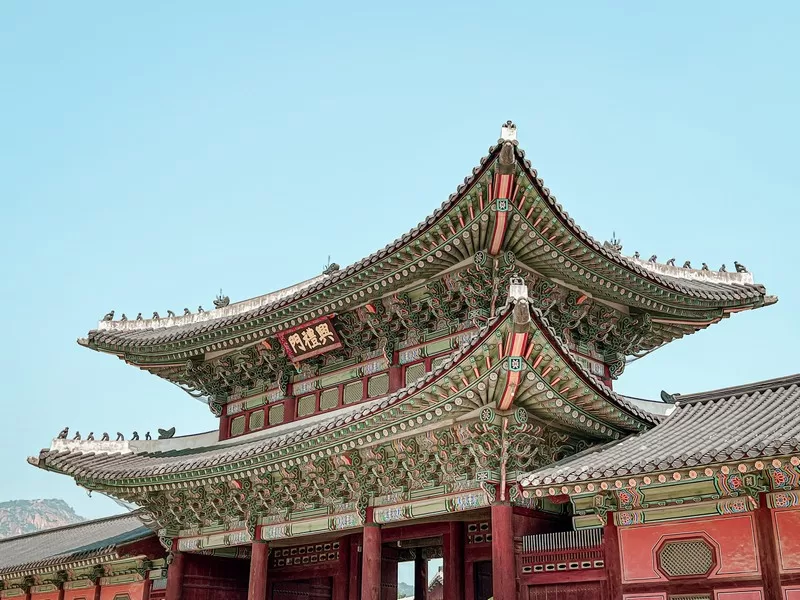
Then there are the folk etymologies, which are wonderful stories but may not really be the historical fact we’re looking for. One links Arirang to Aryeong, the queen of Silla’s legendary founder. Others date to the 1860s rebuilding of Gyeongbokgung Palace, when heavy taxes and forced labor supposedly inspired puns written in Chinese characters: “I wish I were deaf” (我耳聾, airong) for wealthy families hounded for donations, and “I am parted from my loved ones” (我離娘) for conscripted laborers. In Miryang, people connect the name to the legend of Arang. None of these has evidence behind it though make for great storytelling, which really goes hand in hand with folk songs so you’ll likely hear one of these tales if you ask a local where Arirang came from.
One thing everyone does agree on though is the image of “Arirang gogae” (Arirang Pass), a mountain crossing that may or may not be a real place. In most songs, it’s the threshold someone crosses when they leave you, and more broadly the hard stretch of life you have to get over.
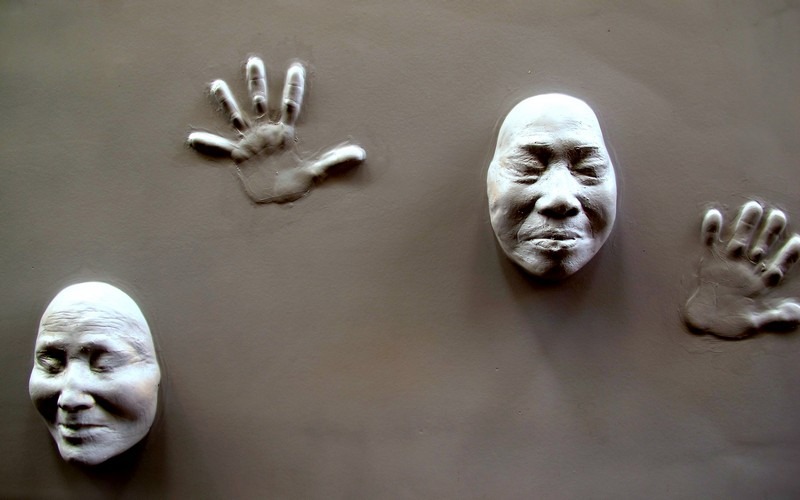
Arirang’s power shows most clearly in the people who held onto it. The National Folk Museum’s 2012 exhibition told the story of Lee Nam-i (1924 to 2001), known as “Grandmother Hun,” who was forced into the Japanese military’s sexual slavery system during the colonial period and spent decades in Southeast Asia before returning to Korea. By then she had lost her Korean language, but she could still sing Arirang. It’s an example of what many diaspora talk about, grandparents abroad who forgot nearly everything except this melody.
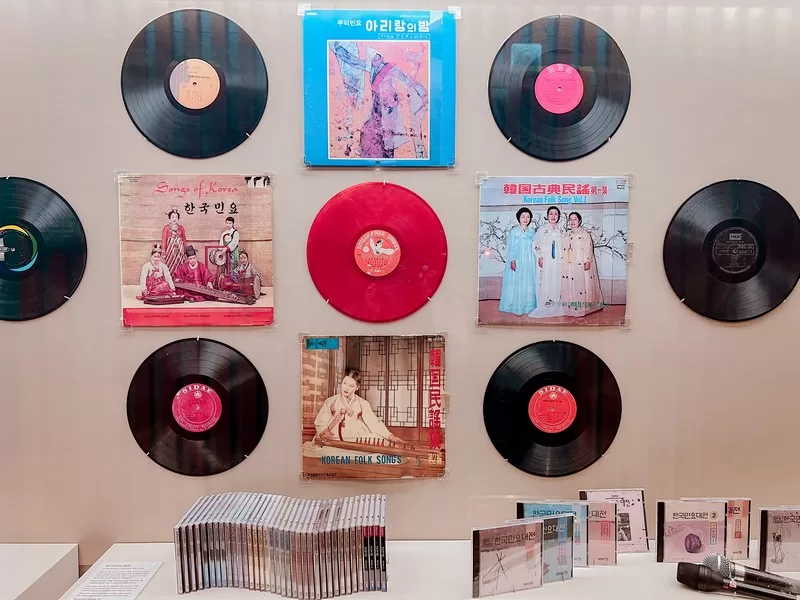
The Arirang Everyone Knows
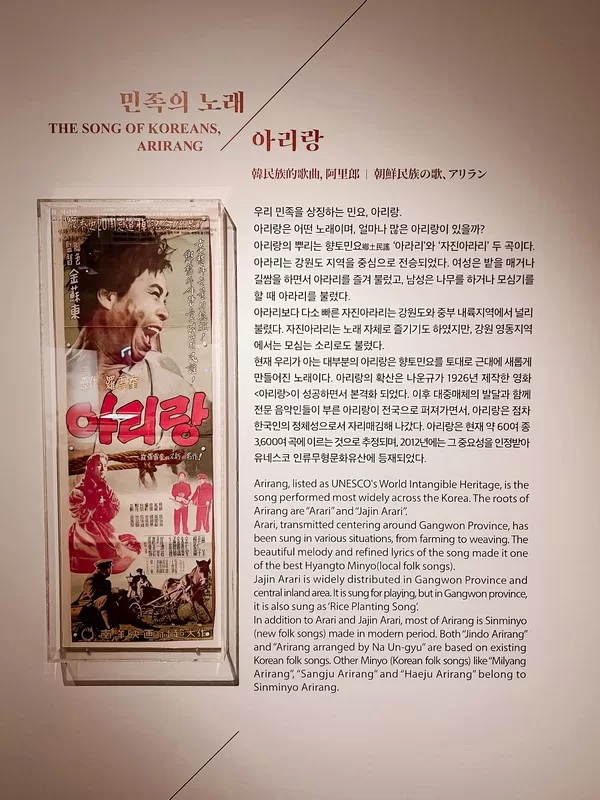
The version most people recognize is Bonjo Arirang (본조아리랑), also called “Movie Arirang” or “Seoul Arirang.” Director Na Woon-gyu arranged it from an older Seoul folk song for his 1926 silent film Arirang, and the film’s success made it the national standard.
| Hangul | Romanization | English |
|---|---|---|
| 아리랑 아리랑 아라리요 | Arirang arirang arariyo | Arirang, arirang, arariyo |
| 아리랑 고개로 넘어간다 | Arirang gogaero neomeoganda | (You are) crossing over Arirang Pass |
| 나를 버리고 가시는 님은 | Nareul beorigo gasineun nimeun | My love, who leaves me behind |
| 십리도 못 가서 발병 난다 | Simnido motgaseo balbyeong nanda | Won’t walk ten li before your feet start to ache |
Ten li stands for roughly four kilometers, about two and a half miles, so the singer is saying, half bitter and half pleading, that their departing love won’t get far. It also reads as a call to come back before you’ve gone ten li, and all is forgiven.
“Bonjo” literally means “original tune.” But Bonjo Arirang is actually the newer version which is an interesting detail in the history of Arirang. The older Seoul version it replaced was renamed “Gujo Arirang” (구조아리랑), or the “old tune,” once the movie version took over.
Because the 1926 film was screened with a Western-style theater orchestra, the song was also nudged toward Western music, closer to a waltz-like three-beat feel and a major key. That hybrid quality is a big reason it travels so easily and why it’s the version foreigners, and school textbooks, learn first. Here in Korea, I’ve heard it picked up a bit but at times it’s been so slow it makes you stop and consider each note and really listen to how the singer has chosen to share the story. It’s easily adaptable that way.
The Arirang Family Tree: From Mountain Song to Movie Theme
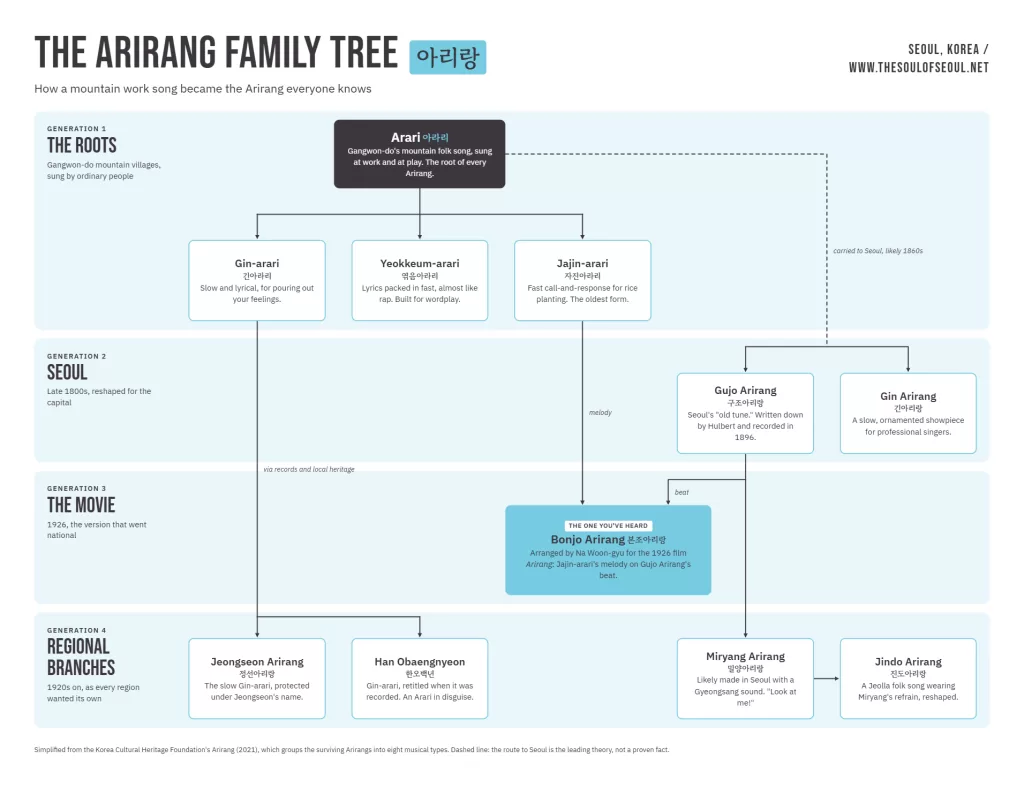
Researchers now group the surviving Arirangs into eight musical types, and they connect roughly like this.
1. Arari in the Gangwon-do mountains. The root of it all. Arari came in three forms (slow Gin-arari, fast Jajin-arari, and the rap-like Yeokkeum-arari), sung by ordinary people with no professional performers involved.
2. Gujo Arirang in Seoul (late 1800s). Arari reached Seoul and was reshaped to fit Seoul’s dialect and musical style. Seoul developed its own fast version (Gujo Arirang) and a slow, highly ornamented showpiece for professional singers (Gin Arirang). Gujo Arirang is the song Homer Hulbert wrote down in 1896, and it’s what the Korean students sang on the 1896 wax cylinders.
3. Bonjo Arirang (1926). Na Woon-gyu said he adapted a song he’d heard from laborers. Musicologists comparing the melodies think Bonjo Arirang combines the melodic shape of Jajin-arari with the beat structure of Gujo Arirang.
4. Regional Arirangs (1920s to 1930s and beyond). As the movie song swept the country, every region wanted its own. Towns from Busan to Ulleungdo, Jeongeup to Gurye produced named Arirangs. Most faded. Miryang Arirang and Jindo Arirang survived, and record companies helped fix the names.
Fun fact: When Gangwon-do’s songs were recorded in Seoul, labels gave them regional titles to sell them. That’s how the slow Gin-arari became the hit “Han Obaengnyeon” (한오백년), a song many Koreans know without realizing it’s an Arari at heart.
How Many Versions of Arirang Are There?
South Korea’s UNESCO nomination estimated about 3,600 variations of songs titled Arirang, grouped into roughly 60 versions. North Korea’s UNESCO inscription refers to 36 known versions. A 2021 Korea Cultural Heritage Foundation study catalogued 126 different Arirang titles, but noted that only about 50 to 60 can be confirmed with actual recordings.
The numbers differ because each country counted its own documented traditions, and because “variation”, which means a new set of lyrics, and “version”, which means a distinct melody and style, mean different things.
Fun fact: The number is still growing. Korean communities in China and the former Soviet Union carry well over 100 Arirang songs of their own, mostly variants of the main types. Anyone can write new verses, and in Jeongseon people still publish books of newly composed Arirang lyrics.


Arari: The Mountain Song Behind Arirang
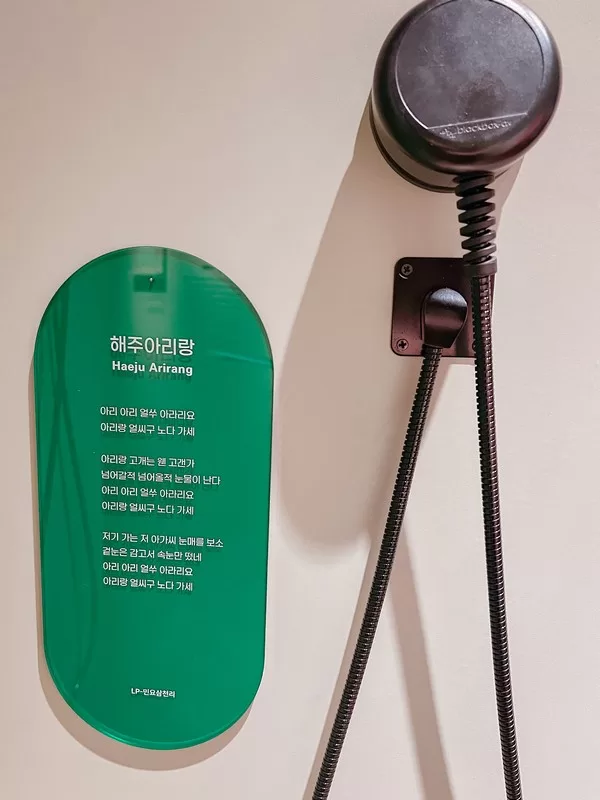
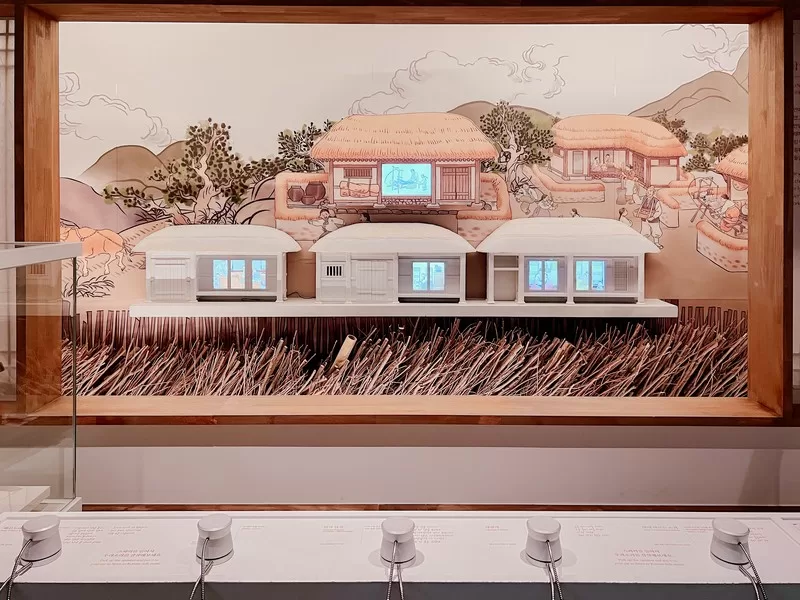
Before there was “Arirang,” there was “Arari” (아라리), a regional folk song of Gangwon-do’s mountain villages along the Taebaek range. People sang it while farming and working, and also at gatherings just for fun. Most researchers consider it the root of every Arirang that followed. The Seoul Museum of Folk Music groups Arari into three forms, and you can hear all of them at the listening handsets.
| Form | Korean | What makes it distinctive | Example in the exhibition |
|---|---|---|---|
| Gin-arari | 긴아라리 | Slow and unhurried; the best-known form | Jeongseon |
| Yeokkeum-arari | 엮음아라리 | Long lyrics packed tightly into the first half of the melody, then the same refrain as Gin-arari | Jeongseon |
| Jajin-arari | 자진아라리 | Faster; one person sings the verse and the group answers with the refrain, the way people sang while transplanting rice | Gangneung |



Musicologists consider Jajin-arari the oldest of all Arirangs, partly because of its rhythm, an alternating 3+2+3+2 pattern that matches the oldest Korean scores from the 1400s.
The Gin-arari plaque from Jeongseon includes one of my favorite verses in the whole exhibition. Where Bonjo Arirang threatens the departing lover with sore feet, this one asks, “Does the sun setting over the western hills set because it wants to? Do you, leaving me behind, go because you want to?” Same heartbreak, much gentler heart.
The Yeokkeum-arari verses, on the other hand, are more domestic. One describes a spouse who storms off, after salting the young radish kimchi and seasoning the cucumber kimchi, of course, and then turns back before even making it to Pyeongchang. The singer scolds them for coming home, and you can hear that she’s delighted. Another sends a husband over the winding Baekbongnyeong pass to buy salt in Gangneung and Samcheok, with a plea to come home safely.
The Three Great Arirangs: Jeongseon, Miryang, and Jindo
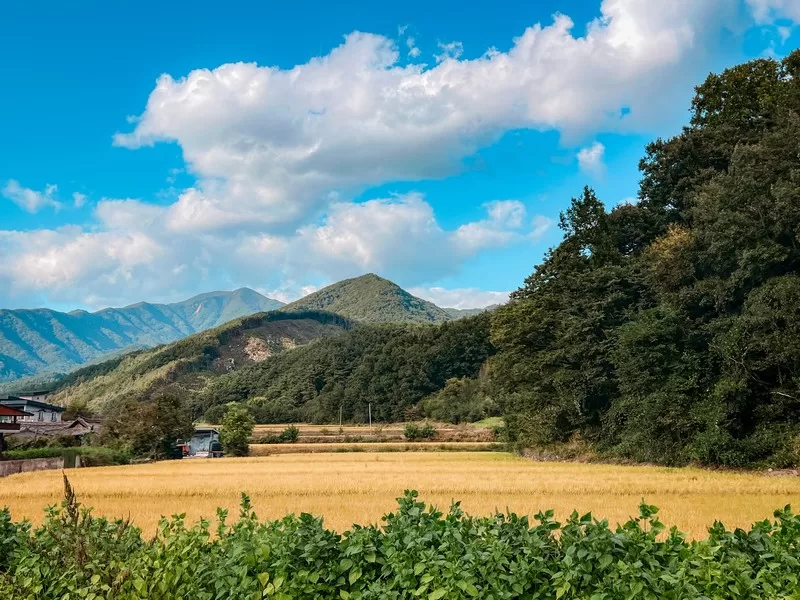
Koreans often refer to Jeongseon, Miryang, and Jindo Arirang as the “three great Arirangs” (3대 아리랑). Each is now protected as regional intangible heritage in its own province. Their backstories are more interesting than the names suggest.
| Jeongseon Arirang | Miryang Arirang | Jindo Arirang | |
|---|---|---|---|
| Korean | 정선아리랑 | 밀양아리랑 | 진도아리랑 |
| Region | Gangwon-do (mountains, northeast) | Gyeongsangnam-do (southeast) | Jeollanam-do (island, southwest) |
| Feel | Slow, plaintive, conversational | Bright, brisk, upbeat | Rich, ornamented, emotional, often humorous |
| Refrain | 아리랑 아리랑 아라리요 / 아리랑 고개 고개로 나를 넘겨 주게 | 아리아리랑 쓰리쓰리랑 아라리가 났네 / 아리랑 고개로 넘어간다 | 아리아리랑 쓰리쓰리랑 아라리가 났네 / 아리랑 응응응 아라리가 났네 |
| Signature lyric | “Does the one leaving me go because they want to?” | “Look at me, look at me, look at me (날 좀 보소)” | “Why is Mungyeong Saejae so winding? Every bend is tears” |
| Regional heritage status | Gangwon-do intangible heritage No. 1 (1971) | Gyeongsangnam-do intangible heritage (2024) | Jeollanam-do intangible heritage No. 64 (2022) |
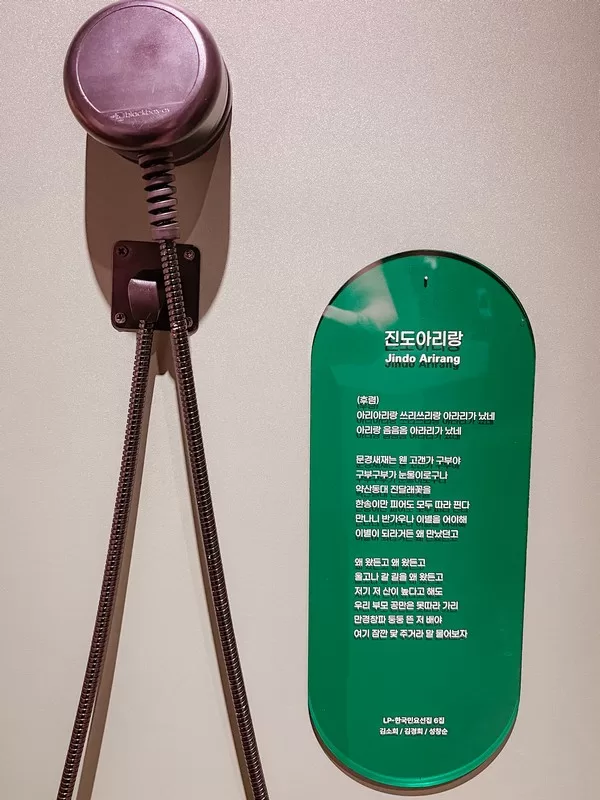
Jeongseon Arirang is the closest to the original Arari, and Jeongseon calls itself Arirang’s hometown. It also has a direct link to Seoul: timber from Jeongseon was lashed into rafts at Auraji and floated down the Namhangang River to rebuild Gyeongbokgung Palace in the 1860s, and many historians think raftsmen and laborers carried Arari to the capital. Locals still sing a “raft Arirang” (떼목아리랑). On records, “Jeongseon Arirang” was attached to the Yeokkeum style, while the slow Gin-arari is what Gangwon-do protected under the Jeongseon name.
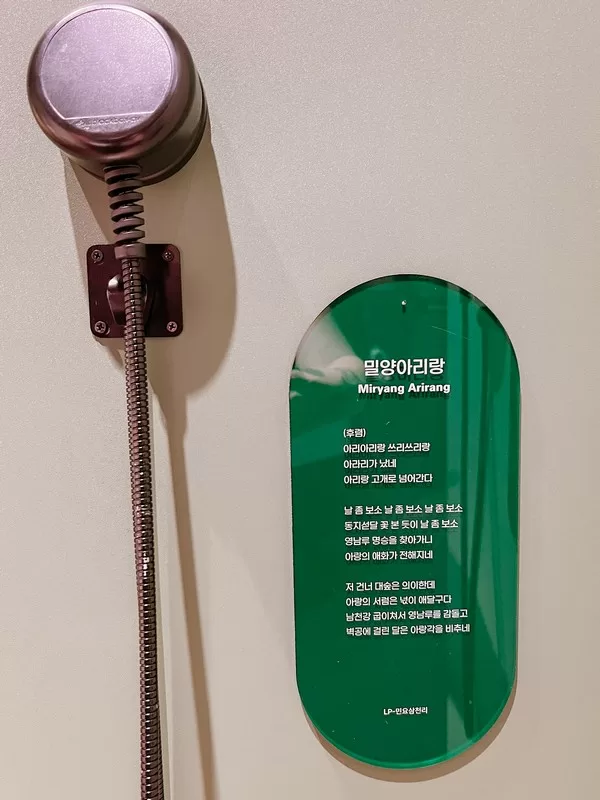
Miryang Arirang is the one that makes people start clapping when they hear it. Its famous opening line (“Look at me, look at me, look at me, look at me like you’d look at a flower in the dead of winter”) is flirtatious and confident. Researchers think it was likely composed in Seoul by singers using a Gyeongsang-style sound, and the Miryang name stuck because it fit. Miryang embraced it anyway, adding verses about Yeongnamnu Pavilion and the legend of Arang, a magistrate’s daughter whose tragic story is commemorated at Aranggak shrine. During the colonial era, Korean independence fighters in China sang their own Arirangs to this melody.
Jindo Arirang is built on “Sanaji taryeong,” a folk song people across southern Jeolla already sang at work and at parties. Only the refrain was swapped for an Arirang chorus adapted from Miryang Arirang into the southern musical style. The story goes that pansori master Kim So-hee and daegeum player Park Jong-gi reportedly chose Jindo (Park’s hometown) on a boat to Japan, where they were headed to record it. It’s the only reason an island song is named for an island at all. And that’s why Jindo Arirang sings about Mungyeong Saejae, a famously rugged pass hundreds of kilometers away.

How to Tell Arirang Versions Apart: Listen to the Refrain
When you’re listening and if you’re trying to tell the songs apart, the refrain is a fingerprint. Researchers sort Arirang refrains into three broad types, and once you know what to listen for, you can usually tell where a version comes from.
- Type A opens with “arirang arirang arariyo” and usually crosses “Arirang Pass” in the second line.
- Type B adds “sseuri-sseuri.”
- Type C adds cheerful shouts of encouragement like “eolssu” and “eolssigu” (roughly “that’s it!” or “hooray!”).
| Version | Type | Refrain (Hangul) | Romanization | Listen for |
|---|---|---|---|---|
| Bonjo Arirang | A | 아리랑 아리랑 아라리요 | Arirang arirang arariyo | The “standard” |
| Jeongseon Arirang | A | 아리랑 아리랑 아라리요 / 아리랑 고개 고개로 나를 넘겨 주게 | …gogae gogaero nareul neomgyeo juge | “Carry me over the pass” |
| Jajin-arari (Gangneung) | (A) | 아리아리 아리아리 아라리요 | Ari-ari ari-ari arariyo | Doubled “ari-ari” |
| Gangwon-do Arirang | B | 아리아리 쓰리쓰리 아라리요 | Ari-ari sseuri-sseuri arariyo | “Sseuri-sseuri” |
| Miryang Arirang | B | 아리아리랑 쓰리쓰리랑 아라리가 났네 | Ari-arirang sseuri-sseurirang arari-ga nanne | “Arari-ga nanne” |
| Jindo Arirang | B | 아리랑 응응응 아라리가 났네 | Arirang eung-eung-eung arari-ga nanne | The hummed “eung-eung-eung” |
| Haeju Arirang (Hwanghae, North Korea) | C | 아리 아리 얼쑤 아라리요 / 아리랑 얼씨구 노다 가세 | Ari ari eolssu arariyo / Arirang eolssigu noda gase | “Eolssu” and “eolssigu” |
Is Arirang a Sad Song?
Arirang is usually described as a song of sorrow and han (한), the Korean idea of deep, unresolved grief and longing, which is part of why the song carried so much weight during the Japanese colonial period and the Korean War. But after listening to a dozen regional versions back to back, “sad” doesn’t feel like quite the right feeling. Plenty of verses are about kimchi, cranky spouses, rice planting, and flirting. It’s not sad in the obvious way.
One Yeokkeum-arari verse is a chain of slaps passed down the pecking order: the old man hits the old woman, who swats the kid, who whacks the dog, whose tail thumps the yard, while the willow trees whip in the wind, and it ends with the wife complaining that, with all this action, her husband is still napping. That version sort of reminded me of the children’s song There Was an Old Woman Who Swallowed A Fly that I grew up listening to. It’s a fun string of interconnected events.
The Haeju Arirang plaque teases a young woman walking by whose “outer eyes are closed, but whose inner eyes are wide open.” A Jindo verse sung by ordinary villagers grumbles that the singer scrimped to buy a rice paddy, the government ran a new road straight through it, and then sent her a bill.
Fun fact: Korea’s first domestically made cigarette (1958) was called Arirang. So was a mid-century popular magazine, the international broadcaster Arirang TV, and Korea’s multipurpose satellite series, which started with Arirang-1 in 1999. When the National Folk Museum of Korea prepared its 2012 Arirang exhibition, curators found more than a thousand products carrying the name. Jindo even sells its local produce through an online “Jindo Arirang Mall.”
A Short History of Arirang
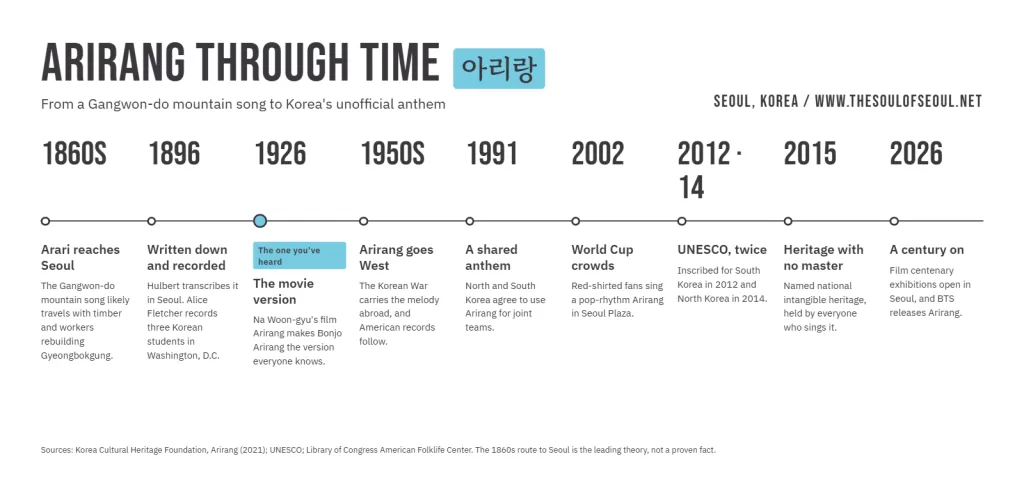
Before the 1800s: Arari in the mountains. Arari was sung in Gangwon-do villages for generations before anyone wrote it down. Its exact age is unknown. A farmers’ song recorded by the scholar Lee Seung-hoon (1756 to 1801) includes the refrain “arorong arorong,” which hints at Arirang-like vocables in the 18th century, though no one can prove a musical link.
1860s: The journey to Seoul. Most historians connect Arari’s arrival in Seoul to the 1865 to 1867 rebuilding of Gyeongbokgung Palace, when Gangwon-do timber and workers flowed into the capital. It’s the leading theory, though not a proven fact.
1880s to 1890s: A palace hit. The historian Hwang Hyeon recorded in his chronicle Maecheon Yarok that King Gojong had entertainers perform a “beautiful new song” called “Arirang taryeong” in the palace night after night, until Japanese forces moved into the palace.
1896: Written down and recorded. American missionary Homer Hulbert transcribed Arirang into Western notation in The Korean Repository, joking that it had “seven hundred and eighty-two verses, more or less” and writing: “To the average Korean this one song holds the same place in music that rice does in his food.” He dated its popularity to about 1883. That same year, on July 24, 1896, ethnologist Alice C. Fletcher recorded three Korean students (Ahn Jeong-sik, Lee Hee-cheol, and Son Rong) singing at her home in Washington, D.C., on wax cylinders. Both Hulbert’s transcription and Fletcher’s recording capture Gujo Arirang, the Seoul song that came before the movie version. The cylinders are held by the Library of Congress’s American Folklife Center.
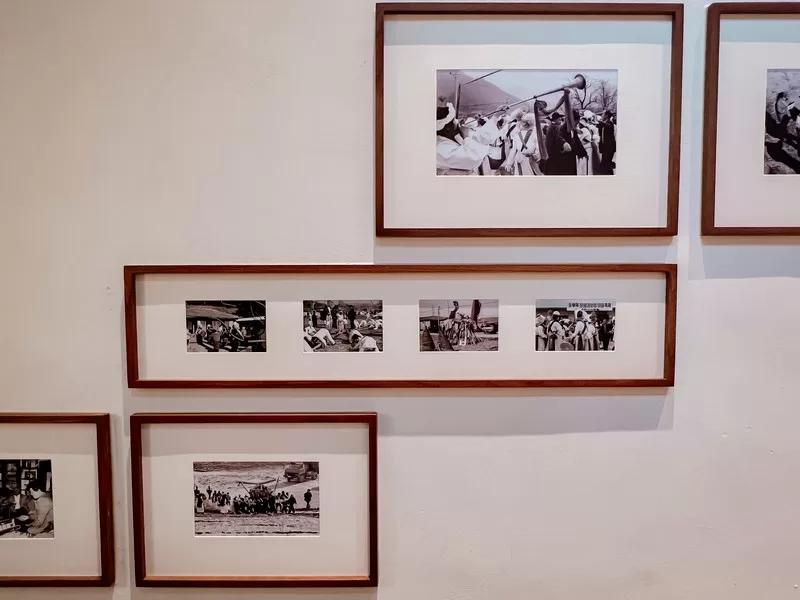
1926: The film that made one version national. Na Woon-gyu (1902 to 1937) wrote, directed, and starred in the silent film Arirang, which opened on October 1, 1926, at Dansungsa theater in Seoul. In its final scene, villagers weep and sing Arirang as the troubled young hero Yeong-jin is led away by a Japanese policeman. The film ran in Seoul for about two years, and newspapers reported crowds so large at a Pyongyang screening that the theater’s supports gave way. The film itself is lost; only stills, newspaper coverage, and script materials survive, several of which are on display in Seoul right now.
Colonial era: A song that traveled. Koreans who emigrated to Manchuria and the Soviet Far East carried Arirang with them, and independence fighters in China sang their own “Independence Army Arirang” and “Liberation Army Arirang,” reportedly passing messages in the lyrics. Arirang was also a hit in Japan, where more than 40 Arirang records were released by 1945.
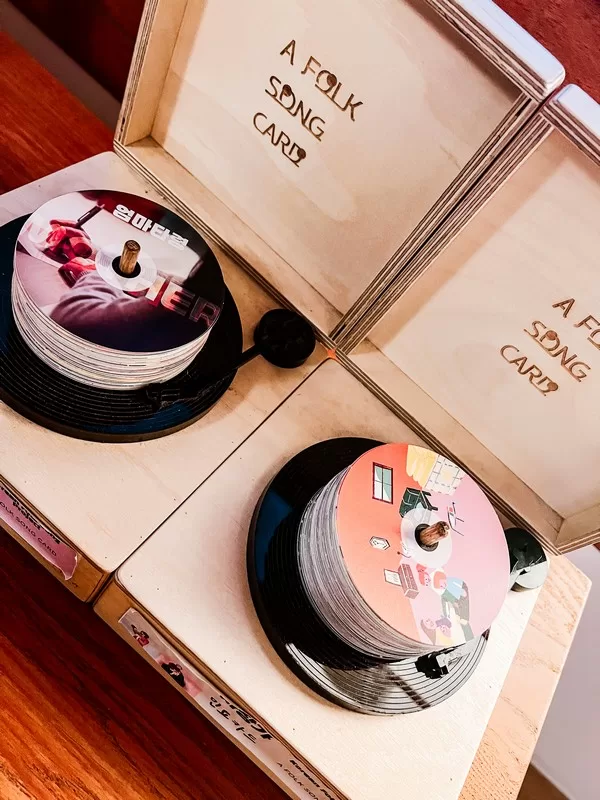
1950s: Arirang goes West. The Korean War introduced American soldiers and entertainers to the melody. Jazz bassist Oscar Pettiford, who performed for UN troops in Korea in 1951, released “Ah Dee Dong Blues” in 1952, and American labels issued pop records titled “Ah Ri Rung” in 1954.
1991 to 2018: A shared anthem. In February 1991, the two Koreas agreed to use Arirang as the anthem for joint teams. It played that role at unified marches and events through the 2018 PyeongChang Winter Olympics.
2002: The World Cup. A “World Cup Arirang,” rearranged in a four-beat pop rhythm, rang out from the red-shirted crowds in Seoul Plaza.
2008: Pyongyang. The New York Philharmonic played Arirang as an encore during its historic concert in Pyongyang.
2011: On ice. Figure skater Yuna Kim performed to “Homage to Korea,” built on Arirang, at the 2011 World Championships.
2012 and 2014: UNESCO, twice. South Korea’s Arirang was inscribed on UNESCO’s Representative List of the Intangible Cultural Heritage of Humanity in December 2012, and North Korea’s Arirang in 2014. Few traditions are recognized separately by both Koreas.
2015: National heritage, with no master. South Korea designated Arirang as national intangible heritage, the first designation made without naming a holder.
2026: A century on, and BTS. The 100th anniversary of Na Woon-gyu’s film brought new exhibitions, and BTS released their album Arirang on March 20, 2026.


Arirang and BTS: Why the Album Is Called Arirang
BTS titled their 2026 comeback album Arirang, their first full-group album after the members all returned from completing their army service, and framed it around themes of longing, identity, and return. The album’s animated trailer reached back to 1896, depicting Korean students at Howard University and the wax cylinder recordings described above. The Library of Congress even published a blog post about the connection. Not only an important point in history for Arirang, but it helped spread the song even further being Korea and Korean diaspora to the world.
Experience Arirang in Korea & Online
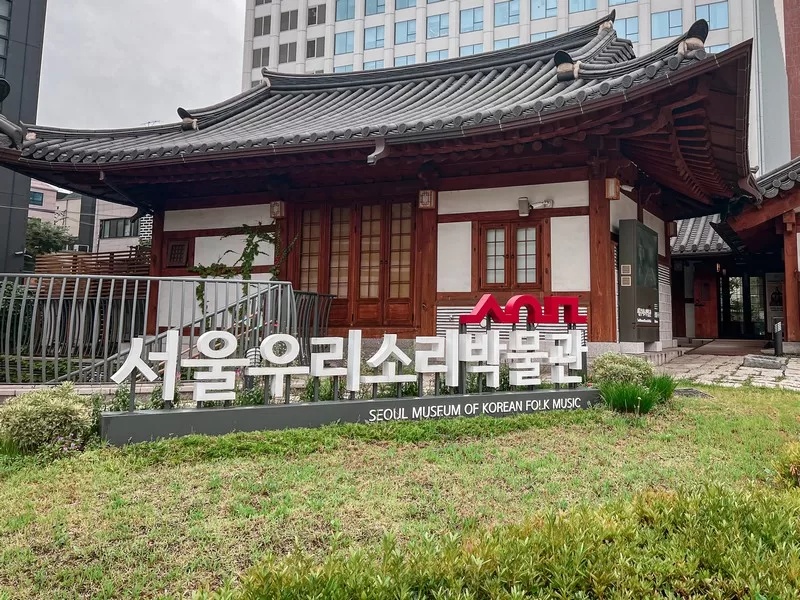
Seoul Museum of Korean Folk Music (서울우리소리박물관)
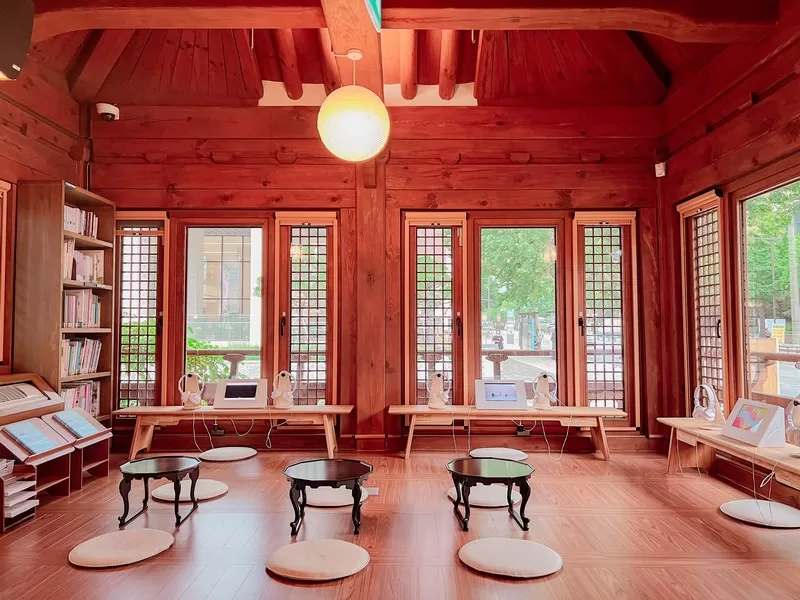
Opened in 2019 as Korea’s first museum dedicated to folk songs, I just stopped into this space for the first time this year and thought it was fantastic. I had never noticed this small unassuming Hanok across the street from Changdeokgung Palace’s Donhwamun Gate before.
Its archive holds roughly 20,000 folk song recordings collected from 904 villages across the peninsula, and you can listen to many of them on headphones while looking out at the palace. It looks smaller than it is, so don’t be deceived. The majority of this museum’s collection is actually underground on B1 and B2.
Arirang’s Home Regions and Festivals
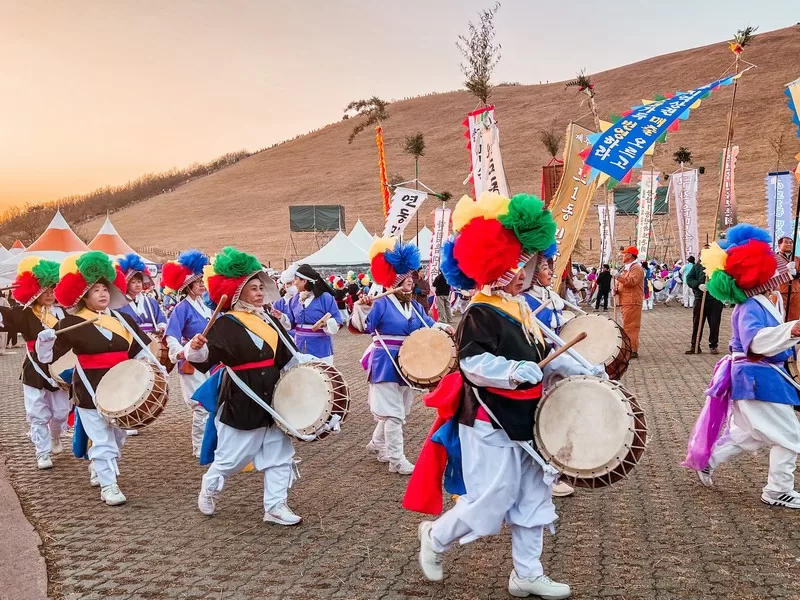
If you want to hear Arirang where it grew up, Jeongseon in Gangwon-do hosts the Jeongseon Arirang Festival and it has been running since 1976. The festival is held in late September or early October each year (the 2026 edition ran October 1 to 4), with a national Arirang singing contest, a raft performance on the river, a street parade, and performances of Arirangs from other regions and the diaspora. The Jeongseon 5-day market often has Arirang performances too.
In Miryang, Arirang is celebrated at the Miryang Arirang Festival, traditionally held in spring around Yeongnamnu Pavilion, and the city has a Miryang Arirang Art Center. On Jindo, the island’s long-running Saturday folk performance often features Jindo Arirang. Mungyeong (yes, the Saejae pass from the Jindo lyric) has held its own Mungyeong Saejae Arirang Festival since 2008.
K-Heritage Series
If you want to do a real deep dive into the history and adaptability of Arirang, check out the publication Arirang: Lyrical Folk Song in the Republic of Korea by the Korea Heritage Agency. You can can download this in-depth publication on kh.or.kr
FAQ
What does Arirang mean?
Probably nothing literal. Most scholars think “arirang” and “arari” are vocables, sung for sound like “fa la la.” Another theory says “ari” once meant a folk song. Popular stories tie it to a Silla queen, Gyeongbokgung-era puns, or the Miryang legend of Arang, but none is proven.
Is Arirang South Korea’s national anthem?
No. The national anthem is “Aegukga.” Arirang is often called Korea’s unofficial national anthem, and it has served as the anthem for joint North and South Korean teams.
How many versions of Arirang are there?
South Korea’s UNESCO nomination estimates about 3,600 variations in roughly 60 versions. North Korea’s inscription cites 36. Researchers group the surviving versions into eight musical types.
What is the difference between Arari and Arirang?
Arari is the Gangwon-do mountain folk song considered the root of the tradition. “Arirang” is the name it took after it reached Seoul in the late 1800s, and the family of songs that grew from there.
Who wrote Arirang?
No one. It’s an oral tradition shaped by generations of ordinary singers. The best-known version was arranged by Na Woon-gyu for his 1926 film Arirang.
When was Arirang first recorded?
On July 24, 1896, when ethnologist Alice C. Fletcher recorded three Korean students in Washington, D.C. The wax cylinders are held by the Library of Congress.
Why is Arirang considered sad?
Many famous verses are about parting, and the song became a symbol of grief and resistance during the colonial era. But many regional verses are funny, flirtatious, or about daily work.
Is Arirang sung in North Korea too?
Yes. North Korea’s Arirang was inscribed by UNESCO separately in 2014, and versions like Haeju Arirang come from what is now North Korea. Some songs go by different names in the North; for example, the song South Koreans call Gujo Arirang is known there as Seodo Arirang.
Why did BTS name their album Arirang?
BTS chose the title for its themes of longing, identity, and return, and the album’s trailer referenced the 1896 recording of Korean students in Washington, D.C.
Is Arirang Pass a real place?
In the songs, it’s mostly symbolic: the hard stretch of life you have to get over. Several places in Korea have since been named after it, including Arirang-gogae in Seoul’s Seongbuk-gu.
Where can I hear Arirang in Seoul?
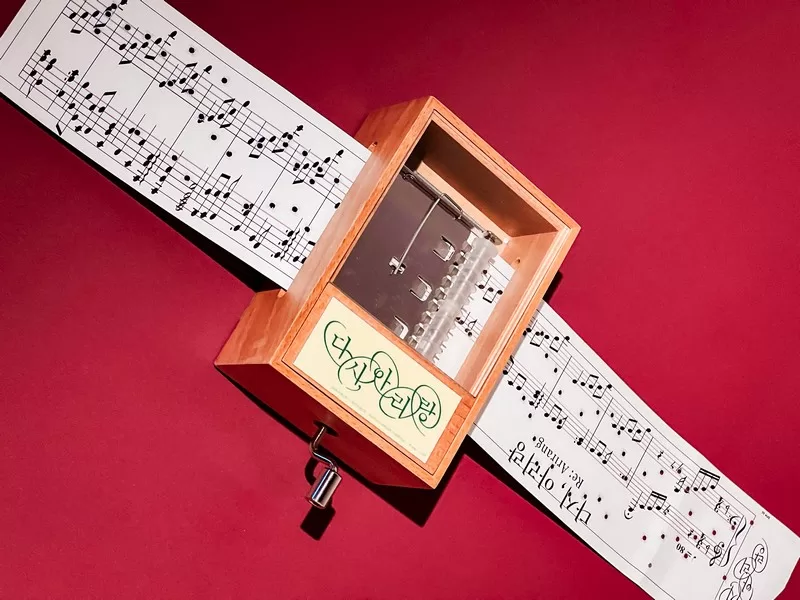
The Seoul Museum of Korean Folk Music near Changdeokgung has free listening stations with regional versions, plus the special exhibition “Arirang, Again” through May 30, 2027.
Did you like this post? Pin iT!