Chingu: Why Friend in Korean Only Works With Same-Age People
Last Updated on April 27, 2026
“Thank you”, “Hello”, “Give me… please” and a few other words and phrases are among a handful of words that foreigners just in Korea learn and among them is often the word chingu (친구), translated loosely as “friend”. Foreigners splice this word into their English sentences without hesitation and use it seemingly without understanding exactly what it means. This is probably one of my least favorite words in Korean and I’ll explain why.
If you’re learning Korean or trying to speak Korean, then you’ve probably learned that there is a hierarchy in the language and how you use it. Because of this, who is considered your “friend” is really important. Chingu — friend — is reserved exclusively for people of exactly the same age. You can be friendly, close, and genuinely affectionate with people older or younger than you, but you will never be their chingu. This isn’t rudeness. It’s the architecture of the language.

- Korean Relationships Quick Guide
- The Dinner Party
- What I Got Wrong
- How Korean Name Endings Work
- The Resolution
- The Wedding Coda
- Want to learn how to speak Korean?
- FAQ
(This post contains affiliate links, which means I receive a certain percentage of a sale if you purchase after clicking at no cost to you.)
Korean Relationships Quick Guide
| Relationship | Korean term | Name ending | Register |
|---|---|---|---|
| Same age | chingu (친구) | -a (consonant ending) or -ya (vowel ending) | Informal (반말) |
| Older male (from female speaker) | oppa (오빠) | -ssi or their title | Formal or semi-formal |
| Older male (from male speaker) | hyung (형) | -ssi or their title | Formal or semi-formal |
| Older female (from female speaker) | unni (언니) | -ssi or their title | Formal or semi-formal |
| Older female (from male speaker) | noona (누나) | -ssi or their title | Formal or semi-formal |
| Younger (any gender) | dongsaeng (동생) | -a (consonant ending) or -ya (vowel ending) | Depends on closeness |
The Dinner Party
Some years ago, I was taking Korean lessons four days a week, four hours each day. I was in a relationship with a Korean man, most of my friends were Korean, and I was living in Korea, I wanted to make life easier.
Before the classes, I was hesitant and wary of what I perceived as forced respect in the language. Parts of Korean grammar require showing deference that you may not feel. Just because someone is older doesn’t automatically mean they deserve respect, and I’d been in enough situations to know that quite a few people, usually men, assumed I should be respectful of them even when they disrespected me.
Through the classes, I learned how to show disapproval without being outright rude, and how to be more assertive in Korean. One of the biggest lessons, however, was that I have almost no “friends” in Korea. (From here on, “friend” in quotation marks refers to the Korean definition, while friend without marks is the English version.)

My husband, boyfriend at the time, and I had a gathering at our house. About ten of us around the table, everyone Korean except me. I’d known my boyfriend and all of his friends for four or five years by then, and in English, I would have called them my friends without hesitation.
After the food was finished and the plates picked up, I thought a game would be fun. Taking what I’d learned from class on how to call someone by name, I said, “So-yung-a, do you want to play a game?” (소영아, 게임 하고싶어?) using the lower form of the language. I had been gaining confidence with the language and using it whenever I could.
There was an audible gasp. After a few seconds of silence, So-yung said, “yes,” but two of the more aggressively conservative members of the group told me I couldn’t say “So-yung-a” to So-yung.
Me: Why not?
Friend 1: So-yung is older than you are.
Me: So…
Friend 2: You can’t say “So-yung-a” because you’re younger than she is.
Me: We’re friends though.
Friend 1: No, you’re not friends with So-yung.
Me: What do you mean? I’ve known her for years. I have her phone number in my phone. I see her a lot. We are friends and my book says that is an appropriate ending for a friend.
Friend 2: No, you can’t be friends because she is older than you are.
Me: I don’t understand.
Friend 1: You can only be friends with someone that is the same age as yourself.
Me: Well, that doesn’t make any sense. You are all my friends and you are all older than I am.
Friend 1: We aren’t your friends.
Me:…

After that I went to my room for a little cry, mostly because I was just told I had no friends and also because the language they were using to express their viewpoint was very aggressive and I don’t handle aggressive situations very well. Coming from a teaching viewpoint, aggressively attacking a student for using a word or a term inappropriately almost never makes the student respond in a positive way.
Usually, the student will become more timid to use the language or try not to use words in the future unless they’re completely sure of their meaning. I also reminded my “friends” later that I don’t attack them when they misuse a word in English. When they are speaking if it’s extremely rude, I remind myself that it’s not their first language and I try to help them understand why it could be taken the wrong way. My “friends” however, were not so patient with my language acquisition.

What I Got Wrong
Though I had excitingly read through my lesson books and went through discussions in my class, I had taken some things and words in the book for granted not realizing they didn’t mean what it appeared they meant. Two of the more tolerant members of our group came in to calm me and explain in nicer terms what everyone had gotten so upset about.
In Korean, you almost never say just someone’s name alone. There is always a title attached. Koreans generally extend flexibility to foreigners calling names without endings because they know in Western culture that’s acceptable, but technically, in Korean, a title always follows.
The formal option for a name like So-yung would be “So-yung-ssi”, the “-ssi” being the standard polite title. If she had a professional title like manager or teacher, that would be used instead, typically with her family name.
Now: if you are actually “friends”, in the Korean sense, you switch from “-ssi” to “-a” (for names ending in a consonant) or “-ya” (for names ending in a vowel). My language book explained: “-a/-ya is used in talking to someone who is junior to the speaker, or to someone on familiar terms with the speaker.”
I had assumed “familiar terms” included So-yung and me, who had known each other for years and were, in my assessment, quite familiar. Apparently not.
The second mistake: I had been using the word chingu, which I’d heard from my very first year in Korea, as if it meant what “friend” means in English. It doesn’t.


How Korean Name Endings Work
Chingu is only used with people of exactly the same age. You can be close, warm, and genuinely fond of people older or younger than you, but you will never be their chingu. Instead of “friend,” Koreans use relational terms: oppa (오빠, older brother from a female speaker), hyung (형, older brother from a male speaker), unni (언니, older sister from a female speaker), noona (누나, older sister from a male speaker), and dongsaeng (동생, younger sibling of any gender).
I still struggle with this. No matter how much of the language or customs I learn, I’m still from the West and there are some things I don’t want to give up. The idea that I can be friends with people of any age is one of them. Calling people older brother or sister when they aren’t my siblings remains genuinely difficult.
The Resolution
After that dinner, I went individually to my husband’s friends, all older than me by nearly a decade, and asked what would make them comfortable. Could I use the informal register with them? Knowing I wasn’t coming from a place of disrespect but familiarity, many of them said the informal was fine.
I’m more aware now, though. When we’re out with mixed company, people I know alongside people I’m meeting for the first time, I use the polite form even with close friends, because strangers won’t have the context to understand my relationship with them and may read me as rude.
One thing they said clearly: while I could use informal sentence endings, it was better to just use their names without any title at all than to use the wrong title.
I’ve had to remind people many times that when I switch into Korean, I’m still operating from a Western mindset. Some things I say easily in Korean may not be what Koreans would normally say, but that should be expected. When I hear a foreigner splice the word chingu into their sentences now, I cringe a little, wondering when they’ll find themselves in the same quiet room I did.
The Wedding Coda
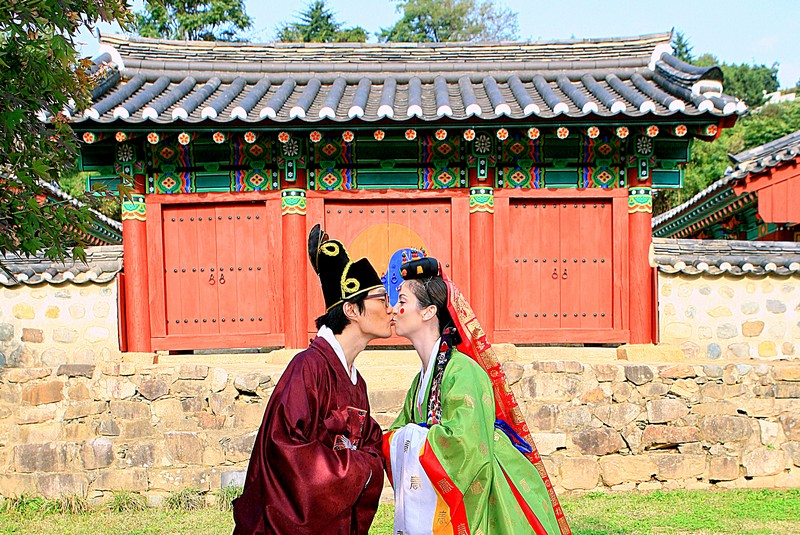
Some years later, everything shifted. After my boyfriend and I married, the people who had been speaking to me informally suddenly started calling me “hyung-sunim.” I had apparently inherited all the years my husband had on his friends through marriage, and was now socially “older” than many of the people I’d been younger than for years.
Learning Korean isn’t easy and there will always be more to learn. Hopefully, you’ll be surrounded by people willing to teach it kindly.
Want to learn how to speak Korean?
- Check out the best Korean classes online to find a course that is good for you.
- Look into the best books to learn Korean from textbooks to slang and verb conjugation.
Check out some of these other posts on learning Korean in Korea, humorous phrases that crack me up every time I say them, which is often because I like saying them and laughing out loud.
- Learning Korean With Noisy Salesmen: Is that guy trying to buy my boogers? You’ll see.
- Conversations With Koreans: Have You Eaten?
- Conversations With Koreans: When Maybe Doesn’t Mean Maybe Anymore
- Conversations With Koreans: Where are you from?
- Learning Korean Can Be Laugh Out Loud Funny
FAQ
What does chingu mean in Korean?
Chingu (친구) means friend in Korean, but specifically refers to someone of exactly the same age. In Korean social and linguistic culture, age determines the vocabulary and speech level used between people. Friendship in the Korean sense is age-matched; relationships with older or younger people use different relational terms.
What do you call older Korean friends?
Depending on your gender and theirs: oppa (오빠) for an older male from a female speaker; hyung (형) for an older male from a male speaker; unni (언니) for an older female from a female speaker; noona (누나) for an older female from a male speaker. These terms don’t map directly to “friend”, they carry relational weight more like “older brother” or “older sister.”
Can foreigners be chingu with Koreans?
If you’re the same age, yes. If you’re different ages, technically no, though many Koreans extend flexibility to foreigners who use the word colloquially. The linguistic and social weight of chingu still applies in more formal or conservative Korean settings, as the dinner party story above illustrates.
How do Korean name endings work?
Formally: name + “-ssi” (e.g., So-yung-ssi) for standard polite address. For same-age friends (chingu): name + “-a” if the name ends in a consonant, name + “-ya” if it ends in a vowel. Professional titles (teacher, manager) replace “-ssi” and pair with the person’s family name. Calling someone by name alone, without any ending, is acceptable in casual contexts, especially between those who’ve agreed to drop formality.
What is the Korean age hierarchy?
Korean social and linguistic culture is structured around age, older people are addressed with deference, younger people with informality. Speech levels (존댓말 for polite, 반말 for informal) are determined by the relative age of the speakers. This hierarchy affects vocabulary choices, name endings, and the terms used for relationships.
Did you like this post? Pin It!

29 Comments
Jesus
I think there are some misunderstandings conveyed in the article. Just because you’re using 존댓말 doesnt mean you can’t be close. Many married couple even use it for each other. As correctly stated, many words may not be translated literally. Moreover, honorous speech somewhat works differently from European language with honorous speech like French or German: depending on the exact Form it can simply express politness, not necessarily distance! At least you must add ~요, before you agree on 반말! If people are 5+ years older, you should stick to 존댓말 but you can still be close.
On the other side, 친구 can be a very broad term. It’s just, that its easily ‘overwritten’ by other defined relationships. As long as you are not in such a relationship, 친구 is an extremely broad term. I dont know what went wrong in the evening, but I use it even more than when talking in English.
However, husband friend to wife relationship is very special and formal in the beginning. Younger generations from Seoul and Gyeongi-do are more understanding towards the Western culture.
Cheryl Jordan
Wow, thank you for sharing your story and teaching us about the much more specific use of the Korean word “friend”. I liberally use the word friend in English, and would be the first to make this blunder in Korea! Even though you and I have never met, and you are young enough to be my daughter, I think of you as a friend, because I have gotten to know you through your posts. So, you see, I am hopeless from a personal mindset perspective, but I think it is imperative to respect the language and culture of others. Thanks again, buddy. 😉
Ian
And now have a discussion about whether or not a watermelon is a fruit or vegetable with Koreans and you will have another argument. I’ve learned the hard way that words in languages, although books try to pin them as direct translations, should never be assumed to be direct translations. For example, 과일 literally means something grown from a tree, but gets translated into fruit. And 채소 gets translated into vegetables in English, but literally means something grown from the ground. So watermelons grow on the ground, so they are vegetables. I’ve had countless conversations about this, especially with students, and my partner.
Hallie
Wait.. so you’re saying Koreans tell you watermelons are vegetables? Or you mean, based on what the Korean word literally means, you then tell Koreans that watermelons must be vegetables to which they disagree? I’ve never heard that before, but now definitely want to ask my husband. haha
Doug
I don’t see this Korean language/mindset as just culturally “different”. I think it’s negative. I grew up in Korea for 16 years and have lived in US for 10 years.
What I concluded so far is that in Korean language, not being able to say “you” to older people or using two different forms of grammar to older and younger (존댓말&반말) really conditions people to treat everyone differently just by their age. I’m not against treating people differently in general because it’s functional/beneficial that our voice tone/behavior can vary towards your professor vs. towards a newbie trainee. However, exercising authority over someone just because he/she is younger despite the persons’ character and maturity is just detrimental to Korean society.
Cc
Your article is really insightful and thank you for that 🙂 I’ve been learning Korean for six months and have already found some good Korean friends on social apps. I’ve even hung out with some of them during their visit to my country. (I live in South East Asia). These Koreans I’ve met so far are very open-minded and friendly but I also notice that they really care about the hierarchy. (which isn’t much of a problem for me as I also have a somewhat asian background). But I still have to be careful not to make my friends feel offended when they’re with me. One of my Korean guy friends, who is one year older than me, asked me to call him just by his name when we first met and when I added Sshi to his name, he said I didn’t have to use it as we weren’t at work and that Sshi sounded too distant. When I found out about our age difference, (In my culture, we also call people brother or sister according to the age differences just like in Korea) I started to call him oppa but he said it’s okay just to use his name. But one day, I called him ‘chingu’ while we were texting and he said that he’d be a brother (all of a sudden) and I feel awkward to start calling him oppa again after using just his name for some time now. I’m not really sure if he’s implying he wants me to use the title “oppa” from now on. I don’t wanna offend him. So, I just call him “bro” in English. hehe I know that sounds awkward as we almost always chat in Korean when we text on kakao 😀 Am I being rude..? Thanks a lot 🙂
P.S Sorry for my English if there’s any mistake 🙂
Hallie
Your English is great! I would say that he probably told you not to use “oppa” when you first met because you had just met. Using “oppa” means you’re close to someone. It’s not something that you just start using as soon as you meet someone and find out that they’re older than you. You’re definitely not “chingus” and can’t be in Korea, but that doesn’t mean you can’t be close so perhaps now he means that you’re closer so you may call him “oppa”. If you’re uncomfortable with it, I would just use his name though and I’m sure he wouldn’t be offended by that. I personally prefer to use names because my culture doesn’t use brother and sister terms to people that aren’t in our family/related/adopted, etc. Because you’re a foreigner though, Koreans would understand if you stuck with the names over other familial titles. And because more and more foreigners are learning Korean, it is acceptable (from you as a foreigner) to just use the name without the -si at the end as well. Again, this is something that is being adapted to the Korean language due to more foreigners and our lack of titles in this manner. Actually, he may have been trying to make you comfortable by telling you to use just his name at first as well. Great that you’re learning a new language though! Keep it up!
ncnc
The exact same things happened to me too. My korean guy friend also asked me to call him just by his name and not put Sshi to his name (when I tried to) when we first met(in my country; south east asia). We did hang out a few more times and had so much fun as friends. Then after when he got back to Korea again, he suddenly said he’d be a brother.. Like 형제 (he didn’t exactly say like “call me oppa” though but is it the same?). Anyway, I became so used to calling him by his name that I found it awkward to start using the new title suddenly. So, i also started calling him Bro in english ㅋㅋㅋ but after a while, i gave up that weird “bro” cuz i usually text him in Korean and now, I just use his name. He doesn’t seem to mind and it’s a relief hehe
christian ray
wow! thanks for this article.. its a great help for me. i’m planning to go to seoul, south korea soon.. i’m excited to learn more of their culture.
Hallie
Thank you for the comment! I’m glad you find it helpful and have a great trip when you’re here in Korea. ^^
John
Oh my, i want to clarify your misunderstanding. I hope the meaning gets across.
They are your friends, just not same age. There is just one more layer of ‘age’ between people in korea, it never means they dont consider you friends.
The english way of replying to your question should have been (if your korean friends were native with english which they werent)
I do consider you as dear person in my life, but korean language differentiates conversation by age with honorifics. Term chingu is used for people with same age.
Which would clarify and explain the culture (hopefully).
This is same in japanese i believe.
If you watch 예능 (variety shows) its kinda big comedy (?) Where people who are dear to each other, with age differences, play 말 놓기 or dropping honorifics for n amount of minutes i.e.
This is considered comedy. Like you know, like yo mama jokes in america ( lol cant think of a counterpart)
Hope this clears up.
Btw i am korean raised elsewhere and i was just reading random things on the internet and came across your blog.
jtrav
As an Asian guy I can confirm that it’s almost impossible for you to become friends with older people. At least not in the western sense of friends. If I were Soyung, I would be very offended too. No matter how close you are to her, the -si is always needed.
Hallie
Soyung wasn’t offended, it was other more conservative less open to western ideas people that were. She knew that I was just learning Korean and as a friend, western definition, she knew I wasn’t trying to be offensive. The problem, though, lies in books and other educational materials translating chingu as friend when it is in fact not at all what the proper translation is. Then when a book proceeds to explain that you say -a and -ya at the end of names to people you’re familiar with apparently not accounting for how familiar you can be with people of younger or older ages is furthering the issue.
Anni
Hi,
Thanks for your article.
I was just confuse and doubt about my new relationship with a korean guy.
We had really good and happy conversation, he texted me everyday. telling me how was his day and everything happen to him daily.
He has very poor english and I know him try to learn and study hard to improve his english to make our conversation work.
But in the conversation, he is calling me “friend”.
I would like to know if a korean guy will call you friend (even i am younger than him about 8 years.)
Is that mean just friend? means we have no chance to have further relationship?
Is that he want to make me clear that we are just friend. nothing else.
Anni.
Hallie
If he is texting you every day, that’s a good sign that’s a bit more than friendship. If he’s saying “friend” in English then he probably knows what it means in English and that it can be for anyone of any age. When it’s spoken in Korean, then the meaning is different. I can’t tell what he wants though as far as a further relationship. Maybe you should just ask him…?
Anni
Hi Hallie,
Thanks for the advice.
That’s really a few times I wanted to ask on his though. But I did considered that we just knew each other only for few months. And I know most of the Korean guy will disappear or lost contact, not even given any reason.
I don’t want to pushing him and let him feel stress. Anyway, if he really do feel only “friend”like what he is calling me.. we just maintain our friendship. It’s all about fate.
Sometimes I tried to bring the topic to know about his view on relationship like married and dating.. but he always not answer it and try to bring out of the topic.
Hallie
In my experience, Koreans are pretty forward about being in a relationship so if he’s not answering the question that might be the answer already. It’s always good to have friends though. ^^
Anni
Thank You for your reply. Yes. I think not bad if just friend rather than nothing. 🙂
Anni
I got the answer finally… friend means friend though~ he got a new girlfriend recently. I am feeling little depressed. But he is still texting me everyday. For him, maybe I am just a person who can help him to learn English. I am not dare to ask more about his girlfriend. Not sure Is korean or foreigner. I should sing Let it go~~ let it go~to myself.
Hallie
Aw, sorry Anni. There’s plenty of fish in the sea as they say. I met my husband when I wasn’t even looking. That of course is just the way isn’t it? Good luck out there in that dating world.
Anni
Thanks Hallie.
Do concentrate on my work now 🙂
I got my answer anyway~~ as you said maybe the fate pump into me when i am not looking.
Thank you and nice to know you. =)
ㅡㅠㅑ52ㅈ
Tell me about it… I have been in that situation many times and I agree they tend to be less understanding (aggressive even, as you’ve called it) when we mess up the polite/informal reference to people. I’ve even gotten the reaction, isn’t it the same in English, to which I just stare blankly in response. Where can I start!
Hallie
After teaching English for so long here, I do have to say that we definitely have formal and informal English as well. They often don’t learn formal speaking here though. They learn conversational ESL which they assume is adequate for all circumstances, though it is not. Many of my students tend to think we don’t have a difference between formal and informal because of this. I have to explain that the lines are just a bit more blurry. We don’t use it based on rules of age, it’s more circumstantial I think. I think it’s harder in a way because it’s not a straight and fast rule like they have. But yes, I agree with you. Where to start!
ㅡㅠㅑ52ㅈ
Exactly, my sentiments as well! Yes, close to all the Koreans I know assume there is no polite speech in English, so they tend to speak and write rather rudely, thinking that it’s all acceptable (and it sometimes borders on offensive), but thing is, without “formalized” formal speech rules in English, it’s rather tough to tell (educate) them otherwise.
Hallie
I agree. Oh the intricacies of English. I tend to tell my students, if nothing else, add “please” to the sentence and no matter what at least you won’t seem like you’re trying to be rude on purpose. I’ve had 40 year olds come to a table and tell me to “move” when they meant for me to move down the bench so they could join our table and of course my gut reaction was to look at them, furl my eyebrows and say, “excuse you?” and then there are the students that say, “come here!” Both sentences would be helped with a little “please” at the very least. ^^
ㅡㅠㅑ52ㅈ
That’s a great tip! All too often, the easier English words (e.g., “move”) are more difficult for them to “master” than the bombastic words they learn for the TOEIC. As a result, some sentences can come across as stiff and unfriendly.
Brent P. Hendricks
“Just add please” is a good tip, Though at least in most of the US, once you are an older teenager and certainly an adult, you will not get reprimanded in public, like I have been in Korea, even by younger Koreans. (The first time I used “Ani” instead of, “aneyo” for No. I had heard it shortened everywhere in Movies, and dramas and by other people, and did not think twice that it was not just a shortened way of saying hello. I was told how embarrasing I was to be around when I tried to speak Korean, and that I was just very rude to the person..” I tried to ask how I was rude, and they wouldn’t tell me, so I was like then I really don’t care. (This was also the same day I was scolded in the middle of a hotel dinig room for food dropping off my plate, or breathing too loudly at a performance.. (I should have seen this for what it was and declined to give them any more of my time, but well. another silly Western traight. Give people the bennifit of othe doubt that they are just having a bad day.. It wasn’t until asking around that silly me, whereas in the West you can get away with being informal first, and use formality only when called for. It is the complete other way around. It is one of the reason I pretty much just stopped trying to make friends with Koreans over there, or tried to learn Korean. It just was not worth the abuse. Though the show on the other foot, I had to go out of my way at any time day or night to help with with something they didn’t understand in English, reaffirm what I thought of them as a person, etc etc etc, and I had to always respect Korean culture / customs, when there is no way in hell they would even think of or get away with speaking to an older Korean that way, especially in front of other people.
koreanlearner
That must have been a really difficult evening.
I happen to be minimum 1 year older than all of my Korean language partners and their Korean classmates since I’m doing my second MSc (I’m 25) while they are abroad for their BSc exhange. I’d like to think we’ve at least grown close “in spite of” the age difference. Of course I know some of them better than others. Maybe it’s easier when I’m the older one and not so harsh when it comes to enforcing politeness and we’re in my home country rather than Korea?
However, I’ve noticed that while most of my female language partners have at one time or another called me 언니 when switching to Korean, *none* of the guys have *ever* called me 누나. Occasionally I’ve felt like I had to fulfill the part of “the 언니” although I’m not entirely sure what it requires… Do my ramblings make sense?
As for Western friends most of them are a few years older than me and some are even about a decade older. That has never made me feel uncomfortable in their company.
Nina
I always found this really interesting and it depends on the person you are talking to as well. my ex`s best friends wife and i communicated in english mostly but i called her by first name or 언니 when i spoke korean. It is definitely a learning curve and something I don`t quite embrace 100% a friend is a friend whether they are younger or older. i do find that those who speak english better or have spent time in foreign countries can classify friends differently based on experience abroad. though when speakimg english one might say this is my friend in korean they will address the person differently. at this point i have no friends the same age haha. but in my book they are friends and that is all that matters. really loved this entry and how it shows how language and culture shape how we speak.