Bokbunja: The Korean Black Raspberry Wine With a Hilarious Name
Last Updated on April 22, 2026
I remember my first sip of bokbunja (복분자) in 2006, my first year in Korea. The wine shelves at the time were limited. There was a lot of local Korean wine that tended toward very sweet, and one Australian wine with a kangaroo on the label that served as the reliable alternative. Most evenings we went for the kangaroo. Come holiday time or a party when something with more character was needed, it was bokbunja.
I had a bit too much that first year and took a lengthy break, only recently returning to it when I sat down to an eel dinner with my father-in-law. The pairing was excellent. With renewed interest, I looked into bokbunja more carefully, and found out it had been served at the 2005 APEC summit and the 2009 inter-Korean summit dinner, that it accounts for roughly 80% of Korea’s wine exports, and that its name is one of the funniest in Korean food and drink. All of which made me feel considerably better about going back to it.
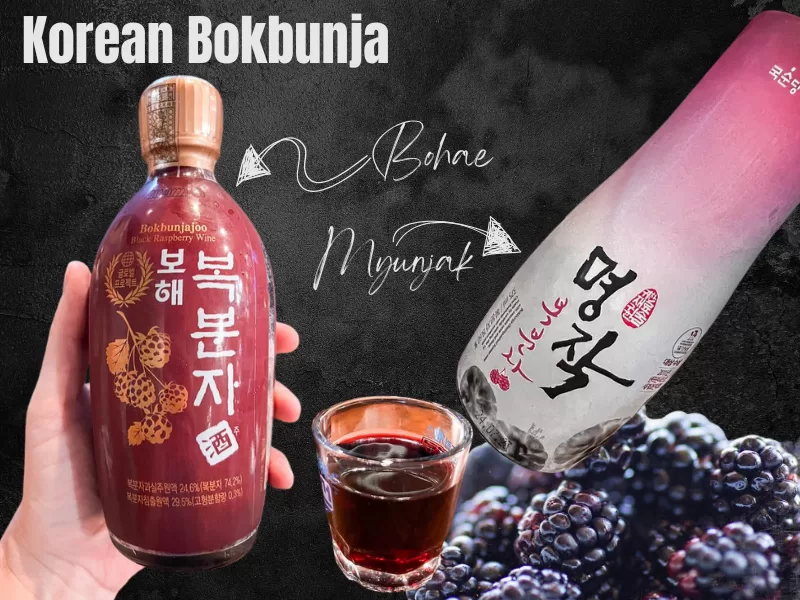
There’s just something about this Korean black raspberry wine. Get ready to learn about Korean bokbunja:
- What Is Bokbunja?
- The Hilarious Name Explained
- Health Benefits
- How To Drink Bokbunja
- Bohae vs Myungjak: A Taste Test
- When To Drink Bokbunja
- FAQ
(This post contains affiliate links, which means I receive a certain percentage of a sale if you purchase after clicking at no cost to you. Thank you for your support.)
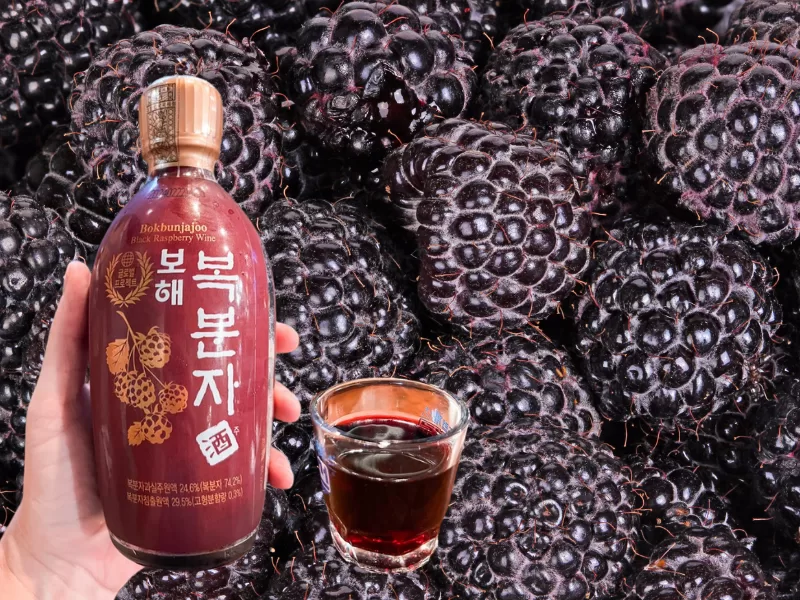
What Is Bokbunja?
Bokbunja is a fruit wine made from Korea’s native wild black raspberry. Unlike the raspberries you might pop into a smoothie, these are a bit different, a bit more mysterious. They grow in the southern provinces of Korea, like Jeolla and on Jeju Island, where they’ve been used in Korean traditional medicine for centuries.
The drink made from them, traditionally a type of gayangju (home-brewed alcohol), is sweet, tart, and a deep inky red. If you’re a wine drinker, your first sip might suggest port meets berry liqueur, with a distinctly Korean character underneath. The alcohol content varies by brand and method but typically ranges between 13% and 19%. Don’t let the fruity aroma mislead you about the strength, as it misled me in 2006.
Bokbunja is available year-round in Korean supermarkets and duty-free shops and works as a gift. Read more about Korean gift-giving customs to understand when and why alcohol makes such an appropriate present.
The Hilarious Name Explained
The hanja for bokbunja may have you thinking twice about trying it. It roughly translates to: bok (overturn), bun (urinal or pot), and ja (person). So together that’s… well appetizing I’m sure you would conclude.
The story goes something like this. A monk, or possibly a hunter, depending on who’s telling it, stumbled upon black raspberries in the mountains. After eating a great quantity of them, he found himself so invigorated that when he urinated, the force of it knocked over the chamber pot. The berries’ aphrodisiac and stamina-boosting reputation was established, and the name followed.
This story is told in Korea with complete seriousness and is considered an entirely normal piece of food history. It is also genuinely funny every time.
Health Benefits
Bokbunja might be the folk remedy you didn’t know you needed. Korean herbalists will tell you a resounding yes, that bokbunja does have health benefits and science seems to be catching up. The fruit has four times the anthocyanins of grapes, those powerful antioxidants found in red wine and blueberries. Anthocyanins are linked to anti-aging, anti-cancer, anti-inflammatory, and even neuroprotective benefits.
Studies, including one by the Ohio State University, found that black raspberries could shrink precancerous growths in patients with familial adenomatous polyposis (a precursor to colon cancer).

It also contains alpha-linolenic acid, a plant-based omega-3 fatty acid, and soluble fiber, both of which are good for your heart and cholesterol levels. Traditional uses include boosting stamina in men and aiding kidney and liver functions in women. This could actually help with blurred vision, premature graying, or just feeling a bit rundown.
How To Drink Bokbunja
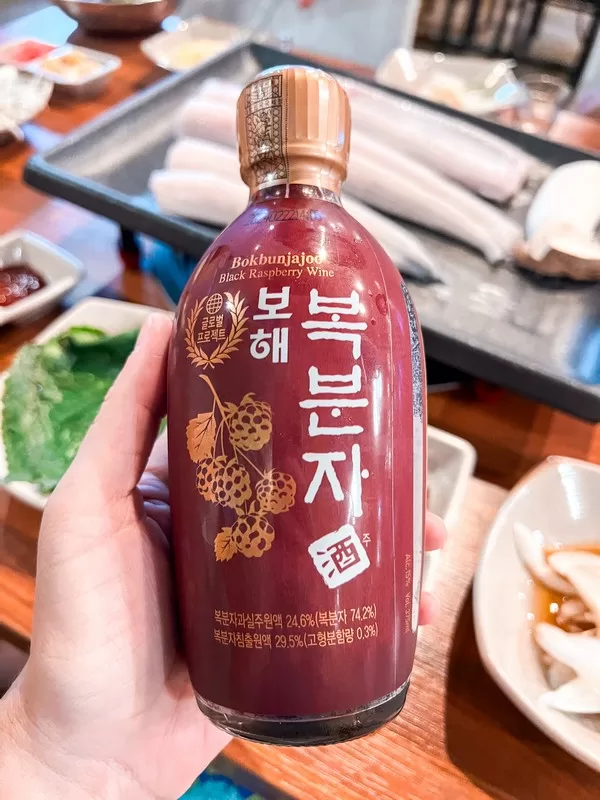
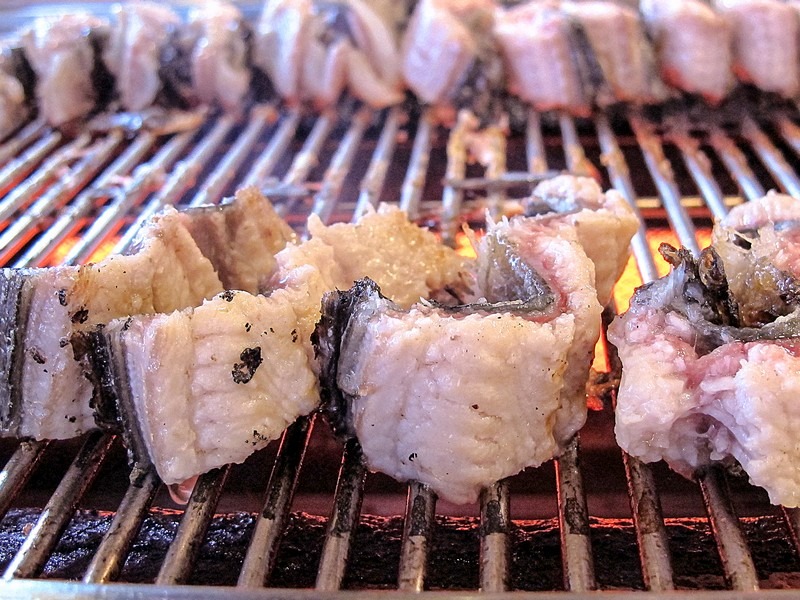
Traditionally, bokbunja is served cold, ice cold. You want it just above freezing, around 1–2°C (35°F). You can sip it straight as an apertif, or pair it with spicy Korean food, seafood, or even rich desserts like dark chocolate. Most recently, I had it at an eel dinner with my father-in-law and it really paired well with the sesame and ginger on the fish.
The sweetness of bokbunja can temper the spice of Korean dishes, while the acidity helps cut the richness of dishes. Some people might even mix it with soju or soda water for a lighter spritz vibe, but that is dangerously drinkable. Also, I’ve always had this with older Korean men, and they would never. Straight up all the way.
Bohae vs Myungjak: A Taste Test
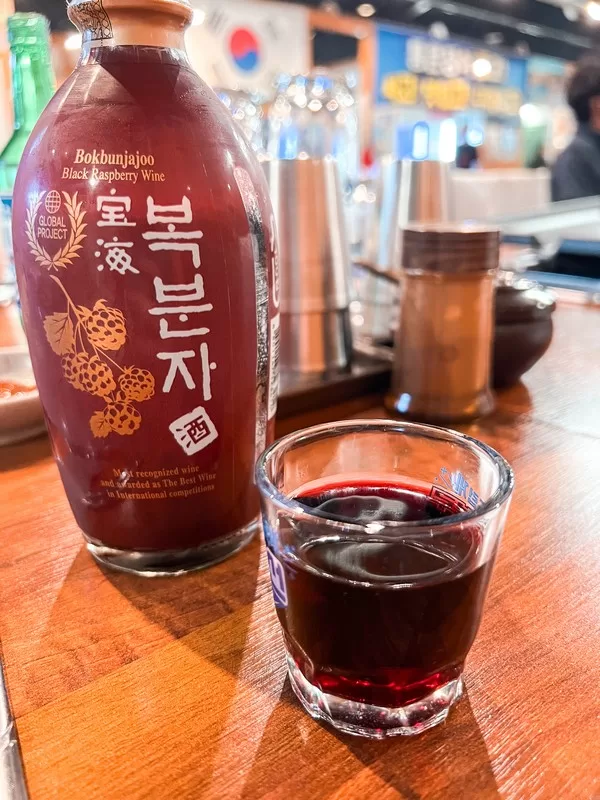
When you look for bokbunja in Korea, Bohae (보해) is what you’ll find almost everywhere. The brewery was established in 1950, uses deep bedrock water, and employs a controlled fermentation process that preserves the fruit’s natural properties.
Bohae’s bokbunja was served at the 2005 APEC summit and the 2009 inter-Korean summit dinner, the most impressive set of credentials any Korean drink could carry. It also won a silver medal at the Dallas Morning News International Wine Competition and currently accounts for approximately 80% of Korea’s wine exports.

Today, Bohae accounts for roughly 80% of Korea’s wine exports. But that’s not to say that it is the only one on the market. There are others to try. We did a head to head taste test between Myungjak bokbunja, also a grand prize winner at the San Francisco International Wine Competition in 2011, and Bohae bokbunja and it was interesting to see what my husband preferred and what I preferred… because we were divided.
| Bohae Bokbunja | Myunjak Bokbunja |
| 15% ABV | 13% ABV |
| Released in 2004 | Released in 2007 |
| Flavor Profile: Acidity: Mildly fermented Sweetness: Moderate; not overpowering Fruit Characteristics: Noticeable astringency and light bitterness that reflects the black raspberry’s natural profile Impression: Clean, nuanced, and mature, appealing to a broad range of drinkers but especially favored by older men | Flavor Profile: Acidity: Subtle, balanced with sweetness Sweetness: More pronounced than Bohae, offering a brighter and fruitier sip Fruit Characteristics: Juicy and approachable with a lighter feel Impression: Fresh and sweet, ideal for those who prefer a fruit-forward profile or are new to bokbunja |
| What my husband preferred | What I preferred |
The bottom line: if you’re new to bokbunja, Myungjak’s sweeter, fruitier profile is the more accessible entry point. If you want the more serious, complex version, the one that’s been at state dinners, start with Bohae.
When To Drink Bokbunja
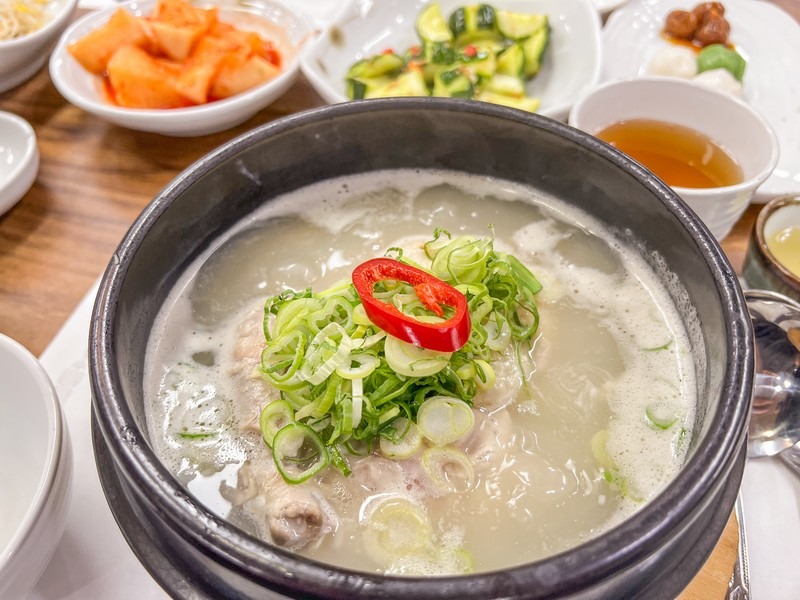
Bokbunja is especially popular in Korea during the summer months when fresh black raspberries are in season and the air is heavy with humidity. This is also when dishes like eel, mentioned above, and samgyetang are especially popular. The drink also has a winter appeal. There’s something particularly fitting about the deep, rich berry color in a cold season.
FAQ
What is bokbunja?
Bokbunja (복분자) is a Korean fruit wine made from wild black raspberries grown primarily in the Jeolla province and on Jeju Island. It’s sweet, tart, deep red, and typically between 13-15% ABV for commercial versions. It has been used in Korean traditional medicine for centuries and has significant modern health research supporting some of its benefits.
What does bokbunja taste like?
Sweet and tart, with a deep berry character. Wine drinkers often compare it to port meets berry liqueur with a slightly wild, herbal quality underneath. Bohae is the more nuanced, slightly bitter version; Myungjak is sweeter and more fruit-forward. Serve ice cold.
Is bokbunja healthy?
It contains four times the anthocyanins of grapes, plant-based omega-3 fatty acids, and soluble fiber. An Ohio State University study linked black raspberries to reduction in precancerous growths in colon cancer risk patients. Traditional Korean medicine uses it for stamina, kidney and liver support, and fatigue. As with any alcohol, consume in moderation.
Is bokbunja vegan?
Yes, it’s made from black raspberries and contains no animal products.
What’s the difference between Bohae and Myungjak bokbunja?
Bohae (15% ABV) is the dominant brand with more complex, nuanced flavor and astringency, the one served at the APEC and inter-Korean summits. Myungjak (13% ABV) is sweeter, fruitier, and more approachable for first-time drinkers. Both have won international wine competition awards.
Where can I buy bokbunja in Korea?
Bohae is available at E-Mart, Homeplus, Lotte Mart, many traditional markets, and duty-free shops. Myungjak is less common, look in specialty alcohol shops or traditional markets. Both are available at some duty-free airport shops on departure.
From mountain monk legends to inter-Korean summit dinners to modern antioxidant research, bokbunja earns its place in any serious exploration of Korean food and drink culture. The name is absurd. The drink is genuinely excellent. If you see a bottle, pick it up.
Did you like this post? Pin IT!


One Comment
Gary Blom
We live in Iowa the United States how can we order some