Museum SAN Wonju: How To Get There From Seoul & What You’ll See
Last Updated on October 21, 2026
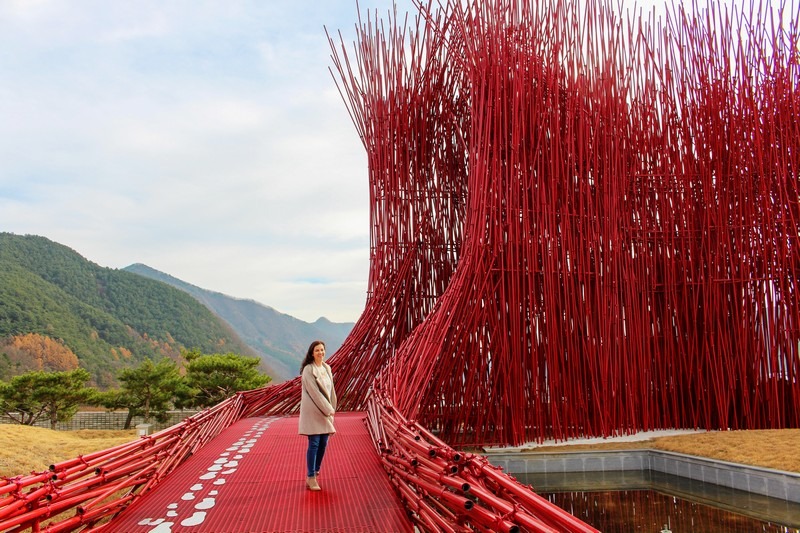
Museum SAN a couple hours from Seoul in Wonju, Korea is an intriguing museum designed by famed architect Tadao Ando. There’s an iconic photo that is posted on Instagram every so often with visitors standing beneath a bright red archway. The red is striking against the natural surroundings. It’s not the easiest museum to get to in Korea, but it’s definitely one of the most interesting as far as architecture and design.
If you’re an architecture enthusiast or a design lover and you’re headed to Seoul, make sure you get this into your itinerary if you’ve got time for a little day trip. Museum SAN draws visitors from all over Korea and you should be one of them this year.

Plan your trip to Museum San in Korea:
- What To Know
- How To Get There From Seoul
- Basic Info
- Which Pass Should You Buy?
- Reservations and Time Slots
- What You’ll See At Museum SAN
- Guided Tours
- FAQ
(This post contains affiliate links, which means I receive a certain percentage of a sale if you purchase after clicking at no cost to you. Thank you for your support.)
What To Know
Museum SAN (san means mountain in Korean by the way) is settled into a beautiful mountainous region and hugs the curves of the mountain gorgeously. The name works on two levels, actually. The museum also spells SAN out as Space, Art, Nature, which pretty much sums up what you’ll find there.
Designed by Tadao Ando, a minimalist architect, the concrete buildings are stark and yet at the same time perfectly suited for the nature it is surrounded by. Museum SAN is one of the seven Tadao Ando buildings in South Korea worth finding.

Ando first visited the site in 2005, and in his own words on the museum’s website, he almost worried no one would come. The museum is quite far from Seoul and he wasn’t sure people would make the trip. What convinced him was the land itself (a long, narrow mountaintop he saw as a chance to create “a world apart”) and the wish of Hansol advisor Lee In-hee to share the art collection she’d spent more than 30 years building. It took eight years to finish.
Opened in May of 2013, it wasn’t officially completed until James Turrell’s work was added. In 2019, the museum was named one of the 100 Must-Visit Tourist Spots in Korea for the third year in a row by the Korea Tourism Organization so it’s no wonder it makes the rounds in articles and on Instagram each year. To be honest, I wouldn’t say the collection of artworks inside was especially appealing, not to me anyway, but I was drawn to the natural surroundings and how the architecture of the building connected with that nature.
The museum has kept growing since it opened. The Meditation Hall was added in 2019, the Space of Light in 2023, and GROUND, a collaboration between Tadao Ando and British sculptor Antony Gormley, opened in June 2025. I visited in the autumn and haven’t been back since GROUND opened, so I’ve marked those newer spaces below and described them using the museum’s own information.
Museum SAN’s slogan is “Disconnect to connect” and this is certainly the best place to do that.
How To Get There From Seoul
Address: 260 Oak Valley 2-gil, Jijeong-myeon, Wonju-si, Gangwon-do (강원특별자치도 원주시 지정면 오크밸리2길 260)
By Car: If you don’t have a car, this might just be the time to rent one. Perfect for day trips from the city. Museum SAN is by no means easy to get to any other way but more than that, you can add more into your itinerary. Head out to the amazing Yeongwol Y Park, a beautiful experiential art complex and then go to Museum San on your way back into the city. OR, visit Museum San and then make a stop at the Illumination Theme Park Ooozooo which is the coolest rest stop in the country and has some brilliant light installations.
By Train and the Wonju City Tour Bus: Using public transportation used to take quite a few extra hours than you might have, but it’s gotten easier since Wonju redesigned its city tour bus in February 2026. Take a train from Seoul to Manjong Station (만종역) or Wonju Station (원주역), then hop on the Wonju City Tour Bus, which stops right at Museum SAN.
| Stop | Morning bus 1 | Morning bus 2 |
|---|---|---|
| Wonju Station | 9:20 | 10:40 |
| Wonju Bus Terminal | 9:29 | 10:49 |
| Manjong Station | 9:38 | 10:58 |
| Seowonju Station | 9:50 | 11:10 |
| Museum SAN | 10:31 | 11:51 |
For the trip back, buses leave the Museum SAN stop at around 1:13pm, 2:43pm and 4:51pm. The easiest plan is to catch the 9:20 from Wonju Station (or 9:38 from Manjong), arrive at 10:31, and take the 4:51pm back. That gives you around six hours at the museum, which is plenty for any pass.
A day pass is ₩5,000 for adults and ₩3,000 for youth and kids (₩8,000 for a two-day pass). You pay the driver in cash or by card. No reservation needed. The bus doesn’t run on Mondays (neither does the museum), and keep your bus ticket because it gets you 20% off admission. Check the current schedule on the Wonju tourism site before you go.
By Intercity Bus and the Oak Valley Shuttle: Take an intercity or express bus to the Wonju Intercity Bus Terminal, then look for the Oak Valley shuttle (a purple or brown Cheonho Tourism bus) at the stop in front of the terminal. The city tour bus also stops at the terminal. Check the shuttle schedule on the Oak Valley website before you go.
By Taxi: A taxi from Wonju Station, Manjong Station or the bus terminal is the fastest backup if the bus times don’t work for you. My friend went on her own and ended up waiting an hour for the local bus when she got to Wonju, so don’t be shy about grabbing a taxi.
A quick note: Museum SAN used to run its own paid shuttle from Seoul, and you’ll still see it mentioned online. It’s currently suspended.
Basic Info
Hours: 10:00am ~ 6:00pm
Days: Tuesday ~ Sunday
Admission: Museum SAN’s tickets work in tiers. Every ticket includes the Basic pass (the outdoor gardens, the Paper Gallery and the Cheongjo Gallery), and you add the special halls on top of that. You can’t buy entry to the James Turrell Hall or the Meditation Hall on their own.
| Pass | What’s included | Adult | Youth | Child | Infant |
|---|---|---|---|---|---|
| Basic | Gardens, Paper Gallery, Cheongjo Gallery | ₩23,000 | ₩15,000 | ₩5,000 | Free |
| GROUND Pass | Basic + GROUND | ₩39,000 | ₩29,000 | ₩5,000 (4:15pm only) | Free |
| James Turrell Pass | Basic + James Turrell Hall | ₩39,000 | ₩29,000 | ₩5,000 (3:00pm only) | Free |
| Meditation Pass | Basic + Meditation Hall | ₩39,000 | ₩29,000 | Not allowed | Not allowed |
| Special Pass 1 | Basic + Turrell + Meditation | ₩49,000 | ₩37,000 | Not allowed | Not allowed |
| Special Pass 2 | Basic + Meditation + GROUND | ₩49,000 | ₩37,000 | Not allowed | Not allowed |
| Special Pass 3 | Basic + Turrell + GROUND | ₩49,000 | ₩37,000 | Not allowed | Not allowed |
| Signature Pass | Everything | ₩59,000 | ₩47,000 | Not allowed | Not allowed |
| 1-Night / 2-Day Pass | Everything, over two consecutive days | ₩79,000 | ₩59,000 | Not allowed | Not allowed |
Who counts as what: Youth means elementary, middle and high school students. Bring proof of your kids’ birth year.
Discounts: Seniors, persons with disabilities, national merit recipients, Gangwon residents and Arts Pass holders get 20% off. Military, police and firefighters get 50% off. ICOM cardholders get in free. If you arrive on the Wonju City Tour Bus, show your bus ticket for 20% off admission.
Which Pass Should You Buy?
If you’re mainly there for the architecture: The Basic pass covers the buildings and gardens, which is where I spent most of my time. It’s the cheapest way to see what Tadao Ando did here.
If you want one upgrade: Pick the hall that matches your interests. The James Turrell Pass is for light and art lovers, the GROUND Pass is for anyone curious about the newest Ando space, and the Meditation Pass is for a quiet, guided rest.
If you’ve traveled a long way to get here: The Signature Pass is ₩59,000 and covers everything. Considering how far Wonju is from Seoul, it’s worth thinking about whether you’ll be back.
If you’re staying overnight at Oak Valley: The 1-Night / 2-Day Pass spreads everything across two days, so you can catch different light and different time slots.
If you’re bringing kids: Stick to Basic, the James Turrell Pass (3pm only) or the GROUND Pass (4:15pm only). Children can’t use the Special or Signature passes, and preschoolers can’t enter the Meditation Hall.
Reservations and Time Slots
You don’t need a reservation for the Basic pass. You just show up and buy a ticket at the Welcome Center. The three special halls are different. Each runs on timed entry, and you can book a slot online in advance or at the Welcome Center on the day. On weekends and holidays I’d book ahead because they can definitely fill up.
| Special hall | Entry times | Notes |
|---|---|---|
| GROUND | Every 30 minutes from 10:15am | Kids only at 4:15pm with a guardian |
| James Turrell Hall | Every 30 minutes from 10:30am | Kids only at 3:00pm with a guardian; last entry varies by season |
| Meditation Hall | Every 40 minutes from 10:25am | Max 25 people; no preschoolers |
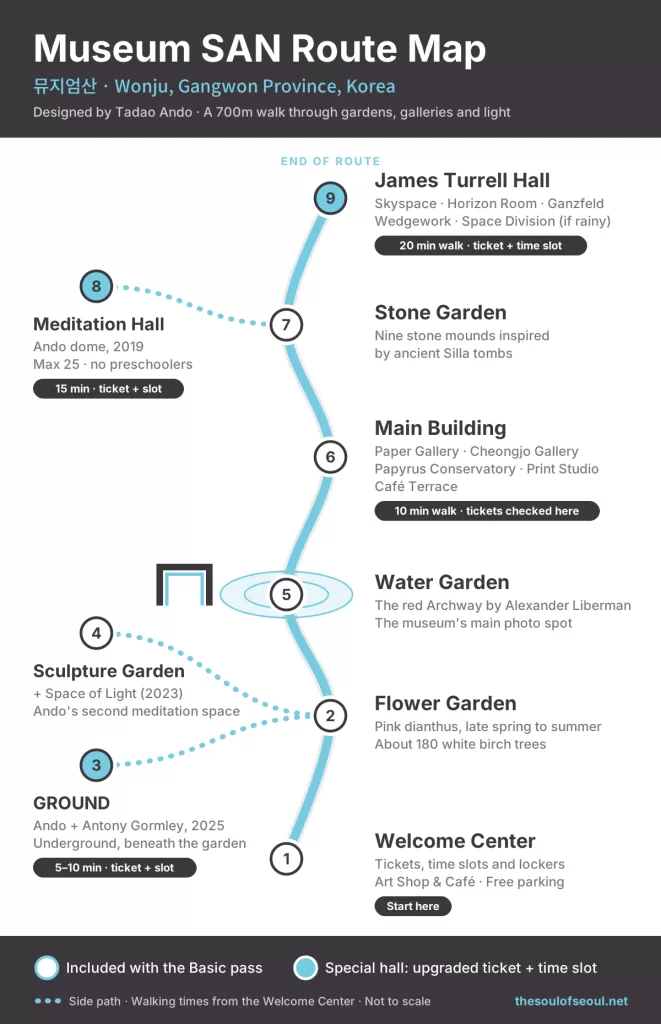
Give yourself time between slots. From the Welcome Center, it’s about a 10 minute walk to the Main Building, 15 minutes to the Meditation Hall, and 20 minutes to the James Turrell Hall (GROUND is closest at 5 to 10 minutes). The whole walking route is about 700 meters, and you’ll want to linger along the way.
What You’ll See At Museum San
Museum Welcome Center
From the parking lot, you’ll immediately enter the Welcome Center to find a desk to buy tickets and doors on either side to go through. You won’t actually present your ticket until you get to the Main Building so make sure you stash it in a pocket or in a bag until you get there as you meander through the Flower Garden and Water Garden.
The staff at the entrance strongly urges people to keep an eye on the ticket. It would seem people lose them on the way to the check point fairly often, so remember yours! The Welcome Center is also where you can book special hall time slots, store large bags in a locker (pick up a key at the front desk), and stop by the Art Shop & Café on your way out.

The Flower Garden
The Flower Garden is outdoors though despite the name, you won’t find flowers there year round if that’s what you’re expecting. Even in the autumn when the flowers have ceased blooming though, it was quite beautiful. When it is in bloom, it is the flower China pink that blankets the entire ground from late spring into summer. I’ve seen photos of this exact field in the summer and winter and can say it seems every season really is quite beautiful. Continue past the red installation and there is a white birch forest (about 180 trees) that leads to water installations and reflections.
GROUND (Antony Gormley Hall)
New since my visit. Right underneath the Flower Garden is GROUND, which opened in June 2025. It’s the first collaboration between Tadao Ando and British sculptor Antony Gormley, and it’s built as an underground cave with a 25-meter round interior and an opening that faces northeast toward the Wonju mountains.
Seven of Gormley’s Blockworks sculptures (blocky, human-shaped figures) are spread through the space and out past the cave’s mouth. Light comes down through a round opening in the ceiling, so the space changes with the time of day, the breeze and the sounds outside. The museum describes it as being the artwork, the space and the surrounding nature all at once.
Visitors are asked to stay silent inside. It’s on the GROUND, Special 2 and 3, and Signature passes.
The Sculpture Garden and the Space of Light
New since my visit. Past a grove of royal azaleas (yeongsanhong) is the Sculpture Garden, a lawn dotted with works by international artists including Joel Shapiro. Inside the Sculpture Garden is the Space of Light, which Tadao Ando designed in 2023 as the museum’s second meditation space. It’s built around Platonic solids (geometric shapes like the cube and tetrahedron), with natural light drawn in to play off each form.


The Water Garden
Once you round the bend, you’ll easily spot the red archway that makes the most iconic photos of the museum. Archway is the outdoor sculpture designed by Alexander Liberman that garners some of the most attention on the grounds. Don’t be surprised if people are taking turns getting their photos beneath it. Take your time, and you’ll get your turn.
Actually, the day we went, it was rather busy and people very efficiently moved in and out allowing each and every one to get their photo should they want it. The reflective pools are calming and if you enjoy them from different angles, you’ll see the sky, the trees, and everything around you. The Main Building is designed to look like it’s floating on the water, and the dark stones lining the pool are Haemi-seok.


The Main Building
The building feels a bit like a maze as it wraps around and is built in a ‘box in box’ concept (an exposed concrete box set inside an outer box of stone). The halls and doors go this way and that and I definitely got turned around a few times, but you’ll easily recognize the triangular spaces, circular spaces, and rectangular spaces which connect each gallery and lead to windows and cement walls as well as walls done in local Paju stone.
The shapes and materials represent the earth, sky, and human within the building (in Korean, Cheon-Ji-In). While there are artworks in the building, I was more drawn to the architecture of the museum itself and most of my companions were as well. I think I could definitely go back again and appreciate completely different angles of the museum.
The artworks inside are housed in the Paper Gallery and the Cheongjo Gallery. The Paper Gallery has a bit of a history museum vibe and showcases how paper is made and inked. The works here make sense considering the museum along with nearby Oak Valley Ski and Golf Resort was funded by the Hansol Group, a company best known for manufacturing paper.
The Paper Gallery actually started out as the Hansol Paper Museum in 1997, Korea’s first paper museum, and it holds designated National Treasures. It begins with a small Papyrus Conservatory where you can see the plant that was used for writing before paper existed, then moves through three halls covering the history of paper, Korean hanji crafts, and historic texts. There’s also a Print Studio where you can watch printmaking and make a commemorative postcard.
The Cheongjo Gallery has a permanent exhibition as well as two special exhibitions each year. Like I said though, we really breezed through the actual exhibitions as we were more in awe of the architecture.

The Stone Garden
I really loved the Stone Garden. Inspired by the ancient Silla tombs which you can see elsewhere in Korea, the most popular being in Gyeongju, the nine mounds here are completely covered in stone. There are other works interspersed throughout the garden and trees that stand solo. It was really a beautiful area. It was also one of the quieter spaces in the complex as everyone else seemed to want to sit near the Water Garden or in the cafe near even more reflective pools.
They are of course iconic for this museum, but definitely don’t miss a walk in the Stone Garden when you visit for something different. If you also purchase the ticket for the James Turrell work, then you’ll walk through the garden to that structure.
The Meditation Room
Though we missed the meditation space, it’s definitely something I’d go back for. Opened in January 2019 for the museum’s fifth anniversary, Tadao Ando designed the structure to fit in with the original museum elegantly. You can find the dome shaped building down some steps from the Stone Garden. The Meditation Hall actually resembles the mounds of the Stone Garden purposefully, so you might easily walk by not realizing what is inside.
Light enters the dome from above, and depending on the weather and time of day, the ambient light coming in changes which means you could go back numerous times and have completely different experiences. Sessions are guided programs (think aroma, sound and quiet breathing), with up to 25 people per session.
The James Turrell Hall
At the far end of the route is the James Turrell Hall, the piece that officially completed the museum in 2013. Turrell is an American artist (born 1943) who works with light itself as his material, and the hall holds five of his signature works: Skyspace, Space Division, Horizon Room, Ganzfeld and Wedgework.
Here’s something most people don’t realize until they’re there: which works you see depends on the weather. On a normal day, you’ll see Skyspace, Horizon Room, Ganzfeld and Wedgework. When it rains, Skyspace and Horizon Room are swapped out for Space Division. So if you’re set on seeing the open sky through Skyspace, check the forecast before you book.
Entry is by timed slot every 30 minutes, and kids can only go in at the 3pm slot.
Guided Tours
Museum SAN runs its own docent tours from the Main Building, limited to 20 people first come, first served. The one to know about if you don’t speak Korean is the English tour every Friday at 12:00pm.
| Tour | Times | Length |
|---|---|---|
| Architecture + outdoor garden (Korean) | 1:00pm, 2:00pm | 1 hour |
| Paper Museum / Art Museum (Korean) | 11:00am, 3:00pm | 50 to 60 minutes |
| Landscaping (Korean) | Wednesdays 12:00pm (not July to August) | Varies |
| English tour | Fridays 12:00pm | Varies |
Private tours aren’t allowed inside, so outside guides can’t lead groups through the galleries or gardens.
FAQ
Is Museum SAN worth visiting?
If you love architecture, yes. The Tadao Ando buildings and the way they sit in the mountains are the main event. Honestly, the architecture outshone the art collection for me, and that alone made the trip worth it.
How do I get to Museum SAN from Seoul without a car?
Take a train to Wonju or Manjong Station (or an intercity bus to Wonju), then the Wonju City Tour Bus, which stops at the museum. The 9:20am bus from Wonju Station arrives at 10:31. A taxi from Wonju is the fastest backup. The museum’s own shuttle from Seoul is currently suspended.
How much are Museum SAN tickets?
As of 2026, adult tickets range from ₩23,000 for the Basic pass (gardens and galleries) to ₩59,000 for the Signature pass (everything, including the James Turrell Hall, Meditation Hall and GROUND).
Do I need to book Museum SAN in advance?
Not for the Basic pass. The James Turrell Hall, Meditation Hall and GROUND need a timed slot, which you can book online or at the Welcome Center on the day.
How long should I spend at Museum SAN?
At least two to three hours. If you’re adding the special halls, plan on half a day since each runs on its own time slot.
Can children go into the James Turrell Hall?
Only at the 3:00pm slot, with a guardian. Children can enter GROUND only at 4:15pm, and preschoolers can’t enter the Meditation Hall.
What will I see in the James Turrell Hall?
Four of Turrell’s five works on any given day. On clear days that’s usually Skyspace, Horizon Room, Ganzfeld and Wedgework. On rainy days, Space Division replaces Skyspace and Horizon Room.
What is GROUND at Museum SAN?
An underground, cave-like space beneath the Flower Garden, designed by Tadao Ando with sculptor Antony Gormley. It opened in June 2025 and holds seven of Gormley’s Blockworks sculptures.
Is there food at Museum SAN?
Yes. The Café Terrace in the Main Building has sandwiches, soup, cake and coffee with a mountain view, and the Art Shop & Café at the Welcome Center has snacks and soft-serve.
Is there an English tour at Museum SAN?
Yes, every Friday at 12:00pm, starting from the Main Building.
I think Museum San is really gorgeous and worth the trip it takes to get out to it. That said, it’s much more efficient to join a tour rather than try to get out there on your own. My friend went on her own and it took her four hours from Seoul because an hour was just spent waiting for the local bus when she got to Wonju. It’s eye catching and intriguing, but not in the easiest location. All things to consider.
Did you like this post? Pin it!