Jeju Stone Park: The Complete Guide by a Local & the Seolmundae Halmang Myth
Last Updated on October 14, 2026
Honestly, the name Jeju Stone Park just doesn’t tell you enough about what you’ll be able to learn and take away from a visit here. You might go thinking you’ll see a collection of interesting volcanic rocks, maybe some dol hareubang statues, but the park is far more than that. Officially called the Jeju Stone Culture Park (제주돌박물관), it showcases the relationship between Jeju’s landscape, people, mythology, and history and after visiting three times, I can tell you, it’s a must visit.
Jeju is often called the “Island of Stones,” but that phrase means much more after a visit here. Lava stone has formed the island’s fields, walls, homes, graves, spiritual practices, and stories for generations. Jeju Stone Park brings all of those layers together in one place, and it does so without separating culture from the landscape that created it.
The Jeju Stone Park combines outdoor walking trails, stone sculptures, traditional architecture, a Gotjawal forest, and some of the best museums on Jeju Island. The newer Seolmundae Halmang Exhibition Hall is especially impressive, with engaging exhibitions on Jeju mythology, history, and folk culture, plus a huge children’s play hall. The older Jeju Stone Museum explains how the volcanic island itself was formed and displays stones shaped entirely by nature.
All in all, Jeju Stone Park needs to be on any Jeju itinerary if you ask me.

Get ready to explore Jeju Stone Park, from the legend of Seolmundae Halmang and the Five Hundred Generals to volcanic geology, traditional stone culture, and one of the best children’s museum spaces on the island.
- Basic Info
- How Much Time Do You Need At Jeju Stone Park?
- Why Stone Matters So Much on Jeju Island
- A Park Decades in the Making
- What To See at Jeju Stone Park
- What Makes Jeju Stone Park Family-Friendly?
- When Is The Best Time To Visit?
- Is Jeju Stone Park Worth Visiting?
- FAQ
(This post contains affiliate links, which means I receive a certain percentage of a sale if you purchase after clicking at no cost to you. Thank you for your support.)
Basic Info
Address: 2023 Namjo-ro, Jocheon-eup, Jeju-si, Jeju-do (제주특별자치도 제주시 조천읍 남조로 2023)
How to get there: If you don’t have a rental car, local Jeju buses 231, 701-1, 701-2, and 131 all stop directly at Jeju Stone Park, look for the bus stop named “Jeju Stone Culture Park.” This is one of the easier mid-mountain attractions to reach by public bus, so don’t let the lack of a car keep you away. I do recommend renting a car on Jeju Island if you want to see more generally though.
Hours: Tuesday ~ Sunday: 9:00am ~ 6:00pm (Last entrance at 5:00pm)
Admission: Adults: W5,000; Youth and Young Adults (13-24): W3,500; Children 12 and under: Free
Tickets: No advance booking is needed for general admission, tickets are sold on-site at the ticket booth.
Website: https://www.jeju.go.kr/jejustonepark/index.htm
Good to know: An eco-friendly electric vehicle travels a separate loop through the park for an additional fee. It is a nonstop sightseeing ride rather than a hop-on, hop-off shuttle. The Children’s Hall has its own age and admission procedures, which have changed as the space has grown in popularity, so check the current notice before visiting.

How Much Time Do You Need At Jeju Stone Park?
At a minimum, plan for three to four hours. There are other quick easy stops on Jeju Island, this isn’t one of them. It’s vast. Three to four hours gives you enough time to walk through the myth-inspired outdoor area and properly visit the Seolmundae Halmang Exhibition Hall or Jeju Stone Museum. The Seolmundae Halmang Exhibition Hall is fascinating, but if you go there, you may likely be museumed out for the others on the grounds. Consider which museum you’ll want to visit when you go.
If you want to see the major museums, explore the outdoor stone culture displays, and walk through the traditional thatched-roof village, this can easily become a full-day visit. The park covers approximately 3.27 million square meters, or 327 hectares, and more than 80 percent of the site remains Gotjawal forest.
On my first visit, we started to the left and followed the Seolmundae Halmang and Five Hundred Generals route. On later visits, I headed east to make sure we visited the Jeju Stone Museum and most recently we headed straight to the Obaek Jang-goon Gallery as that’s where art events like the Jeju Biennale are hosted.
Recommended Route for a First-Time Visitor
If you have half a day, prioritize:
- The Path of Legend and myth garden
- The Mother’s Room and Five Hundred Generals sculptures
- The Seolmundae Halmang Exhibition Hall
- The Children’s Hall if you are visiting with younger kids
- Traditional thatched-roof village
If you have more time, continue to the Jeju Stone Museum and the Stone Culture Outdoor Exhibition Area.

Why Stone Matters So Much on Jeju Island
To understand Jeju, you have to understand its stone. Jeju is a volcanic island created through repeated eruptions, and basalt appears everywhere. It is in the black walls dividing fields, the foundations of traditional homes, village gates, graves, shrines, tools, and protective sculptures.
Stone was not just a building material though, Jeju residents had to adapt their lives to rocky fields, strong winds, scarce resources, and an island environment that could be beautiful and difficult at the same time. The stone walls that visitors photograph today reflect generations of practical knowledge. If you visit and experience Jeju wind, you may wonder how these walls remain standing year in and year out. They allowed wind to pass through small gaps without knocking the entire wall down, thus they were able to continue to mark property, protect fields, and help people make use of the materials already beneath their feet.

You will see familiar dol hareubang here, but the park goes well beyond Jeju’s famous “stone grandfathers.” Look for jeongjuseok, the stone gateposts used at traditional homes; dongjaseok, small figures placed near graves; stone pagodas and guardian structures; millstones; water jars; and rocks connected to village belief and shamanic practice.

A Park Decades in the Making
Jeju Stone Culture Park grew from the work of Baek Un-cheol, who spent decades collecting stones, tree roots, folk objects, and sculptures through the former Tamna Mokseokwon. In 1999, the collection and its planning vision became the basis of a public-private project with the former North Jeju County.
Construction on the Jeju Stone Museum began in 2001, and Jeju Stone Culture Park officially opened on June 3, 2006. Development continued in phases, with galleries, outdoor exhibitions, the traditional village, and the enormous Seolmundae Halmang Exhibition Hall added over time. The latter just opened to visitors on June 13, 2025 as a comprehensive museum devoted to Jeju’s folklore, history, and mythology.

One of the most surprising parts of the park’s history might be the land beneath the Jeju Stone Museum though. The site had been used as a household waste landfill for about ten years, from 1989 through 1999. Because it did not produce leachate, planners were able to transform the depressed land into a museum built largely below ground.
The park’s guiding idea was always to preserve the natural surroundings first. Facilities were placed largely on pastureland while the dense Gotjawal forest was left intact. Rather than feeling like a large attraction imposed on the landscape, much of the park feels as if the trails, museums, and sculptures are quietly emerging from it. You really won’t understand how large the museums are until you’re inside because they’re built into the earth as opposed to on top of it.


What To See at Jeju Stone Park
This park is HUGE, so be prepared to do a fair amount of walking. Upon entering, you’ll want to take a look at the map to see what you definitely want to see and what you’re okay skipping… unless you plan to spend the entire day here. It’s that big! Actually, before you even enter, make sure to head to the bathroom at the ticket booth. There are bathrooms throughout the complex, but go before you enter so you have time to get your bearings rather than need something right away.
Once inside, decide on the path you want to take. At the entrance is a signboard with the various recommended paths which make it s bit easier to understand how the park is laid out and which path or paths you want to follow.

Seolmundae Halmang And The Five Hundred Generals
How long to allow: About 1 hour, including the Obaekjanggun Gallery
Seolmundae Halmang is Jeju’s giant creator goddess. In one of the island’s best-known origin stories, she carried earth in her skirt to form Jeju. Soil falling through holes in the fabric created the hundreds of smaller volcanic cones called oreums, while the largest mound became Hallasan.
Another, much sadder legend connects her to the Five Hundred Generals. During a time of famine, Seolmundae Halmang prepared a giant pot of soup for her five hundred sons while they went out to find food. While they were away, Grandma Seolmundae made some soup but as she was cooking, she slipped into the giant boiling pot and drowned. When the famished sons returned, they devoured the soup, not realizing their mother had perished and was in the soup.


The youngest son arrived last, discovered a bone, and understood the truth. He denounced his brothers and ran away crying. He ran until he reached as far as Chagwi Island and there he turned into a rock. His remaining brothers watched this and stood together lamenting their mother’s death every night and day until they too turned into rocks. The dramatic rock pillars of Yeongsil on Hallasan are associated with these Five Hundred Generals.
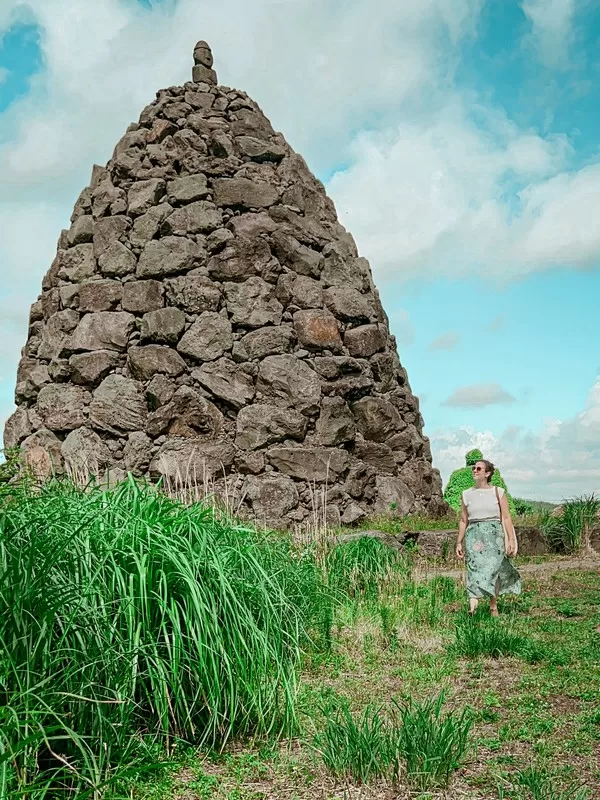
Within the park, the Pond Symbolizing a Soup Pot, Mother’s Room, Five Hundred Generals sculptures, and symbolic stone towers translate that story into a physical landscape. Knowing the legend before walking through makes these spaces much more moving.
Step off of the main path to follow a dirt path in to see the Five Hundred Generals Statues. On the southern slope of Hallasan, there’s a pictuesque place called Youngsi where the rocks rise high up into the sky. This area is called the five hundred generals which is what this page homage to.


Obaekjanggun Gallery
How long to allow: 30 – 45 minutes
The Obaekjanggun Gallery is an art and cultural exhibition space with seven special exhibition rooms, a permanent gallery, a performance hall, and an archive. Temporary exhibitions change, so there may be another reason to return even if you have already seen the park’s permanent collections. We’ve visited the park for various programs here including concerts, the Jeju Biennale and so on. It’s a spot to keep checking to see what’s going on.


The permanent exhibition downstairs contains something unexpected: sculptural roots from Japanese zelkova trees. These roots grew for centuries underground, pushing against Jeju’s rocks and taking on strange natural forms. Like the unlabeled stones elsewhere in the park, they invite you to look for faces, animals, and figures without telling you what you are supposed to see. That said, we definitely saw a camel, a bird perched on a nest, a seal… I remember learning long ago that our brains look for things we can make sense of recognize, even in the things with no rhyme or reason, we definitely found images when we took the roots in.


Seolmundae Halmang Exhibition Hall
How long to allow: 1.5 to 2 hours, longer with the Children’s Hall
The Seolmundae Halmang Exhibition Hall is one of the best museums I have visited on Jeju Island. It is also much larger than it appears when you approach it. The massive cultural complex was designed around the image of Jeju’s creator goddess and brings together the island’s folklore, history, and living mythology. I probably need to write an entire article just about this museum because it is just so full of fantastic information.
The hall opened in June 2025 (actually the building was finished in 2020, but it sat closed for five years because the initial exhibits fell short so they waited for further investment, it was worth it) with four permanent exhibition spaces, a special exhibition hall, and the Children’s Hall. There are more than 1,100 objects across the exhibitions, but the museum does not rely on objects in glass cases alone. Videos, large-scale installations, interactive displays, and hands-on activities make the stories much easier to follow.


Folklore Hall: Life In The Stone Fields
The folklore section begins with Halmang’s Treasure Chest, a storage-style exhibition displaying around 600 Jeju folk artifacts. Instead of hiding most of the collection away, the museum places tools, wooden objects, woven pieces, pottery, and household items across tall open shelves. It immediately gives you a sense of how much daily knowledge was required to live on the island.

From there, the exhibition moves into clothing, weaving, farming, homes, food, rites of passage, and seasonal customs. With scarce resources, fabric was extremely valuable. Different parts of the island became known for producing cotton, silk, or hemp, and the clothing on display reflects the durable, practical garments people needed.
The farming section also felt familiar to me after living on Jeju. It explains how neighbors shared labor, moving from one farm to the next to complete work together. I still see a version of this today when groups move from citrus orchard to citrus orchard to pick tangerines as they ripen.
What to look for: Notice the galot/garot (갈옷), this is traditional persimmon-dyed cloth, everyday working attire that was unique to Jeju. It was made by crushing unripe green persimmons into pulp and then dying cotton, linen, or ramie. When drying, the cloth goes from a bright yellow-orange to a deep rust-brown. The tannin from the persimmon juice stiffens the fabric at first, but then it becomes durable, water-resistant, and quick-drying and has natural antimicrobial properties.


With kids: Look for the table where children can examine and measure relics, the weaving activity, and clothing they can try on. There is also a traditional Jeju board game called neokdong-begi. It may remind you of yutnori, a traditional game played during the Lunar New Year, but it uses smaller pieces and a distinctive radial board.


The History Hall: Jeju, Time Of The Island
The history exhibition looks at the people of Jeju through the sea, stone, and land. It moves from the maritime kingdom of Tamna through the Goryeo and Joseon periods, showing how trade, religion, defense, and stone culture changed over time.
One of the most impressive spaces is a huge three-sided video hall devoted to Tamna and its trading ship. The curved exhibition design evokes ocean waves, which is fitting for an island whose history cannot be separated from the sea. Elsewhere, OLED displays highlight Buddhist artifacts and visitors can step into a recreation of Byeolbangjin, a Joseon-era fortress built to defend against Japanese raiders.


Exit one building, and enter the next to find the epilogue, Life on Halmang’s Island. Seolmundaehalmang remained on Jeju even after creating the island. She lived diligently in harmony with nature. This mythical image served as a guiding light reflecting the lives of Jeju’s people, who had to work tirelessly in harmony with their environment. This is the introduction to Jeju’s folklore where a love for nature and neighborly consideration is of the utmost importance for survival.

The Mythology Hall: Jeju’s Living Gods
Jeju is often described as the homeland of 18,000 gods. The phrase makes more sense after walking through this section, which explores the bonpuri, narrative songs that tell the origins and lives of deities in Jeju shamanism.
This is the only permanent exhibition hall in Korea devoted to Jeju’s Twelve Bonpuri. The stories deal with birth, farming, family, prosperity, death, shamans, and the relationship between the human and divine worlds. They are not simply folktales from a distant past. Many are still recited during rituals today.
The galleries also explain village shrines, or dang. A shrine may include a sacred tree, an altar enclosed by stone walls, and a small hollow called a gwe where offerings are placed. The Bonhyang-dang is the village’s principal shrine, connected to the safety, prosperity, births, deaths, and wellbeing of the community.
Fun fact: Depending on the village, locals usually visit the Bonhyang-dang on the 7th, 17th, and 27th of the month or the 8th, 18th, and 28th.


Today, there are five shrines: Songdang Bonhyang-dang, Saemiharosan-dang, Waheul Bonhyang-dang, Susan Bonhyang-dang, and Walpyeong Darakut-dang that are designated as Jeju Province Folklore Heritage. There are four major rituals of Bonhyang-dangs, the New Year greetings, one for the wind god, one for the livestock god, and one for the harvest. All four are still performed at Songdang Bonhyang-dang and are designated as Jeju Province Intangible Cultural Heritage.

I appreciated that this section treats Jeju’s spiritual culture as a living system rather than something quaint or decorative. It is one of the best places on the island to begin understanding how mythology, nature, and community remain intertwined. It’s absolutely fascinating and if you live on Jeju Island like we do, you’ll gain a much deeper understanding of the ceremonies, rites, and beliefs still held today.
The Children’s Hall
The Children’s Hall is not just a small corner with a few blocks and coloring pages. It is a huge play space themed around “The Future of Jeju,” with Hallasan, Seolmundae Halmang, and the Five Hundred Generals worked into the environment. Children can climb, crawl, balance, and play while becoming familiar with the island’s shapes and stories. The hall was designed especially for young children and lower elementary students, and it has become extremely popular with local families since opening.
If you are traveling with younger kids, this makes Jeju Stone Park an especially good rainy-day option. You can explore the cultural exhibitions together and then give the children time to play indoors. The play hall sometimes uses timed sessions or separate registration procedures during busy periods. Confirm the latest rules on the official Jeju Stone Culture Park website before you go.
Family tip: Do the museums before the play hall if you can. Once children see the climbing structures, it may be difficult to persuade them to return quietly to the exhibitions.


Jeju Stone Museum
How long to allow: 1 to 1.5 hours
The Jeju Stone Museum is where the park shifts from mythology and folk culture toward geology. Built mostly below ground, the museum uses the shape of the former landfill site rather than rising high above the surrounding landscape so you won’t realize how big this museum is, though not as large as the Seolmundaehalmang Complex.


At the center of the Jeju Formation Exhibition Hall is a 12-meter-long model of Jeju Island that appears to float on water. Exhibits circle around it in nine themes, including the universe and Earth, Korean geology, Jeju’s volcanic activity, volcanic ejecta, lava caves, oreums, sediment, landforms, and groundwater. There is some great information here. If your children are learning about geology and land formations in school, this is a great addition to that education.

This is an excellent museum for anyone who has been hiking oreums or visiting lava tubes but does not fully understand how they formed too. Models show how different volcanic cones developed, while rock and sand samples give children something more tangible to observe. The groundwater display is also particularly useful on an island that depends heavily on water stored and moving beneath porous volcanic rock.

The Natural Stone Exhibition And Stone Gallery
The natural stones here have not been carved by people. Their unusual shapes were created by magma, repeated eruptions, weather, and waves. Twenty-three stones donated by Baek Un-cheol are displayed without names or interpretive labels. Visitors are instead given room to see their own landscapes, animals, faces, or figures rather than being told what each stone resembles, much like the previous gallery mentioned with the root structures.
The Stone Gallery continues with lava balls, volcanic bombs, head-shaped stones, and rocks worn smooth by the Jeju sea. Walk around them if you can. Their expressions and forms seem to shift as your angle changes.


Stone Culture Outdoor Exhibition Area
How long to allow: 1 hour
The outdoor stone culture area shows how Jeju residents used stone from the prehistoric Tamna period through more recent history. The approximately 970-meter route includes stone connected to homes, belief, agriculture, graves, pagodas, guardian figures, and everyday work.
Eight thatched-roof exhibition buildings provide chronological and practical context, while the outdoor displays let you see the objects in a landscape much closer to the one in which they were originally used. This section is especially worthwhile if you have noticed stone structures around Jeju but have not known their names or purposes.


Jeju Traditional Thatched-Roof Village
How long to allow: About 1 hour
The traditional village recreates a Jeju settlement from around 200 years ago. It contains 49 thatched-roof buildings arranged as 19 households, along with barns, a mill, cattle sheds, resting spaces, and a shrine dedicated to Seolmundae Halmang. The village sits among oreums, pasture, and Gotjawal with Hallasan behind it. Great care was taken to make it appear like a living old village from a distance rather than a tidy collection of isolated replica houses.
Walk along the low stone walls, look for onggi jars, and pay attention to how the homes sit close to the land for protection from Jeju’s winds. More recently, the village has also attracted visitors looking for scenery used in the Korean drama When Life Gives You Tangerines.
If you want to learn more about traditional life on Jeju Island, you can also visit the Jeju Folk Village with more than 100 houses from the 1890s, or visit the Seongeup Folk Village, not a replica like Jeju Folk Village and the village here at Jeju Stone Park, rather it is a living village that has been continuously inhabited for around 600 years.
If you’re only visiting Jeju Stone Park and nowhere else, the village here is a convenient two-for-one. But if you have more time in your itinerary, I’d point you toward Seongeup Folk Village first, since it’s lived-in rather than reconstructed, and if your family wants more hands-on activities than either of the other two offers, Jeju Folk Village is the better fit.

What Makes Jeju Stone Park Family-Friendly?
I have visited with my daughter, and this is one of the rare Jeju attractions that works on several levels at once. Adults can spend hours with the art, mythology, geology, and cultural history, while children have interactive museum stations, outdoor space, stories, and an enormous dedicated play hall.
The park also gives families room to adjust. If children need movement, head outside to the paths. If the weather changes, go into one of the substantial museums. You do not need to expect a young child to appreciate every historical label for the day to feel worthwhile.
Tips For Visiting Jeju Stone Park With Kids
- Bring a stroller for younger children, but expect some forest paths and uneven outdoor ground.
- Wear walking shoes. The distances between major zones are longer than they look on the map.
- Check the Children’s Hall rules before visiting, especially on weekends.
- Bring water and snacks, but eat only in permitted areas.
- Save the Children’s Hall for later in your visit.
- Do not try to see everything. Choose two or three priority areas and enjoy them.
- Keep a rainy-day version of your plan focused on the Seolmundae Halmang Exhibition Hall and Jeju Stone Museum.

When Is The Best Time To Visit?
Jeju Stone Park is open year-round, and each season changes the outdoor experience. Spring and autumn are the most comfortable for covering the long walking routes. Summer is lush and green, but the combination of sun, humidity, and distance can be tiring. Don’t underestimate the heat. That said, you never have to be outside all that long thanks to the position of the museums you wouldn’t have to walk more than 10-15 minutes between them if you didn’t want to. In winter, the exposed outdoor areas can feel much colder than coastal Jeju, so dress for wind.
Rain does not ruin a visit because the two major museums can fill several hours on their own. In fact, Jeju Stone Park is one of my favorite rainy-day attractions on Jeju for families. Just know that you will miss some of the atmosphere if you skip the outdoor mythology and stone culture routes entirely.

Is Jeju Stone Park Worth Visiting?
Absolutely. I have been three times, and I still do not feel as though I have exhausted it. That is partly because of the park’s sheer size, but it is also because the experience changes as you learn more about Jeju.
On one visit, the stone sculptures may stand out. On another, it may be the story of Seolmundae Halmang, the remarkable mythology galleries, or a tiny household tool that explains how people survived in a difficult landscape. With the addition of the Seolmundae Halmang Exhibition Hall and Children’s Hall, the park has become even easier to recommend to families.
It’s not just my opinion, either, Jeju Stone Park was named one of “Korea’s Top 100 Must-Visit Tourist Attractions” for 2023–2024, has been certified in the Public Museum Evaluation for three consecutive years, and was rated the best-managed public tourist site on Jeju in the province’s 2024 evaluation.
Jeju Stone Culture Park is not simply a place to look at rocks. It is a place to understand why stone sits at the center of Jeju’s landscape, homes, beliefs, and identity. If you want to see the real Jeju rather than only moving from one scenic photo spot to the next, put this on your itinerary and give it the time it deserves.
FAQ
Is Jeju Stone Park the same as the Jeju Stone Museum?
No, the Jeju Stone Museum is one part of the larger park, which also includes the Seolmundae Halmang Exhibition Hall, outdoor stone-culture trails, the Obaekjanggun Gallery, and a traditional village.
How long does it take to see Jeju Stone Park?
Plan on three to four hours minimum. Seeing everything, both major museums, the outdoor trails, and the traditional village, can easily fill a full day.
Do I need to book tickets in advance?
No. General admission tickets are sold on-site at the ticket booth, no advance reservation needed. The Children’s Hall may have its own registration process during busy periods, so check the current notice before you go.
Is Jeju Stone Park good for kids?
Yes. The Children’s Hall is a large indoor play space themed around Jeju folklore, which makes Jeju Stone Park one of the better rainy-day options for families on the island.
How do you get to Jeju Stone Park without a car?
Local buses 231, 701-1, 701-2, and 131 all stop at the “Jeju Stone Culture Park” bus stop.
Is there a discount or free admission day?
Jeju residents receive a discounted rate with ID. Everyone gets in free on the last Wednesday of the month, which is designated Culture Day.
What is the legend of Seolmundae Halmang?
Seolmundae Halmang is Jeju’s giant creator goddess, said to have carried earth in her skirt to form the island, soil falling through holes in the fabric created the smaller volcanic cones called oreums, while the largest pile became Hallasan.
Did you like this post? PIN IT!


