A Guide To Renting or Buying A House in Korea
Last Updated on September 25, 2025
Having lived in Korea for almost twenty years, I’ve gone through nearly every type of housing you can imagine. I started off in school-provided housing, then rented a tiny room, moved into an officetel and then a villa, and eventually with my husband, we bought an apartment, and now we live in an actual house on Jeju Island.
From sleeping on a friend’s floor while waiting for a job to sort out housing, to putting down tens of thousands of dollars in key money, I’ve experience the highs and lows of navigating Korea’s unique housing system. If you’re a foreigner moving to Korea, or even considering buying property here, this guide breaks down what you need to know.

There’s a lot to know when it comes to housing in Korea whether you’re renting or buying:
- Housing Options in Korea
- Key Words To Know for Korean Housing
- How to Find Housing
- Loans & Banking
- Reducing Housing Risks
- Moving In and Out
- Buying a House in Korea as a Foreigner
- Tips from My Own Experience
(This post contains affiliate links, which means I receive a certain percentage of a sale if you purchase after clicking. These funds go to maintain the site. Thank you for your support.)
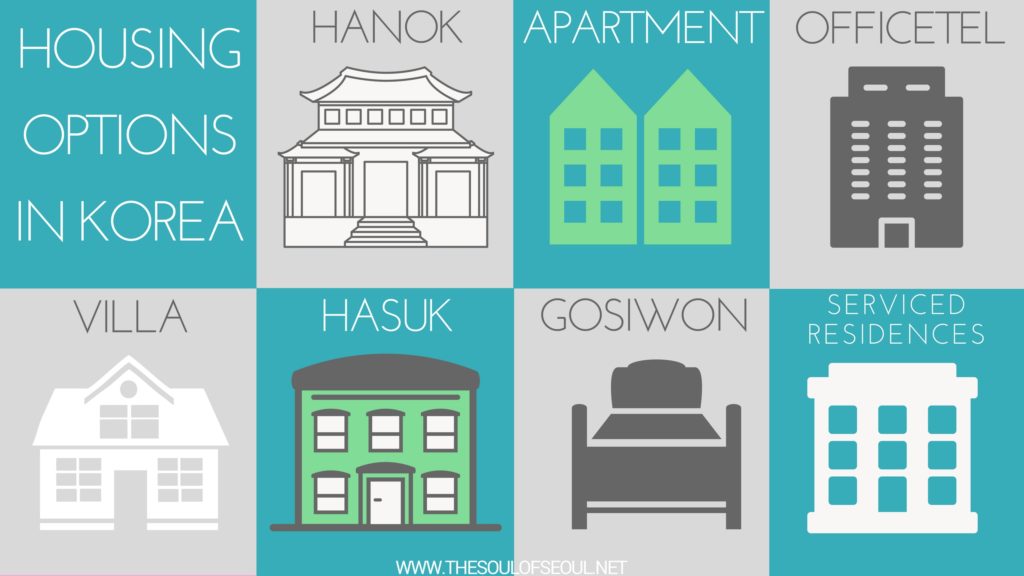
Housing Options In Korea
Serviced Residences: Great for short and long term residents. Fully furnished with kitchens, front desk service, and business facilities. Usually cheaper than hotels but more expensive than renting.

Apartments (아파트): The most common type of housing in Korea. Large complexes often have playgrounds, markets gyms, and underground parking. The water/gas and heating are all well established however, the units may be a bit smaller than they are in their western country counterparts. Convenient but sometimes noisy and crowded.
Officetels/One Room Studios (오피스텔 / 원룸): Popular with students and young professionals. Small but modern, often in great locations near transport. Typically equipped with kitchens and keyless entry.
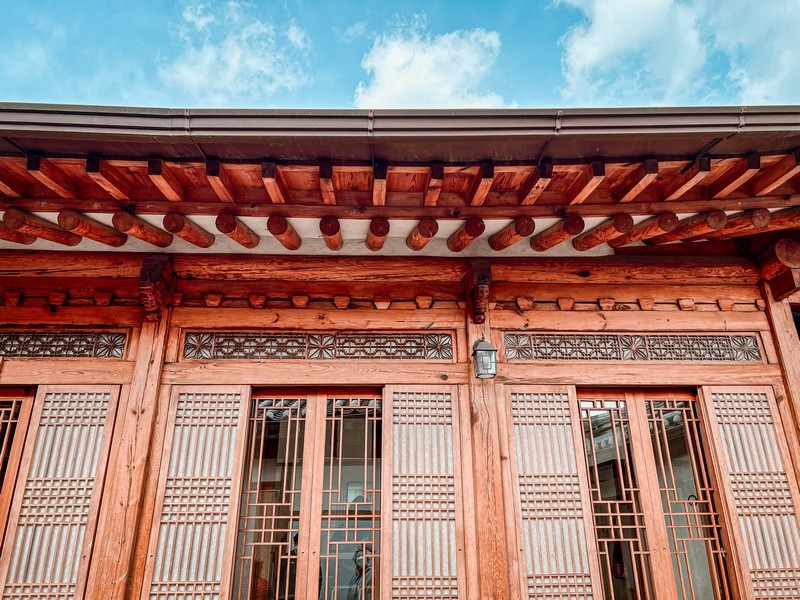
Hanok (한옥): Traditional Korean houses with the traditional ondol (heated floors) heating. Rare, but possible to rent. Many have been updated with modern kitchens and bathrooms.
Villa/Jutaek (주택): Low-rise buildings, they are usually a bit older than the apartments. These villas may be furnished or not and usually have a gate and perhaps a courtyard, garden or rooftop patio/garden. They don’t usually have maintenance personnel or security guards. I’ve always opted for a jutaek because I like getting to know my neighbors and they’re usually a bit more unique than the cookie cutter apartments.
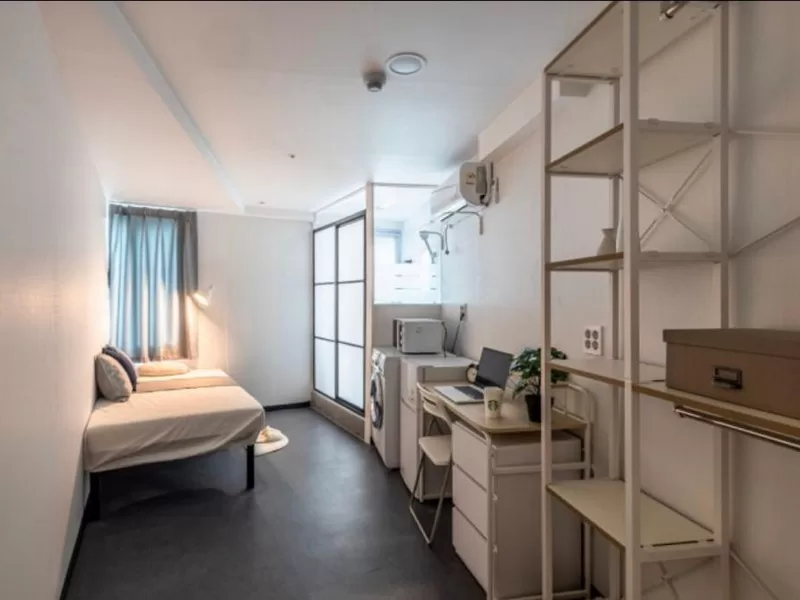
Goshiwon (고시원): Tiny rooms, often just large enough for a bed, desk, and a private bathroom, these are the cheapest option, popular with students preparing for exams or workers needing a crash pad. Ideal if you don’t plan to spend too much time in your house.
Hasuks (하숙 집): These are mini-dormitory like abodes in a house for students coming to the city for university or for business people who want to live closer to the workplace. Usually run by an older housekeeper and meals are included, the rooms are usually small but furnished with a bed, storage and a desk.

Key Words To Know For Korean Housing
Jeonse (전세): A large lump-sum deposit that is usually 30% to 60% of the property value. The landlord keeps this money for the duration of the housing contract which is usually 2 years long. At the end of the contract, the landlord MUST return this deposit.
Note: Landlords used to put this money into a CD for interest, but since interest rates have fallen drastically, they’re using it for other investments. Unfortunately, in recent years there have been a number of scandals with landlords unable to repay jeonse and going bankrupt so jeonse is becoming less common and less popular.
Wolse (월세): A key money deposit plus monthly rent. Most common for foreigners. The key money deposit in this case is about 4 to 20 times the amount of the monthly payment. Rents can range from W150,000 (~$150) to W3,000,000 (~$3,000) a month depending on how much is deposited and location.
Kalse (칼세): Pay the entire rent upfront for the whole contract. Used mostly by companies, but also common on Jeju Island.
Pyeong (평): Korean measurement for housing size. 1 pyeong = ~3.3m², but actual usable space is often 30-40% less than stated as this can include the hall/elevator, etc.
How to Find Housing
There are a number of ways to find housing in Korea.
- Housing apps: Zigbang (직방), Dabang (다방), and Naver Real Estate are popular apps. Be aware of the bait and switch though as realtors have been known to put up great pictures and then tell you they just want to show you a different spot nearby which is completely different.
- Real estate agencies (부동산): It’s most common to go to the area that you wish to take up residence and find the nearest budongsan. Stop in to meet the realtor and see what they have available. They usually hang paper in the window with a brief overview of what they have on offer.
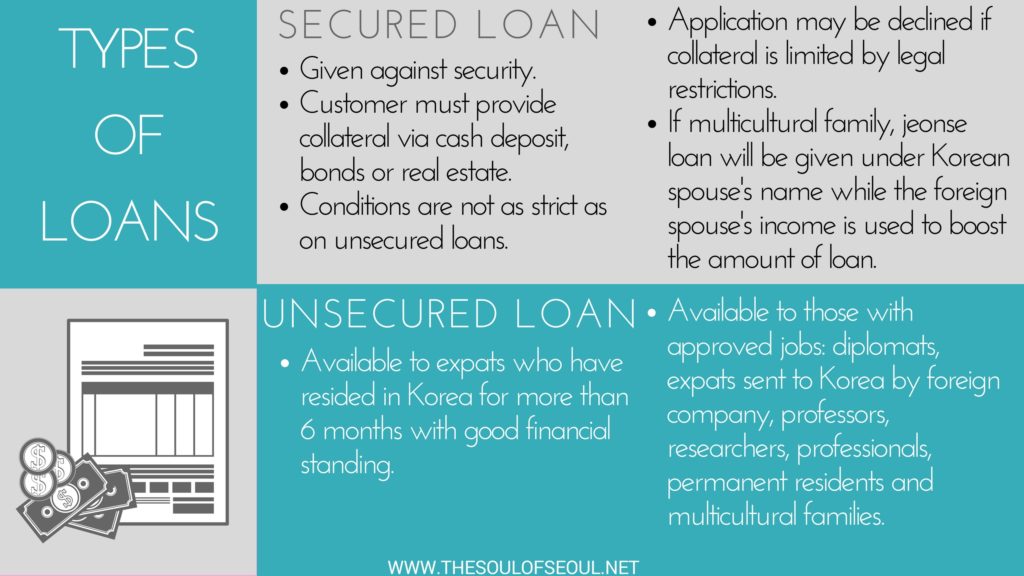
Loans & Banking
Check for liens or loans on the property (the bank will verify this if you go to take out a loan and may not offer you a loan if a lien/loan exists).
Loan requirements: Have an initial assessment at a bank. The bank will consider your personal information, job status, annual income and other collateral information to let you know what you may be able to borrow. Banks may have slightly different qualifications and some work more easily with foreigners than others so if you go to your bank and they are hesitant, try another bank. KEB is generally the most foreign friendly. Note that it’s not solely based on you though, the bank also needs to assess the property and the property owner in order to consider the loan so there will be a three day waiting period while this is done.
What to take to the bank for the assessment:
- Alien Registration Card
- Proof of employment/certificate of employment
- Proof of salary (annual tax settlement form/pay stubs from the past three months)
- Proof of alien registration (obtained from the Korean Immigration Service)
- Marriage certificate or a family relations certificate issued from the district office, if applying for loan as a multicultural family
After the initial process is started at the bank and the application has been approved, the loan officer will then assess and set lending conditions for you to agree to. Once you agree, you sign a contract and the loan amount will be deposited into your account via the loan center. This process can take up to a week. Any fees/expenses are deducted from the amount, so be aware of that.
Pro tip: Check at a few different banks as criteria vary by branch and company. Start with KEB Hana, Woori, and Shinhan.

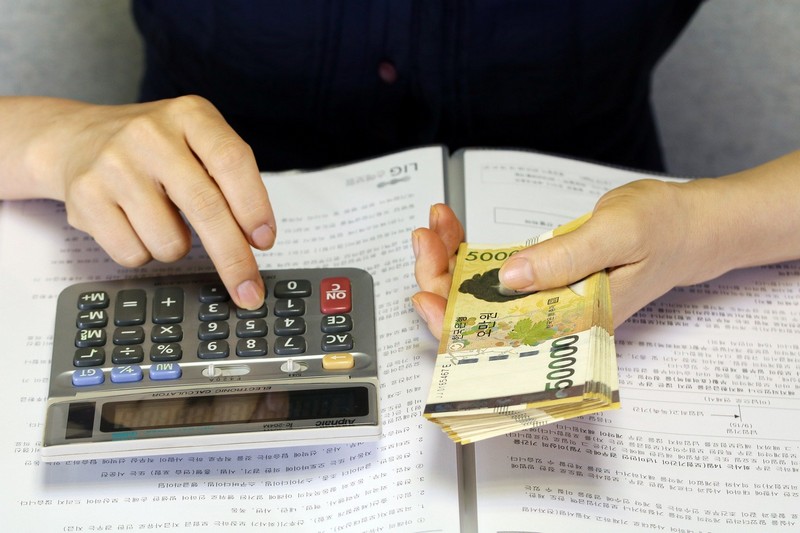
Paying deposits: Typically 10% of the key money is required when signing, while the balance is expected on moving day. Avoid moving on a weekend as banks are closed. Make proper arrangements with the owner if you have no other option.

Reducing Housing Risks
Register your lease at the district office and get a hwak-jeong-il-ja (확정일자). This form is an official record of your deposit money and establishes your priority for getting your money back if the landlord defaults.
Tenant rights: If you don’t register, you still have some protection if you live in the unit and register your address, but you may not recover the full deposit.
Scams: Always check ownership documents and avoid paying deposits in cash without official contracts.
Leasehold Right Registration Order: If the landlord delays your refund, apply for a Leasehold Right Registration Order to keep your preferential repayment rights even if you must vacate.
Moving In and Out
Get movers: Korean moving companies are the best money spent for the big change. They arrive with their own reusable boxes, pack, move, and unpack everything for you. The entire process is usually done in less than 10 hours. They take apart and reassemble furniture, hang shelves, pictures, and mirrors.
Leaving early: You may need to find your own replacement tenant to get your deposit back if you’re breaking your contract. Per Korean etiquette, even if you’re not asked to find your own tenant, you will be expected to pay the realtor costs.
Standard notice period: 60 – 90 days
Landlord notice: If your landlord asks you to leave, perhaps for building redevelopment, they are also required to provide the same notice period.
Deposit return: Clarify with the landlord when the deposit will be returned. Deposits may be delayed if the landlord doesn’t have liquidity. Often the landlord relies on the incoming renter’s deposit and uses that to pay the previous.
Personal note: We once had a landlord that could not pay us back our key money at the end of our tenancy as no one new had taken up the contract for rental. Our contract had finished, but because we weren’t going to get our money back until they had a new renter, we stayed… for three months. My recommendation? Don’t leave the apartment until you’re assured you get your money back. They have less urgency if you skedaddle.
We once had a friend whose landlord couldn’t pay him back, so he just stayed in the apartment and didn’t pay anything for 6 months to recoup the loss.
Buying a House in Korea as a Foreigner
Yes, foreigners can buy property in Korea.
- Registration: You must file a Real Estate Transaction Report with the local district office within 60 days and register the ownership transfer.
- Loans: Some banks, like KEB Hana, lend to foreigners, but you’ll need stable income, a long-term visa, and lots of paperwork.
- Taxes: Acquisition tax (취득세), property tax, and possible capital gains tax will be required when selling. Be prepared.
2025 Updates: In parts of Seoul, foreign buyers now need prior approval and, in some cases, must move in and reside for a period of time. This new restriction is in an effort to curb speculation.
Tips from My Experience
- School-provided housing is convenient for new teachers but risky as your boss essentially controls your roof. If you’re planning to come to Korea to teach English for just a short time, this makes for a soft landing. Just make sure you’ve vetted the school.
- Renting on your own gives more freedom, but always register your deposit.
- Be cautious with jeonse. It can save money but carries risks if landlords misuse your deposit which is happening more and more.
- Buying can be a long process, but with the right bank and patience, it’s possible for foreigners too.
Finding housing in Korea can feel overwhelming at first, but once you learn the system it becomes manageable. Whether you’re here for a year of teaching English or planning to settle long-term, there are options for every budget and lifestyle.
Did you like this post? Pin It!

2 Comments
Julissa Vizcarra
I’m planning on moving there for a year. I will find my own job before going. I have always wanted to move to a safe country to help in someway in the medical field. I chose Korea. So my question is , is it better to just rent a airb and b for that year if I play upfront ? Or is that something I shouldn’t do ? I’m assuming they don’t need a deposit?
Bee
Woah…some serious paper work. So glad you guys found your own place. I agree I’m very happy to be done with the e2 hagwon sponsored housing. Well done!