Bruise Cure = Egg?
Last Updated on October 12, 2026
“Put an egg on your bruise. You know an egg can suck out the bruise.”
I eyed him skeptically and then cracked up. (How fitting is that idiom right now?) Do eggs cure bruises? I had never heard of this bruise remedy before and didn’t know if it was a my husband thing, a Korean thing, a his mother thing, or just a thing I’d never heard before. He wondered why I was laughing so much and I said I’d only ever heard of putting raw meat on bruises to cure them… though I’ve also never tried that “cure”. I’ve learned a lot about holistic medicine while living in Korea, so I was game.
So, do eggs actually cure bruises? No, there’s no scientific evidence that an egg cures bruises. What I think is really going on is that this folk remedy conflates two different, and actually contradictory, practices: rubbing a hot hard-boiled egg on the skin (which is a version most tutorials online describe, and which can actually make fresh bruising worse by increasing blood flow to the area) and applying something cold, which is closer to what my husband actually meant, and which is the one version of this that lines up with what doctors actually recommend.

Does a hard-boiled egg help a bruise? Here’s what I found out:
- What A Lot of Directions Online Say To Do (The Hot Egg Method)
- Did I Actually Try It?
- Other Bruise Remedies & Treatments
- How Long Does a Bruise Normally Take To Heal?
- FAQ
(This page contains affiliate links. That means if you click on them and purchase something, I will get a percentage of the transaction at no cost to you. Thanks for the support!)
Apparently the heat from a warm egg opens up the pores in your skin and allows vitamins and protein from the egg to get in to help move the blood around in the skin. I’m still not sure where it came from, or if it works, but when I search for information on the internet directions pop up.
This cure is an old idea but there is no scientific evidence behind it. To be honest, one thing I’ve learned while living in Korea is that some of those old folk and herbal remedies just work. It’s one reason I love visiting Yangnyeongsi Herbal Market and the Seoul K-Medi Center in Seoul because there are so many opportunities to learn about what what roots, herbs, and other dried plants can do for the body.
I’ll be honest, I still don’t know for certain whether the egg trick, hot or cold, is something specifically Korean, something my mother-in-law’s generation picked up from somewhere else, a remedy that shows up independently in a lot of cultures, or perhaps it was just a mom telling her kid to sit still with something she had cold in the fridge which happened to be an egg. If you know the actual origin, I’d love to hear it though.
If you want some other ideas on holistic medicines from Korea specifically, check out this article on how to use roots, herbs, bark, and more as holistic remedies.
What is a bruise? A bruise, or contusion, happens when small blood vessels under your skin break and lead blood into the surrounding tissue, that’s what causes the discoloration and swelling in the first 24-48 hours after an injury.
What A Lot of Directions Online Say To Do (The Hot Egg Method)
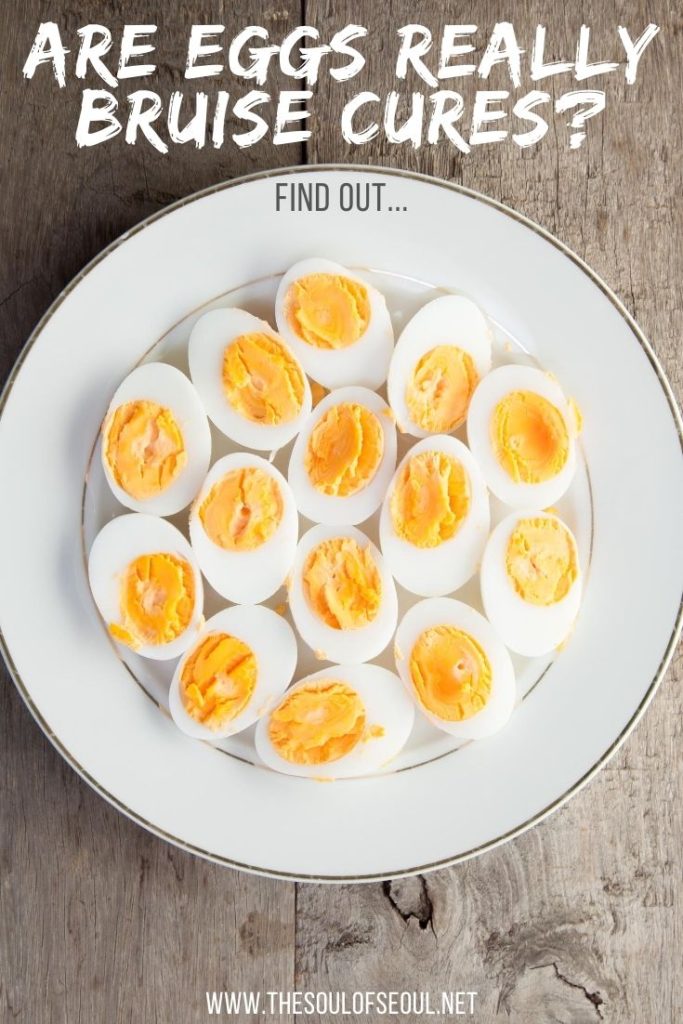
1. Boil water on the stove and when it begins to boil, put the egg in. Boil the egg for 4-6 minutes until it’s hard, the yolk shouldn’t be runny.
2. Remove the egg from the water carefully and then crack the egg open. You don’t want to let the egg cool but it will be hot so protect yourself with a mitt.
3. Wrap the egg along with a silver ring in a light handkerchief or napkin. Do this quickly so the egg is still hot, a cold egg will not help.
4. Apply the cloth covered egg to the bruise and rub until the egg has cooled. Do this a few times a day until the bruise is gone.
Notes: Some directions include the silver ring, some don’t. I’d imagine if you’re rubbing the bruise for a few days, the egg may not matter because a few days later the bruise would be gone anyway.
There’s a problem with this though because rubbing anything hot on a bruise could cause even more internal bleeding which would have the opposite effect and grow a bigger bruise. What would work better? And, what did my husband mean when he talked about putting an egg on my bruise? Putting one of the cold hard-boiled eggs from the fridge on my bruise and that wouldn’t be UNLIKE putting a cold steak on it really so I guess we were really thinking of the same remedy.
What does heat on a bruise do? It widens blood vessels, which increases blood flow to the area. This is useful later to help your body reabsorb an existing bruise faster, but counterproductive on a fresh one.
So what did my husband actually mean when he told me to put an egg on my bruise? He meant taking one of the cold, hard-boiled eggs already sitting in our fridge and holding that against the bruise, which isn’t really so different from icing it, or holding a cold steak on it, the other classic “cure” I’d grown up hearing about. So it turns out we were both circling the same basic idea: cold helps, heat doesn’t. We just landed on very different versions of “egg”.
What does cold on a bruise do? Cold narrows the blood vessels, which slows blood leading into the tissue, reducing swelling, and can limit how large or dark a bruise gets.
Did I Actually Try It?
Yes. I did try the cold-egg version on a bruise. I can’t tell you with any confidence that it healed faster than it would have with just ice, or with nothing at all though. The bruise did eventually fade, like bruises do, but that’s also just the natural rhythm of how a bruise heals on its own. I don’t have a control-group version of my own arm to compare it to.
What I can say is that it felt fine, it’s basically free, and unlike the hot-egg version, it’s not doing anything counterproductive. I wouldn’t tell you it’s a cure. I’d tell you it’s a low-effort, zero-risk thing to reach for if you happen to have hard-boiled eggs in the fridge and no ice pack handy.

Other Bruise Remedies & Treatments
| Remedy | How it’s supposed to work | Evidence level | Best used when |
|---|---|---|---|
| Cold hard-boiled egg | Acts like a makeshift cold compress | Same evidence as any cold compress (real, but the “egg” part is incidental) | Immediately after bruising, first 24–48 hrs |
| Hot hard-boiled egg | Heat said to “draw out” the bruise via pores | No scientific evidence; heat can worsen fresh bruising | Not recommended on a fresh bruise |
| Ice | Reduces blood flow and swelling | Well-supported, standard first-aid advice | Immediately after bruising, 10 min on / 20 min off |
| Aloe vera | Anti-inflammatory, said to reduce blood clotting under skin | Some supporting evidence for anti-inflammatory effect | Once swelling has peaked, to support healing |
| Lavender oil | Mild anti-inflammatory, safe undiluted | Limited evidence, low risk | Any stage, if you like the scent/routine |
| Pineapple (bromelain) | Enzyme said to reduce inflammation and swelling | Some evidence bromelain has anti-inflammatory properties | Applied topically or eaten; avoid if allergic |
| Apple cider vingar (2:1 with water) | Anti-inflammatory, said to help swelling | Limited evidence | Soak a cloth, apply 10–15 min |

How Long Does a Bruise Normally Take To Heal?
Most ordinary bruises fade through a predictable cold change, red or purple in the first day or two, then blue or blackish, then greenish-yellow as it heals, and are usually gone within two weeks, sometimes up to a month for a deeper one. No remedy, egg included, is going to dramatically outrun that timeline; the realistic goal is minimizing size and swelling early on, not “curing” it overnight.
FAQ
Do eggs actually cure bruises?
No. There’s no scientific evidence that an egg, hot or cold, cures a bruise. The cold version acts like a makeshift cold compress, which can genuinely help in the first day or two. The hot version has no evidence behind it and can make a fresh bruise worse.
Is the hot-egg bruise remedy a Korean tradition?
It’s a folk remedy that shows up in Korean home advice, but similar hot-egg practices also appear in other cultures’ folk medicine, and I haven’t been able to pin down a single confirmed origin. If you know more about where it comes from, I’d love to hear it.
Should you use heat or ice on a fresh bruise?
Ice, or anything cold, in the first 24–48 hours. Cold narrows blood vessels and limits swelling. Heat widens them and can increase bleeding under the skin, which is the opposite of what you want early on.
How long does a bruise normally take to heal?
Most bruises fade within about two weeks, cycling through red/purple, then blue/black, then yellow-green as they heal. Deeper bruises can take up to a month.
What home remedies for bruises actually have some evidence behind them?
Ice/cold compresses have the strongest support. Aloe vera and pineapple (bromelain) have some evidence for anti-inflammatory effects. Lavender oil and apple cider vinegar are low-risk but have limited evidence.
When should a bruise be checked by a doctor?
If it’s unusually large or painful for the injury that caused it, doesn’t start fading after two to three weeks, you’re bruising easily without explanation, or it’s affecting movement near a joint.
If quirky questions like this, old wives’ tales, Korean home remedies, the stuff nobody quite agrees on, are your kind of rabbit hole, I write about this side of life in Korea regularly.
Did you like this post? Pin it!

8 Comments
Laryssa Domlovil
THE EGGS WORK. MY FRIEND FELL OVER HER WALKER. HER FACE WAS ONE BIG BRUISE. I DID THE WARM EGG WHITE THREE TIMES A DAY. THE DOCTOR WANTED TO KNOW WHERE HER BRUISES WERE
IN A REVISIT IN FOUR DAYS. HE WAS GOING TO BRING THIS METHOD TO THE NEXT PHYSICIANS MEETING.
Eun
Can i eat the egg afterwards ? If no, why?
Hallie
I eat mine. ^^
Kimberly
Worked for me…but. not a hard boiled egg. Boil the egg for exactly 8minutes, peel, and roll on the bruised area. It took away the black and bou
Hallie
Thanks for the comment. Glad to hear it worked for someone. ^^
Grannyscurefromhoipin
Worked without the ring, just a boiled egg on any bruise. Has to be just bearable hot, I think it’s the heat that breaks up the bruise. Not sure if the egg really helps but I swear it’s bruise coloured afterwards Gone in a day pretty much
Ahad
It originates from ancient China and it worked for me, but it’s probably the temperature that helps drain the blood away.
Hallie
Good to hear someone else does this and it’s not just my husband. ^^